Sat, May 30, 2026
[Archive]
Volume 11, Issue 3 (Summer 2025)
JCCNC 2025, 11(3): 173-198 |
Back to browse issues page




Download citation:
BibTeX | RIS | EndNote | Medlars | ProCite | Reference Manager | RefWorks
Send citation to:


BibTeX | RIS | EndNote | Medlars | ProCite | Reference Manager | RefWorks
Send citation to:
Anggiri R R, Ismail S, Retnaningsih R, Sumardi S. Body Weight Measurement in Critically Ill Patients: A Bibliometric Analysis. JCCNC 2025; 11 (3) :173-198
URL: http://jccnc.iums.ac.ir/article-1-707-en.html
URL: http://jccnc.iums.ac.ir/article-1-707-en.html


1- Department of Nursing, Faculty of Medicine, Universitas Diponegoro, Semarang, Indonesia.
2- Department of Nursing, Faculty of Medicine, Universitas Diponegoro, Semarang, Indonesia. ,suhartini.ismail@fk.undip.ac.id
3- Department of Neurology, Faculty of Medicine, Universitas Diponegoro, Dr. Kariadi Hospital, Semarang, Indonesia.
4- Department of Electrical Engineering, Faculty of Engineering, Universitas Diponegoro, Semarang, Indonesia.
2- Department of Nursing, Faculty of Medicine, Universitas Diponegoro, Semarang, Indonesia. ,
3- Department of Neurology, Faculty of Medicine, Universitas Diponegoro, Dr. Kariadi Hospital, Semarang, Indonesia.
4- Department of Electrical Engineering, Faculty of Engineering, Universitas Diponegoro, Semarang, Indonesia.
Full-Text [PDF 7326 kb]
(724 Downloads)
| Abstract (HTML) (1203 Views)

Data analysis
Bibliometric analysis of the data was conducted using the R package. The R package bibliometrix was downloaded and activated using R Studio software. Then “biblioshiny” was entered into the syntaxes and R console to launch the application. Biblioshiny is a web-based interface that enables individuals without programming expertise to access the bibliometrix R package. This package provides researchers with various tools that allow them to conduct comprehensive bibliometric analyses (Donthu et al., 2021; Donthu et al., 2022).
The VOSviewer software, version 6 was used to analyze the data, with a focus on creating maps based on textual information. This study used co-occurrence as the basis for the analysis. The software facilitates the construction of a bibliometric network, extracting various data points, including authors, journals, organizations, countries, and keywords. The findings are displayed as intersecting circles, illustrating the connections between bibliometric elements. The distance between circles signifies the strength of the relationship between terms, while different color shades denote distinct phrase grouping. Additionally, the circle size correlates with the frequency of phrase occurrence (Zhao et al., 2018).
Co-occurrence procedure
The process for conducting a co-occurrence analysis involves several steps. Initially, the data source was identified, and information was extracted from the reference management file. The “title” and “abstract” sections were then selected for term extraction. The analysis employed a complete calculation method, with a minimum threshold of five occurrences set for each term. The final output comprised 1547 selected terms, organized into 6 distinct clusters.
Co-authorship procedure
The co-authorship procedure facilitates the visualization and exploration of the relationship between researchers based on their collaborative work. After data screening and extraction, the data were prepared for this analysis. This analysis employs the complete counting method, with a minimum of 1 document and 0 citations from an author. The output from this analysis was 8072 authors, with the most extensive set of connected authors consisting of 2297 authors in 64 clusters
Results
Historical scientific literature
The initial scientific literature on body weight measurement in critically ill patients in the Scopus database was revealed in 1973 with an article titled “total intravenous nutrition: experience with fat emulsions and hypertonic glucose” (Yeo et al., 1973). This article has been cited 21 times. This study evaluated the outcomes of total intravenous nutrition (TIN) using hypertonic glucose and fat emulsions in critically ill patients. While patients treated with TIN showed positive nitrogen balance and weight gain, the risk of severe complications, such as septicemia and thrombosis, was noted, particularly with central venous catheters. These findings suggest that intravenous fat emulsions may offer a safer alternative for nutritional support, warranting further research on fat metabolism and combined nutrient solutions to enhance patient care (Yeo et al., 1973).
Publication trends
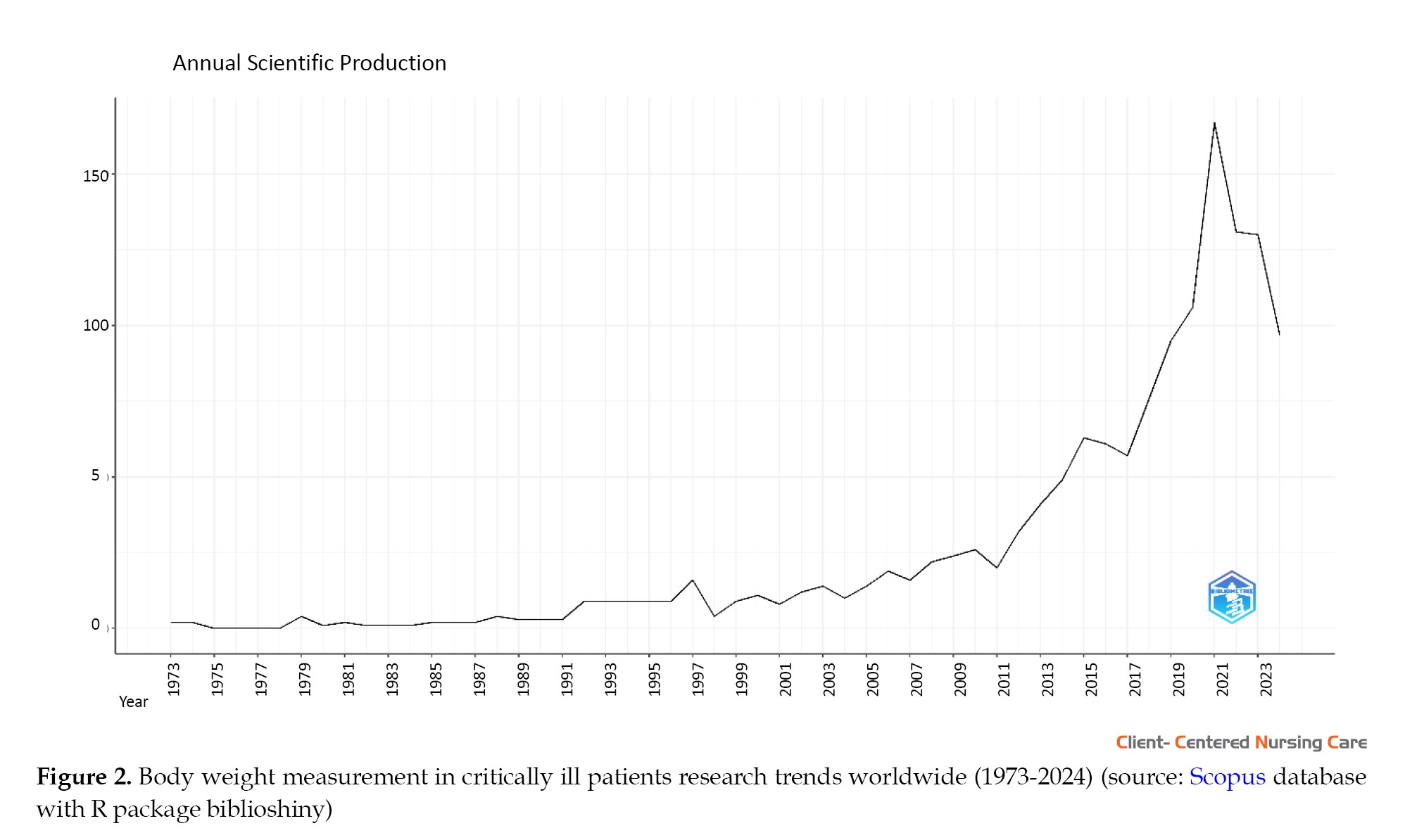
An analysis of bibliometric data was conducted on 1423 publications, primarily comprising articles (92.7%), reviews (6.3%), and conference papers (1.0%). The research trends illustrated in Figure 2 reveal a significant increase in annual article publications from 2017 to 2021.


Interdisciplinary areas
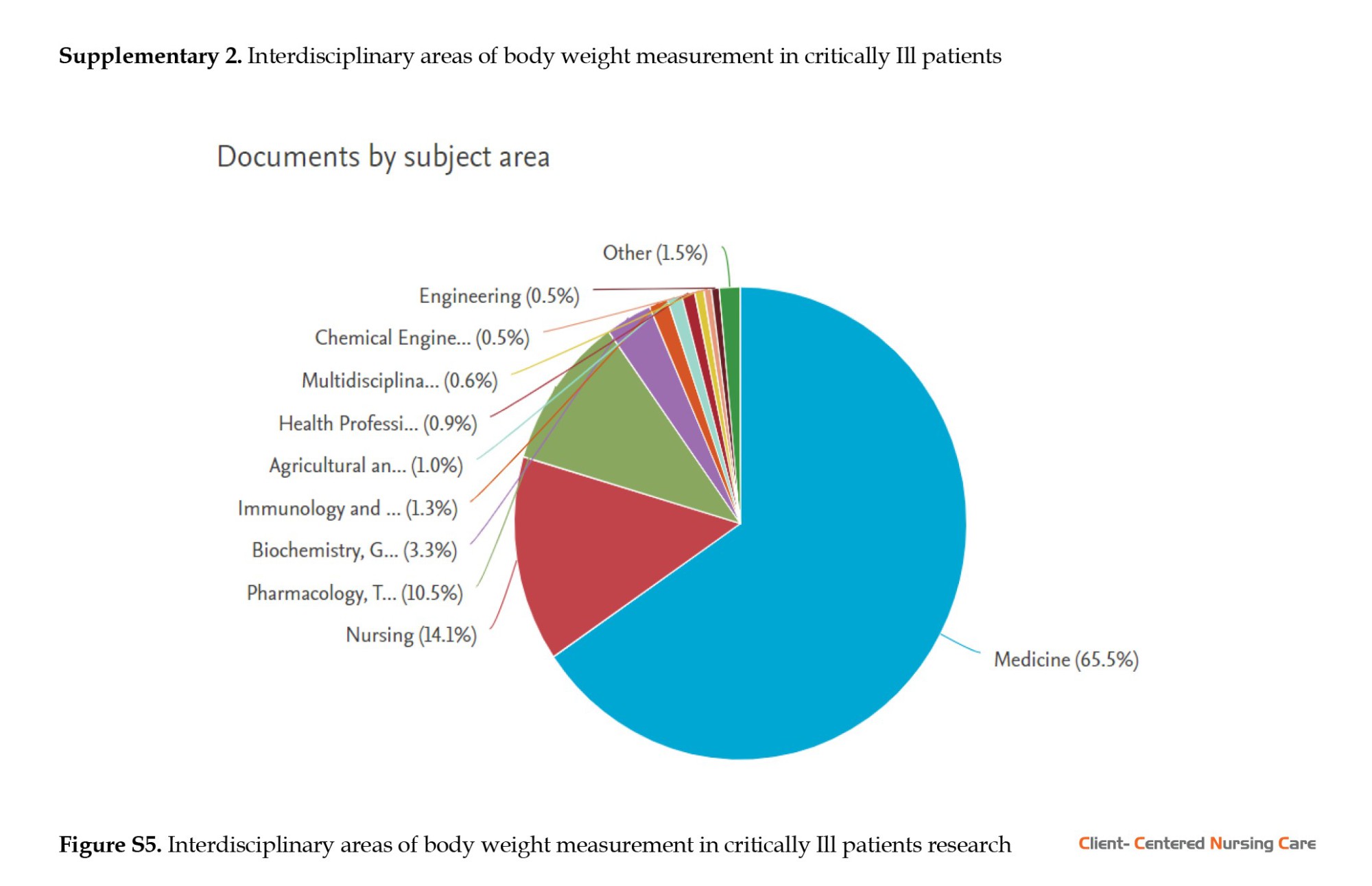
Body weight measurements in critically ill patients originated from various areas. The subject area of “medicine” dominated the field, with 1316(65.5%) published articles, followed by subject areas of “nursing” and “pharmacology, toxicology, and pharmaceutics” with 283(14.1%) and 212(10.5%) published articles, respectively. In addition, “biochemistry, genetics, and molecular biology,” “immunology and microbiology,” “agricultural and biological sciences,” “health profession,” “multidisciplinary,” “chemical engineering,” “engineering,” “materials science,” “neuroscience,” “decision sciences,” “psychology,” “social sciences,” “computer science,” “environmental science,” and “mathematics” have contributed to it. Although some disciplines have made limited contributions to this field of study, their potential to offer unique perspectives and insights into various aspects of this condition remains significant. A visual representation of the interdisciplinary areas involved in body weight measurement in critically ill patients is provied in Supplementary 2.
Keyword analysis
Using VOSviewer we extracted results with a minimum keyword frequency of 5. A total of 1547 keywords were gathered and categorized into 6 clusters based on the bibliometric data. The bibliometric analysis displayed outcomes derived from frequently occurring terms, while words unrelated to participants were removed. Three distinct visualizations were used to map the bibliometric analysis, as shown in Figures 3, 4, and 5.
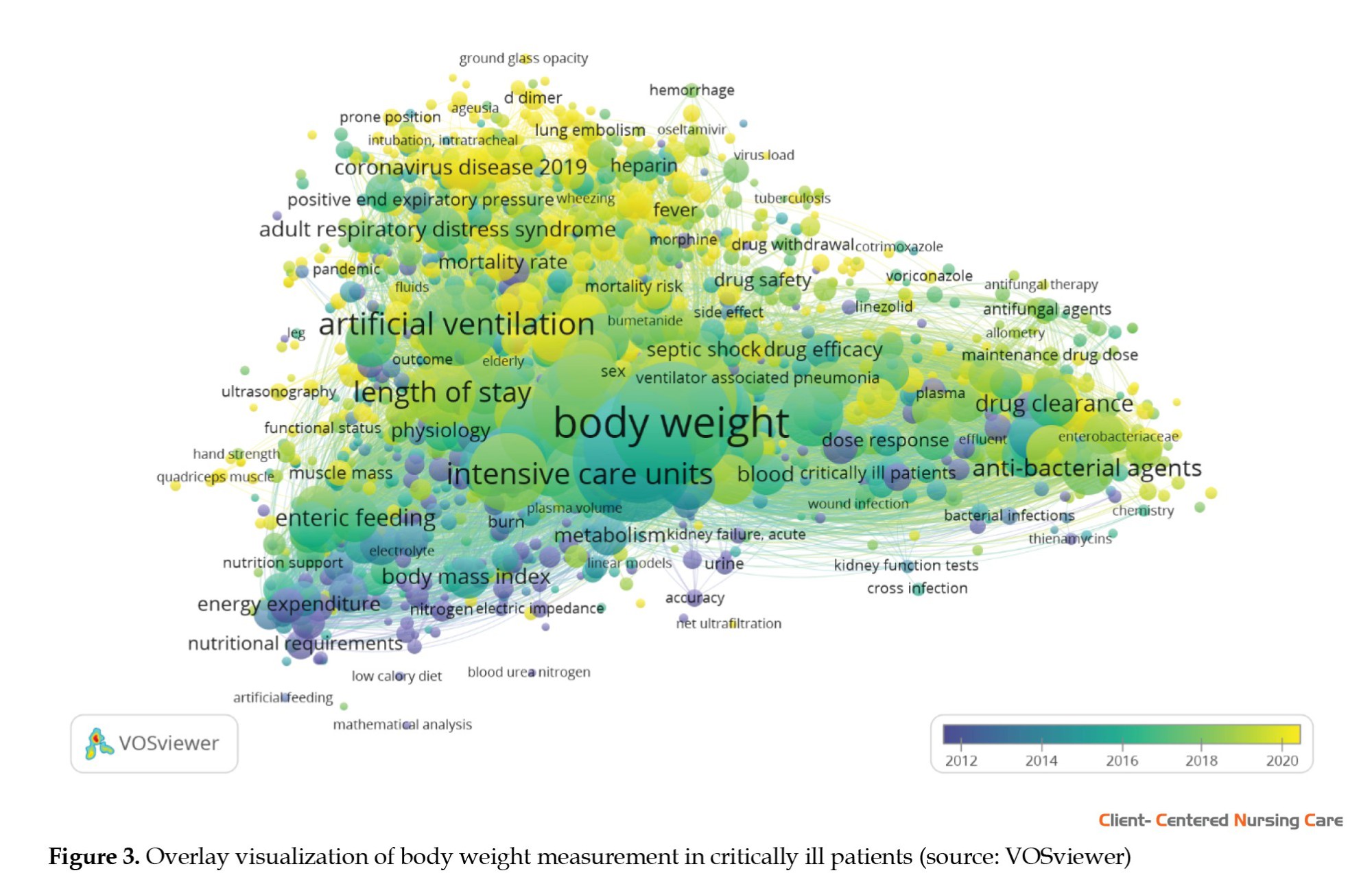


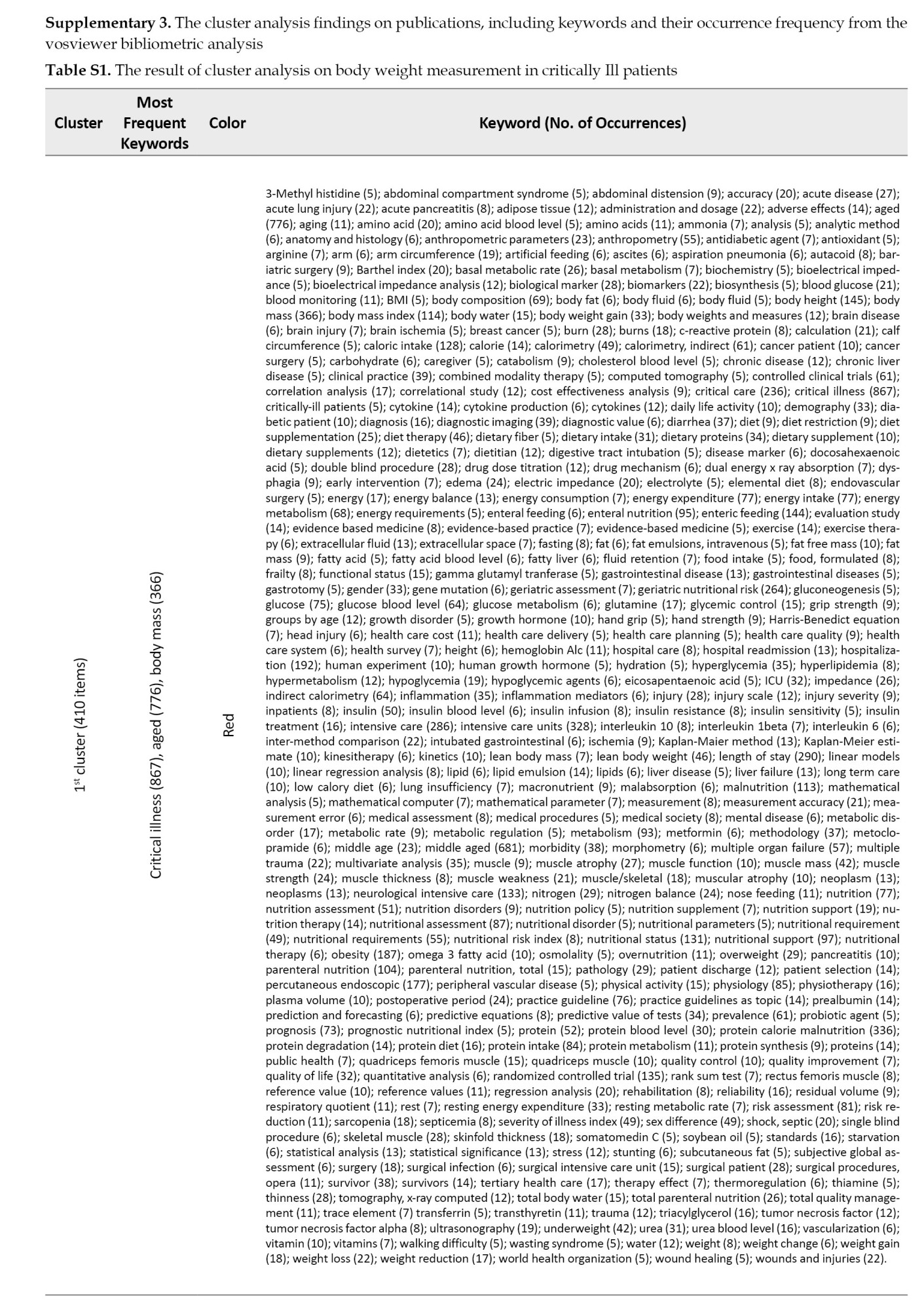


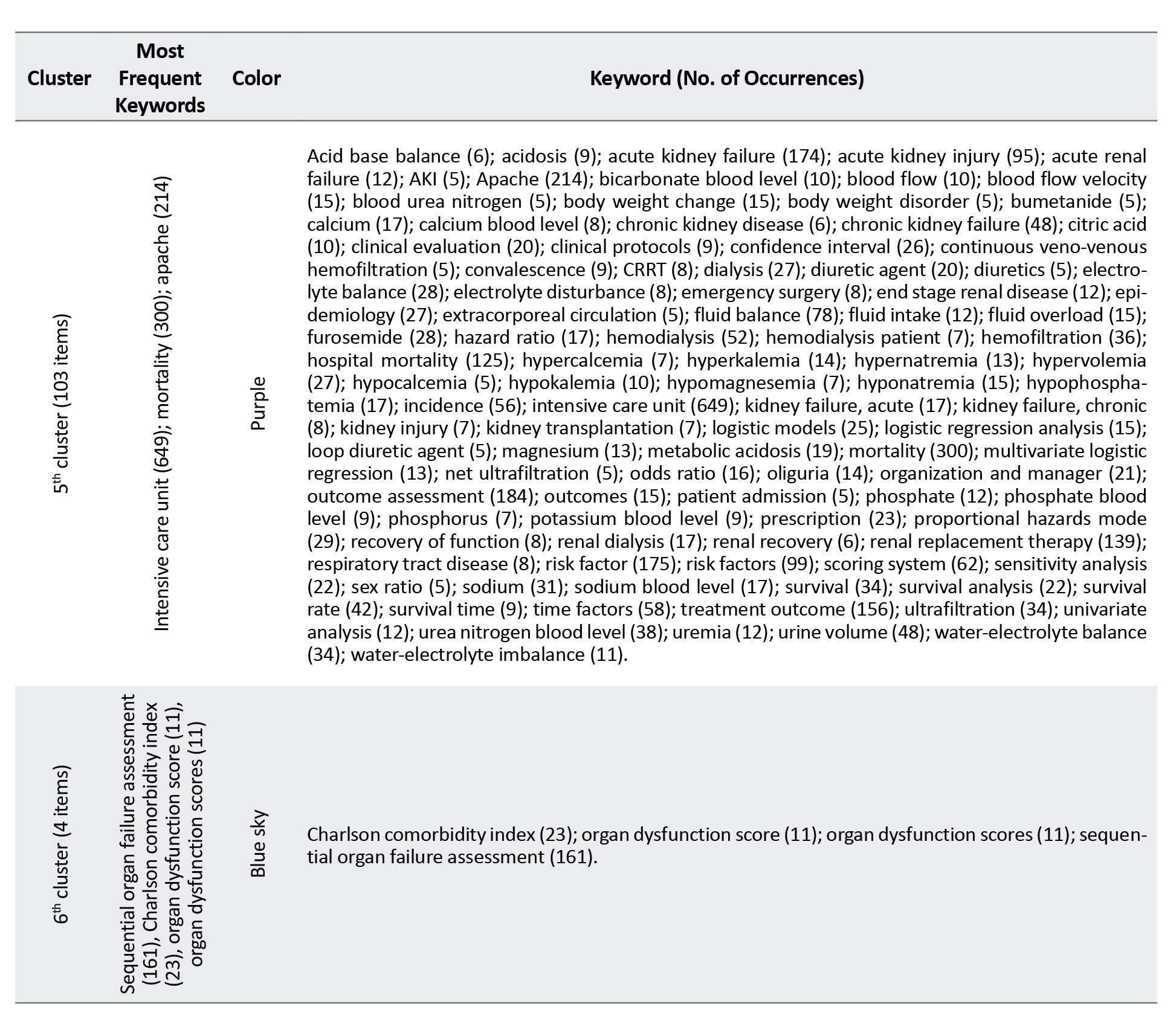
Figure 3 illustrates the progression of research topics from 1973 to 2024, providing a comprehensive overview of their evolution. Based on overlay visualization, it was found that research related to body weight measurement in critically ill patients has increased from year to year, as indicated by the increasing size of the green and yellow circles. Figure 4 illustrates the standard labeling and visualization technique of VOSviewer, where circles represent keywords related to body weight measurement in critically ill patients. Circle size correlates with the frequency and relevance of the item.
The network visualization shows 1547 items of keywords in 6 clusters consisting of red (410 items, cluster 1), green (378 items, cluster 2), blue (338 items, cluster 3), yellow (314 items, cluster 4), purple (103 items, cluster 5), and blue sky (4 items, cluster 6). The most frequent keywords and their number of occurrence from each cluster are 1) “Critical illness” (867), “aged” (776), “body mass” (366); 2) “Hospital admission” (207), “disease severity” (163), “clinical outcome” (134), “complication” (134); 3) “Body weight” (908), “critically ill patient” (831), “creatinine” (236); 4) “Artificial ventilation” (390), “procedures” (222), “artificial respiration” (160); 5) “Intensive care unit” (649), “mortality” (300), “acute physiology and chronic health evaluation (APACHE)” (214); 6) “Sequential organ failure assessment” (161), “Charlson comorbidity index (CCI)” (23), “organ dysfunction score” (11) (see Supplementary 3, for comprehensive clusters keywords). The number of links and the total link strength in the network visualization were 234410 and 609749, respectively.
The potential topics based on research gaps
The density visualization in Figure 5 shows the range of body weight measurement studies in critical care for specific subjects. More concentrated colors appear, indicating an increase in the number of research studies. Figure 5 shows that the keywords that often appeared were “body weight,” “body mass,” “intensive care,” “length of stay,” “physiology, “”enteric feeding,”” and “drug clearance.” Keyword frequency is represented by color intensity, with less frequent terms appearing in lighter shades, indicating areas that require further investigation (potential topics), such as “hemorrhage,” “ground glass opacity,” “artificial feeding,” “mathematical analysis,” “blood urea nitrogen,” “net ultrafiltration,” “kidney function test,” “cross infection,” and “virus load.”
These understudied areas allow researchers to explore and address knowledge gaps. Relationships between keywords can also reveal unconnected terms, suggesting unexplored research avenues that combine these concepts. For example, limited research has been conducted on the effects of artificial feeding on body weight in critically ill patients with hemorrhage. Supplementary 4 presented a word cloud mapping visualization of the most frequent keywords generated using biblioshiny, yielding results consistent with those of VOSviewer.

This consistency underscores the importance of the identified keywords in shaping the research landscape of body weight measurements in critically ill patients.
Thematic map of the studies
This research employed a thematic mapping approach to illustrate the primary concepts in the literature. These concepts, represented as clusters of keywords, are organized in a circular configuration based on their density and centrality. As shown in Figure 6, the thematic map was divided into four sections.


Discussion
Growth of publications
Publications related to body weight measurement in critically ill patients have increased significantly over the past two decades. The increase in publications is driven by the critical role of body weight in managing and predicting outcomes in critically ill patients (You et al., 2013; Hejazi et al., 2016; Ralib et al., 2016; Köster et al., 2017; Mundi et al., 2019; Lakenman et al., 2024) advancements in measurement technologies (Davies & Morgan 2019; Van Ruijven et al., 2021; Manoj et al., 2024) the complexity introduced by obesity (Lagrand et al., 2012; Lagrand et al., 2013; Pickkers et al., 2013), and increased awareness in research focus (You et al., 2013; Ralib et al., 2016; Martos-Benítez et al., 2024). These factors have collectively contributed to the increased focus on this study area, highlighting the importance of accurate body weight measurement in improving clinical practice and patient care (Evans, 2012; Flentje et al., 2018).
Contributing authors
Jason A Roberts has authored 36 articles, compared to the 8072 other authors in the field. This high volume of publications indicates a consistent and dedicated research effort. The 1362 citations of Jason A Roberts ’s work reflect the influence and recognition of their research within the academic community. The article “vancomycin dosing in critically ill patients: Robust methods for improved continuous-infusion regimens” (Roberts et al., 2011) is particularly noteworthy, with 198 citations. This high citation count suggests the study has been widely referenced and utilized in subsequent research and clinical practice. Jason A Roberts ’s research often focuses on accurately measuring body weight and dosing in critically ill patients. This estimation is critical as accurate body weight measurement is essential for proper medication dosing and treatment planning in the ICU (Freitag et al., 2010; García-Martínez et al., 2018).
Nurses play a crucial role in monitoring and caring for the critically ill patients, including regularly assessing body weight as part of routine nursing care (Bruzzone et al., 2004; Davies & Morgan, 2019; Chapple et al., 2020). Important nursing research topics often address the practical aspects of measuring body weight in critically ill patients through the implementation of procedures and clinical care (Freitag et al., 2010; García-Martínez et al., 2018).
Interdisciplinary areas of research
Body weight measurement encourages interdisciplinary healthcare providers to manage critically ill patients for various clinical reasons, such as maintaining fluid balance, addressing nutritional needs, and adjusting medication dosing (Zauner et al., 2006; Flentje et al., 2018; Davies & Morgan, 2019). Based on the subject area analysis of 1423 published articles, 65.5% were related to medicine, and 14.1% were related to nursing.
Keyword analysis
The network visualization displays 1547 keywords in 6 clusters. This analysis identifies key research areas and trends, providing valuable insights for research and clinical practices. The cluster of keywords is listed below. The first cluster focuses on research related to severe health conditions requiring intensive care (Chase et al., 2010; Hewett et al., 2012; Ralib et al., 2016) and examining the impact of body mass on patient outcomes in critical care settings (Prescott et al., 2014; Zampieri & Colombari, 2015). The second cluster of research discussed the criteria and outcomes of patients admitted to hospitals, particularly in the ICU (Chase et al., 2010; Hewett et al., 2012; Ralib et al., 2016), associated with the assessment of disease severity (Chase et al., 2010; Ralib et al., 2016; Nair & Adetayo, 2019; Fuchs et al., 2020). The third cluster focuses on the role of a patient’s weight in their prognosis and treatment outcomes in critical care (Prescott et al., 2014; Zampieri & Colombari, 2015) and studies on patients with life-threatening conditions requiring intensive medical intervention (Chase et al., 2010; Hewett et al., 2012; Ralib et al., 2016; Nair & Adetayo, 2019; Fuchs et al., 2020). The fourth cluster focuses on the use of mechanical ventilation in patients who cannot breathe independently and undergo various medical procedures, such as intubation and tracheostomy, in intensive care settings (Chase et al., 2010; Hewett et al., 2012; Ralib et al., 2016). The fifth cluster discusses studies on the management and outcomes of patients in ICUs and research assessing the death rates among critically ill patients and the factors influencing these rates (Chase et al., 2010; Hewett et al., 2012; Ralib et al., 2016; Nair & Adetayo, 2019; Fuchs et al., 2020). The sixth cluster is associated with a scoring system used to track a patient’s status during their ICU stay and predicting the outcomes, and various scoring systems that are used to evaluate the extent of organ failure in critically ill patients (Chase et al., 2010; Hewett et al., 2012; Ralib et al., 2016; Nair & Adetayo, 2019; Fuchs et al., 2020).
Potential topics based on research gaps
Further research, based on keyword frequency, indicated potential issues related to body weight measurement in critically ill patients. The knowledge gaps that might exist include the relationship between body weight measurement in critically ill patients with hemorrhage, ground-glass opacity, artificial nutrition, mathematical analysis, net ultrafiltration, kidney function tests, cross-infection, and virus load. Body weight measurement in critically ill patients with hemorrhage is crucial for managing fluid balance, addressing nutritional needs, and monitoring clinical outcomes (Bruzzone et al., 2004; Zauner et al., 2006; You et al., 2013; Manoj et al., 2019). Accurate body weight measurement is necessary for fluid management, while the presence and extent of ground-glass opacity can indicate the severity of the condition (Matos et al., 2021; Roig-Marín & Roig-Rico, 2023).
However, the relationship between body weight measurement and artificial nutrition involves accurately estimating energy requirements and administering nutritional support (Zauner et al., 2006; Rittler et al., 2008; Berger & Pichard, 2014; Goeters, 2019). The impact of body weight measurement on net ultrafiltration and kidney function tests should be prescribed based on the patient’s body weight (Murugan et al., 2019; Balakumar & Murugan, 2021). The relationship between body weight measurement in critically ill patients and cross-infection and virus load involves several factors, such as obesity, fluid balance, and infection risk (Zauner et al., 2006; Dossett et al., 2009; Manoj et al., 2019). Mathematical analysis can be applied in body weight measurement; however, the challenge of inaccurate estimations highlights the need for precise and reliable methods for body weight assessment (Frankenfield et al., 2012; Tarnowski et al., 2018; Vail et al., 2018).
Thematic maps
This thematic map presents basic, niche, and thematic areas of density and clarity. The thematic maps, which focus on basic themes such as body weight and critical illness, can be interpreted as essential factors in healthcare research, potentially indicating areas of focus for public health interventions or research studies (Cauvin et al., 2013; Tennekes, 2018). Niche themes, such as creatinine, antibacterial agents, and anti-infective agents, suggest focusing on specific medical interventions or treatments within the broader context of healthcare research (Cauvin et al., 2013; Tennekes, 2018). The central area of density and clarity in the thematic map, where clusters such as artificial ventilation, body mass, and length of stay are located, may indicate a strong association or interrelationship between these factors in the context of healthcare research (Cauvin et al., 2013; Tennekes, 2018). The thematic map could be valuable in informing healthcare policy and decision-making by highlighting areas of concentration or significance, such as the clusters and themes identified in the central density area and clarity (Cauvin et al., 2013; Tennekes, 2018).
Global contribution
The bibliometric analysis conducted in this research offers a detailed evaluation of the global landscape of body weight measurement in critical care. The United States emerged as the leading contributor to this related study. The insufficient research output in the Middle East and Southeast Asia presents a significant opportunity for growth. This gap underscores the need for increased research efforts in these underrepresented areas to enhance the global research network’s diversity and inclusivity (Maskin et al., 2010; Moisey et al., 2017; Kokong et al., 2018). Countries with low research output can make a significant contribution to the global body of knowledge by enhancing their research efforts and fostering international collaborations. This endeavour can lead to more comprehensive and inclusive research findings that benefit critical care practices worldwide (Moisey et al., 2017; Kokong et al., 2018).
Influential articles
The most cited article, “intensity of renal support in critically ill patients with AKI,” by Palevsky et al. (2008), has been cited 1462 times. The article’s findings compare intensive versus less-intensive renal replacement therapy in critically ill patients with AKI (Palevsky et al., 2008). The specific relationship between the article and body weight measurement is not directly addressed in the abstracts, but body weight was a factor related to fluid and nutritional management in critically ill patients with AKI (Palevsky et al., 2008; Davies & Morgan, 2019). Daily fluid balance charting and body weight measurement are recommended to estimate body fluid status. Inaccurate assessment can lead to fluid overload, which in turn impacts patient outcomes Davies & Morgan, 2019). However, challenges exist in achieving accurate body weight assessment, and further research is needed to establish feasible methods for daily weighing of ICU patients and their impact on AKI patients (Schneider et al., 2012; Manoj et al., 2019).
Conclusion
This study highlights the role of body weight measurement in managing critically ill patients, shedding light on key trends, regional disparities, and promising avenues for future research. The analysis highlights a notable increase in publications over the past two decades, with a concentration in medical research and a relative underrepresentation in nursing and specific regions, particularly parts of Asia. This gap in research presents an essential opportunity to expand collaborative efforts, particularly in these underrepresented regions, and enrich and diversify the global understanding of body weight measurement in critically ill patients. As the field evolves, further exploration can lead to the development of therapeutic interventions, enhance patient care strategies, promote more inclusive global research networks, and contribute to the management of critically ill patients. This study was retrieved only from Scopus databases. We suggest that future investigations incorporate additional databases, such as PubMed, Web of Science, and Springer, to obtain a more comprehensive collection of high-quality scientific contributions.
Ethical Considerations
Compliance with ethical guidelines
There were no ethical considerations to be considered in this research.
Funding
This research did not receive any grant from funding agencies in the public, commercial, or non-profit sectors.
Authors' contributions
Conceptualization and study design: Refonda Rias, Anggiri and Suhartini Ismail; Data interpretation, writing and final approval: All authors.
Conflict of interest
The authors declared no conflict of interest.
Acknowledgments
The authors would like to express their deep gratitude to all researchers and field colleagues for their invaluable support and guidance during this study.
References
Alfonzo, P., Sakraida, T. J. & Hastings-Tolsma, M., 2014. Bibliometrics: Visualizing the impact of nursing research. Online Journal of Nursing Informatics, 18(1), pp. 1-16. [Link]
Baas, J., et al., 2020. Scopus as a curated, high-quality bibliometric data source for academic research in quantitative science studies. Quantitative Science Studies, 1(1), pp. 377-86. [DOI:10.1162/qss_a_00019]
Balakumar, V. & Murugan, R., 2021. Kidney replacement therapy for fluid management. Critical Care Clinics, 37(2), pp. 433-52. [DOI:10.1016/j.ccc.2020.11.006] [PMID]
Bailey, B. R., Gaunt, M. J. & Grissinger, M., 2016. Update on medication errors associated with incorrect patient weights. Pennsylvania Patient Safety Advisory, 13(2), pp. 50-7. [Link]
Berger, M. M. & Pichard, C., 2014. Development and current use of parenteral nutrition in critical care - an opinion paper. Critical Care, 18(4), pp.478. [DOI:10.1186/s13054-014-0478-0] [PMID]
Best, C. & Shepherd, E., 2020. Accurate measurement of weight and height 1: Weighing patients. Nursing Times, 116(4), pp. 50-2. [Link]
Bruzzone, P., et al., 2004. [The fluid balance in the critically ill patient (Italian)]. Minerva Anestesiologica, 70(5), pp. 431–6. [PMID]
Carter-Templeton, H., et al., 2018. Robotics in Nursing: A bibliometric analysis. Journal of Nursing Scholarship, 50(6), pp. 582-9. [DOI:10.1111/jnu.12399] [PMID]
Cauvin, C., Escobar, M. F. & Serradj, A., 2010. Thematic cartography and transformations. London (United Kingdom): John Wiley & Sons, Inc. [Link]
Chapple, L. A., et al., 2020. Nutrition-related outcomes and dietary intake in non-mechanically ventilated critically ill adult patients: A pilot observational descriptive study. Australian Critical Care: Official Journal of the Confederation of Australian Critical Care Nurses, 33(3), pp. 300–8. [DOI:10.1016/j.aucc.2020.02.008] [PMID]
Chase, J. G. et al., 2010. Organ failure and tight glycemic control in the SPRINT study. Critical Care, 14(4), pp. R154. [DOI:10.1186/cc9224] [PMID]
Choi, I., et al., 2016. Incidence and treatment costs attributable to medication errors in hospitalized patients. Research in Social and Administrative Pharmacy, 12(3), pp. 428-37. [DOI:10.1016/j.sapharm.2015.08.006] [PMID]
Cobo, M. J., et al., 2011. An approach for detecting, quantifying, and visualizing the evolution of a research field: A practical application to the Fuzzy Sets Theory field. Journal of Informetrics, 5(1), pp. 146-66. [DOI:10.1016/j.joi.2010.10.002]
Csige, I., et al., 2018. The impact of obesity on the cardiovascular system. Journal of Diabetes Research, 2018, pp. 3407306. [DOI:10.1155/2018/3407306] [PMID]
Davies, H., et al., 2019. Estimation of body fluid status by fluid balance and body weight in critically Ill adult patients: A systematic review. Worldviews on Evidence-Based Nursing, 16(6), pp. 470-7. [DOI:10.1111/wvn.12394] [PMID]
Donthu, N., et al., 2022. Mapping of journal of service research themes: A 22-year review. Journal of Service Research, 25(2), pp. 187-93. [DOI:10.1177/1094670520977672]
Donthu, N., et al., 2021. How to conduct a bibliometric analysis: An overview and guidelines. Journal of Business Research, 133, pp. 285-96. [DOI:10.1016/j.jbusres.2021.04.070]
Dossett, L.A., et al., 2009. Obesity and site-specific nosocomial infection risk in the intensive care unit. Surgical Infections, 10(2), pp. 137-42. [DOI:10.1089/sur.2008.028] [PMID]
Evans, A., 2012. Positive patient outcomes in acute care: Does obtaining and recording accurate weight make a difference? Australian Journal of Advanced Nursing, 29(3), pp. 62-7. [DOI:10.37464/2012.293.1648]
Flentje, K. M., et al., 2018. Recording patient bodyweight in hospitals: Are we doing well enough? Internal Medicine Journal, 48(2), pp. 124-8. [DOI:10.1111/imj.13519] [PMID]
Frankenfield, D. C., Ashcraft, C. M. & Galvan, D.A., 2012. Longitudinal prediction of metabolic rate in critically Ill patients. Journal of Parenteral and Enteral Nutrition, 36(6), pp. 700-12. [DOI:10.1177/0148607112446702] [PMID]
Freitag, E., et al., 2010. Determination of body weight and height measurement for critically ill patients admitted to the intensive care unit: A quality improvement project. Australian Critical Care, 23(4), pp. 197-207. [DOI:10.1016/j.aucc.2010.04.003] [PMID]
Fuchs, P. A., Czech, I. J. & Krzych, Ł.J., 2020. Mortality prediction using SOFA score in critically ill surgical and non-surgical patients: Which parameter is the most valuable? Medicina (Lithuania), 56(6), pp. 273. [DOI:10.3390/medicina56060273] [PMID]
García-Martínez, M.A., et al., 2018. Quality of anthropometric measurements in Spanish Intensive Care Units (The CAMIES Study). Medicina Intensiva (English Edition), 42(6), pp. 329-36. [DOI:10.1016/j.medin.2017.09.008] [PMID]
Goeters, C., & Ernährung–Parenterale, E., 2019. Enteral vs. Parenteral nutrition. Anasthesiologie und Intensivmedizin, 60, pp. 433-42. [Link]
Hayes, M. A., et al., 1994. Elevation of systemic oxygen delivery in the treatment of critically ill patients. The New England Journal of Medicine, 330(24), pp. 1717–22. [DOI:10.1056/NEJM199406163302404] [PMID]
Hejazi, N., et al., 2016. Nutritional assessment in critically ill patients. Iranian Journal of Medical Sciences, 41(3), pp. 171-9. [PMID]
Hewett, J. N., et al., 2012. Assessment of SOFA score as a diagnostic indicator in intensive care medicine. IFAC Proceedings Volumes, 45(18), pp. 467-72. [DOI:10.3182/20120829-3-HU-2029.00035]
Kokong, D. D., et al., 2018. Estimation of weight in adults from height: A novel option for a quick bedside technique. International Journal of Emergency Medicine, 11(1), pp. 54. [DOI:10.1186/s12245-018-0212-9] [PMID]
Koliaki, C., Liatis, S. & Kokkinos, A., 2019. Obesity and cardiovascular disease: revisiting an old relationship. Metabolism: Clinical and Experimental, 92, pp. 98-107. [DOI:10.1016/j.metabol.2018.10.011] [PMID]
Köster, M., et al., 2017. Cumulative changes in weight but not fluid volume balances reflect fluid accumulation in ICU patients. Acta Anaesthesiologica Scandinavica, 61(2), pp. 205-15. [DOI:10.1111/aas.12840] [PMID]
Lagrand, W. K., Van Slobbe-Bijlsma, E. & Schultz, M. J., 2012. Hemodynamic monitoring of the critically Ill obese patient. In Critical Care Management of the Obese Patient (pp. 123-134). New Jersey: Wiley-Blackwell. [Link]
Lagrand, W. K., van Slobbe-Bijlsma, E. R. & Schultz, M. J., 2013. Haemodynamic monitoring of morbidly obese intensive care unit patients. The Netherlands Journal of Medicine, 71(5), pp. 234–42. [PMID]
Lakenman, P. L. M., et al., 2024. Association between fat-free mass and survival in critically ill patients with COVID-19: A prospective cohort study. Journal of Parenteral and Enteral Nutrition, 48(2), pp. 192-8. [DOI:10.1002/jpen.2585] [PMID]
Manoj, R., et al., 2019. Continuous weight monitoring system for ICU Beds using Air-filled Mattresses/Pads: A proof of concept. Paper presented at: 2019 IEEE International Symposium on Medical Measurements and Applications (MeMeA), Istanbul, Turkey, 26-28 June 2019. [DOI:10.1109/MeMeA.2019.8802148]
Manoj, R., et al., 2024. Periodic weight measurement for bedridden patients using a pressurized liquid-filled channel system integrated with hospital beds. Paper presented at: 2024 IEEE International Symposium on Medical Measurements and Applications (MeMeA), Eindhoven, Netherlands, 26-28 June 2024. [DOI:10.1109/MeMeA60663.2024.10596806]
Martos-Benítez, F. D., et al., 2024. Fluid balance, biomarkers of renal function and mortality in critically ill patients with AKI diagnosed before, or within 24 h of intensive care unit admission: A prospective study. Journal of Nephrology, 37(2), pp. 439–49. [DOI:10.1007/s40620-023-01829-z] [PMID]
Maskin, L. P., et al., 2010. Accuracy of weight and height estimation in an intensive care unit. Anaesthesia and Intensive Care, 38(5), pp. 930–4. [DOI:10.1177/0310057X1003800519] [PMID]
Matos, M. J. R., et al., 2021. Differential diagnoses of acute ground-glass opacity in chest computed tomography: Pictorial essay. Einstein (Sao Paulo, Brazil), 19, pp. eRW5772. [DOI:10.31744/einstein_journal/2021RW5772] [PMID]
McClave, S. A., et al., 2009, Guidelines for the provision and assessment of nutrition support therapy in the adult critically ill patient: Society of Critical Care Medicine (SCCM) and American Society for Parenteral and Enteral Nutrition (A.S.P.E.N.). JPEN. Journal of Parenteral and Enteral Nutrition, 33(3), pp. 277–316. [DOI:10.1177/0148607109335234] [PMID]
Mogensen, K. M., et al., 2015. Nutritional status and mortality in the critically ill. Critical Care Medicine, 43(12), pp. 2605–15.[DOI:10.1097/CCM.0000000000001306] [PMID]
Moisey, L. L., et al., 2017. Existing equations to estimate lean body mass are inaccurate in the critically ill: Results of a multicenter observational study. Clinical Nutrition, 36(6), pp. 1701-6. [DOI:10.1016/j.clnu.2016.09.013] [PMID]
Mundi, M. S., Patel, J. J. & Martindale, R., 2019. Body composition technology: Implications for the ICU. Nutrition in Clinical Practice, 34(1), pp. 48-58. [DOI:10.1002/ncp.10230] [PMID]
Murugan, R. et al., 2019. Association of net ultrafiltration rate with mortality among critically Ill adults with acute kidney injury receiving continuous venovenous hemodiafiltration: A secondary analysis of the Randomized Evaluation of Normal vs Augmented Level (RENAL) of Renal Replacement Therapy Trial. JAMA Network Open, 2(6), pp. e195418. [DOI:10.1001/jamanetworkopen.2019.5418] [PMID]
Nair, L. & Adetayo, O.A., 2019. Cultural competence and ethnic diversity in healthcare. Plastic and Reconstructive Surgery. Global Open, 7(5), pp. e2219. [DOI:10.1097/GOX.0000000000002219] [PMID]
Narayan, S. K., Gudivada, K. K. & Krishna, B., 2020. Assessment of nutritional status in the critically ill. Indian Journal of Critical Care Medicine, 24(Suppl 4), pp. S152–6. [DOI:10.5005/jp-journals-10071-23617] [PMID]
Novy, E. et al., 2024. Population pharmacokinetics of fluconazolein critically ill patients receiving extracorporeal membrane oxygenation and continuous renal replacement therapy: An ASAP ECMO study. Antimicrobial Agents and Chemotherapy, 68(1), pp. e0120123. [DOI:10.1128/aac.01201-23] [PMID]
O’Brien, J. M., et al., 2012. The association between body mass index, processes of care, and outcomes from mechanical ventilation: A prospective cohort study. Critical Care Medicine, 40(5), pp. 1456-63. [DOI:10.1097/CCM.0b013e31823e9a80] [PMID]
VA/NIH Acute Renal Failure Trial Network., et al., 2008. Intensity of renal support in critically ill patients with acute kidney injury. The New England Journal of Medicine, 359(1), pp. 7–20. [PMID]
Pan, S. D., et al., 2016. Weight-based dosing in medication use: What should we know? Patient Preference and Adherence, 10, pp. 549-60. [DOI:10.2147/PPA.S103156] [PMID]
Pickkers, P., et al., 2013. Body mass index is associated with hospital mortality in Critically III patients: An observational cohort study. Critical Care Medicine, 41(8), pp. 1878-83. [DOI:10.1097/CCM.0b013e31828a2aa1] [PMID]
Prescott, H. C., et al., 2014. Obesity and 1-year outcomes in older Americans with severe sepsis. Critical Care Medicine, 42(8), pp. 1766-74. [DOI:10.1097/CCM.0000000000000336] [PMID]
Ralib, A. M., et al., 2016. The impact of fluid balances in the first 48 hours on mortality in the critically ill patients. International Medical Journal Malaysia, 15(1), pp. 13-18. [DOI:10.31436/imjm.v15i1.401]
REMAP-CAP Investigators., et al., 2021. Interleukin-6 receptor antagonists in critically ill patients with Covid-19. The New England Journal of Medicine, 384(16), 1491–502. [PMID]
Rittler, P., et al., 2008. Nutritional support in the critically ill obese patient. Aktuelle Ernahrungsmedizin, 33(6), pp. 275-9. [DOI:10.1055/s-2008-1067545]
Jason A Roberts, et al., 2011. Vancomycin dosing in critically ill patients: Robust methods for improved continuous-infusion regimens. Antimicrobial Agents and Chemotherapy, 55(6), pp. 2704-9. [DOI:10.1128/AAC.01708-10] [PMID]
Roig-Marín, N. & Roig-Rico, P., 2023. Ground-glass opacity on emergency department chest X-ray: A risk factor for in-hospital mortality and organ failure in elderly admitted for COVID-19. Postgraduate Medicine, 135(3), pp. 265-72. [DOI:10.1080/00325481.2021.2021741] [PMID]
Ronco, C., et al., 2000, Effects of different doses in continuous veno-venous haemofiltration on outcomes of acute renal failure: A prospective randomised trial. Lancet, 356(9223), pp. 26-30. [DOI:10.1016/S0140-6736(00)02430-2] [PMID]
Van Ruijven, I. M., et al., 2021. Monitoring muscle mass using ultrasound: A key role in critical care. Current Opinion in Critical Care, 27(4), pp. 354-60. [DOI:10.1097/MCC.0000000000000846] [PMID]
Schneider, A. G., et al., 2012. Estimation of fluid status changes in critically ill patients: Fluid balance chart or electronic bed weight? Journal of Critical Care, 27(6). [DOI:10.1016/j.jcrc.2011.12.017] [PMID]
Sikandar, H., et al., 2021. Scientific mapping of industry 4.0 research: A bibliometric analysis. International Journal of Interactive Mobile Technologies, 15(18), pp. 129-47. [DOI:10.3991/ijim.v15i18.25535]
Singer, P. et al., 2019. ESPEN guideline on clinical nutrition in the intensive care unit. Clinical Nutrition, 38(1), pp. 48-79. [DOI:10.1016/j.clnu.2018.08.037] [PMID]
Singh, V. K., et al., 2021. The journal coverage of Web of Science, Scopus and Dimensions: A comparative analysis. Scientometrics, 126, pp. 5113-42. [DOI:10.1007/s11192-021-03948-5]
Tarnowski, M. S., et al., 2018. Height prediction from ulna length of critically Ill patients. Nutrition in Clinical Practice, 33(6), pp. 887-92. [DOI:10.1177/0884533617716432] [PMID]
Tennekes, M., 2018. Tmap: Thematic maps in R. Journal of Statistical Software, 84(6), pp. 1–39. [DOI:10.18637/jss.v084.i06]
Vail, E. A., Harrison, D. A. & Wunsch, H., 2018. Relationship between height and outcomes among critically ill adults: A cohort study. Intensive Care Medicine, 44(12), pp. 2122-33. [DOI:10.1007/s00134-018-5441-0] [PMID]
Yeo, M. T., et al., 1973. Total intravenous nutrition: Experience with fat emulsions and hypertonic glucose. Archives of Surgery, 106(6), pp. 792-6. [DOI:10.1001/archsurg.1973.01350180032011] [PMID]
You, J. W. et al., 2013. Association between weight change and clinical outcomes in critically ill patients. Journal of Critical Care, 28(6), pp. 923-7. [DOI:10.1016/j.jcrc.2013.07.055] [PMID]
Zampieri, F. G. & Colombari, F., 2015. A gradient-boosted model analysis of the impact of body mass index on the short-term outcomes of critically ill medical patients. Revista Brasileira de Terapia Intensiva, 27(2), pp. 141-8. [DOI:10.5935/0103-507X.20150025]
Zauner, A., et al., 2006. Weight-adjusted resting energy expenditure is not constant in critically ill patients. Intensive Care Medicine, 32(3), pp. 428-34. [DOI:10.1007/s00134-005-0056-7] [PMID]
Zhao, X., Wang, S. & Wang, X., 2018. Characteristics and trends of research on new energy vehicle reliability based on theweb of science. Sustainability (Switzerland), 10(10), pp. 3560.[DOI:10.3390/su10103560]
● Publications related to body weight measurement in critically ill patients have increased substantially over the last 20 years.
● Based on the subject area analysis of 1423 published articles, 65.5% were related to “medicine” and 14.1% to “nursing.”
● Keyword analysis revealed 6 clusters, with the most frequent keywords being “critical illness,” “hospital admission,” “body weight,” “artificial ventilation,” “intensive care unit,” and “sequential organ failure assessment.”
● Potential topics based on research gaps included “hemorrhage,” “ground glass opacity,” “artificial feeding,” “mathematical analysis,” “blood urea nitrogen,” “net ultrafiltration,” “kidney function test,” “cross-infection,” and “virus load.”
● The insufficient research output, particularly in the Middle East and Southeast Asia, presents a significant opportunity for growth.
● Based on the subject area analysis of 1423 published articles, 65.5% were related to “medicine” and 14.1% to “nursing.”
● Keyword analysis revealed 6 clusters, with the most frequent keywords being “critical illness,” “hospital admission,” “body weight,” “artificial ventilation,” “intensive care unit,” and “sequential organ failure assessment.”
● Potential topics based on research gaps included “hemorrhage,” “ground glass opacity,” “artificial feeding,” “mathematical analysis,” “blood urea nitrogen,” “net ultrafiltration,” “kidney function test,” “cross-infection,” and “virus load.”
● The insufficient research output, particularly in the Middle East and Southeast Asia, presents a significant opportunity for growth.
Plain Language Summary
Body weight measurement and documentation are crucial for determining the appropriate care for critically ill patients. This study used bibliometric analysis to track trends in body weight measurements of critically ill patients. This approach helps identify dominant research themes and emerging areas of interest. The results showed that publications on body weight measurement in critically ill patients have increased markedly over the past two decades. An analysis of 1423 published articles revealed that 65.5% focused on “medicine,” whereas 14.1% were associated with “nursing.” The United States led globally with 457 publications, while the Middle East and Southeast Asia had insufficient research output. Cluster analysis using VOSviewer, identified six 6 primary research themes, each with frequent keywords related to the research. This study also utilized the RStudio package with biblioshiny to present the growth of publications and a thematic map of the studies. These findings indicate a growing body of research in this field, predominantly focusing on critical care and highlighting the potential for more nursing research topics related to body weight measurement in critically ill patients. This research gap also presents an essential opportunity to expand more inclusive global research networks that can contribute to improved health management related to body weight measurement for critically ill patients.
Full-Text: (404 Views)
Introduction
Measuring and documenting body weight is crucial for determining the most effective interventions in critically ill patients. The weight of patients in the intensive care unit is related to hemodynamic assessments of cardiac output and stroke volume (Csige et al., 2018; Koliaki et al., 2019), nutritional needs and status (Singer et al., 2019), body fluid requirements (Davies & Morgan, 2019), drug doses (Pan et al., 2016), and mechanical ventilation settings (O’Brien et al., 2012). Body weight measurement accuracy can affect the accuracy of the intervention (Best & Shepherd, 2020).
The results of measuring the body weight of critically ill patients can impact physiological parameters. The consequences of incorrect body weight calculations are as follows: Inaccurate hemodynamic assessment (cardiac output and stroke volume) related to calculating body fluid requirements (Davies & Morgan, 2019); inaccuracy in assessing nutritional status, which results in undernutrition in patients (Narayan et al., 2020); and inaccuracy in calculating drug doses resulting in underdose or overdose (Bailey et al., 2016). Providing inappropriate therapy worsens the patient’s condition and increases health costs (Choi et al., 2016).
Inappropriate therapy occurs in several cases owing to errors in weight measurements. The prevalence of inappropriate drug doses based on inaccurate body weight in the medical and surgical ICU was 3.7% (48 out of 1291) reports, according to the Pennsylvania patient safety reporting system (Bailey et al., 2016). It has been stated that among 6518 ICU patients, 56% of cases of non-specific malnutrition and 12% of cases of protein-energy malnutrition were attributed to the anthropometric measurement errors and risk factors for malnutrition (Mogensen et al., 2015). A systematic review study involving 5 of 13 cohort studies states that inaccuracies in consecutive daily weight measurements could reduce the accuracy of monitoring changes in patient body fluids (Davies & Morgan, 2019).
Ongoing efforts are being made to develop various techniques for accurately weighing critically ill patients. Interest in these methods can be observed through Google Trends by searching for “weight measurements for critical patients” globally. However, these data provide only a general overview of the interest in weighing techniques for critically ill patients. Researchers often require more detailed information regarding weight measurements in critical care settings, such as scientific articles and conference proceedings. Researchers have utilized search engines to examine trends over time and facilitate trend analysis through bibliometric methods.
Bibliometrics has been employed to enhance information accessibility and explore the evolution of knowledge structures. The method aids in charting the progress of the field, pinpointing key information sources utilized in the research area, recognizing new research trends, and evaluating research outputs. These evaluations consider factors such as productivity, funding, impact, and information adoption from a geographical perspective. Bibliometric analysis is a valuable tool for comprehending the limited and emerging literature in this specialized field of study (Alfonzo et al., 2014; Carter-Templeton et al., 2018). There has yet to be a bibliometric analysis of methods for measuring body weight in critically ill patients to identify trends and novel approaches. Accordingly, this bibliometric analysis aims to explore trends in the number of publications, the most contributing authors, interdisciplinary research areas, keyword analysis, potential topics based on research gaps, thematic maps, global contributions, and influential articles regarding the body weight measurement of critically ill patients.
Materials and Methods
Research design
This bibliometric study examined the literature on body weight measurements in critically ill patients. Although the primary data of interest in bibliometric analyses are typically objective, their interpretation often relies on evaluative and subjective criteria established through informed methodologies. This analytical approach facilitates the deciphering of scientific insights and understanding of the nuances of how established fields evolve by rigorously examining large volumes of unstructured information(Donthu et al., 2021; Donthu et al., 2022). The process of conducting bibliometric analysis consists of three main stages: 1) Gathering data by defining search terms to identify relevant publications in the Scopus database and subsequently refining the collected records, 2) Visualizing data by transferring the acquired information to the VOSviewer software, version 6 and RStudio software, version 4.5.1 for bibliometric examination and graphical representation, and 3) Analyzing data to determine the key topics addressed in the literature.
Data source
The Scopus database was used in this study. Scopus supports a variety of software packages for retrieving bibliometric information (authors, titles, publication dates, abstracts, references, institutions, and countries) (Sikandar et al., 2021). It is one of the world’s largest available databases covering publication coverage, including journals, articles, books, and conferences (Baas et al., 2020). Since Scopus does not include grey literature, it ensures a more accurate selection of academic journals and identifies a wider range of documents than Web of Science. In bibliometric studies that focus on citation analysis, it is preferable to use a single database. This approach ensures that citations are extracted from the same dataset and that the quality and comparability of the analyzed documents are maintained (Singh et al., 2021).
Article inclusion criteria
The search was conducted on October 11, 2024, and covered the years 1973 to 2024. We focused only on journal articles, reviews, and conference proceedings that had completed the publication process. News articles, books, book series, chapters, letters, editorials, short surveys, notes, and other documents were excluded from the analysis. The gathered data were saved in RIS format and processed with EndNote for metadata completion. Subsequently, we validated the information and filled in any gaps that were identified. We then conducted co-authorship and co-occurrence analyses and developed a network diagram based on citation reviews. Our data collection methodology adhered to the preferred reporting items for systematic reviews and meta-analyses (PRISMA) guidelines and involved a systematic literature search.
Selecting data
Stages of PRISMA include identification, screening, and inclusion. In stage 1, namely identification, 1496 articles were obtained from the search results in the Scopus database using the following search query (TITLE-ABS-KEY (“body weight measurement” OR “weights and measures” OR “body weight*” OR “body scale*” OR “weight scale*” OR “weight measurement”)) AND (TITLE-ABS-KEY (“critical illness” OR “critical ill*” OR “critically ill”)) AND (TITLE-ABS-KEY (“adult*” OR “older adult” OR “young adult*” OR “middle-aged” OR “middle age” OR “aged”)) AND NOT TITLE-ABS-KEY (animal) AND (LIMIT-TO (DOCTYPE, “ar”) OR LIMIT-TO (DOCTYPE, “re”) OR LIMIT-TO (DOCTYPE, “cp”)) AND (LIMIT-TO (PUBSTAGE, “final”)) AND (LIMIT-TO (SRCTYPE, “j”)). In stage 2 of screening, each search term was selected in the column, resulting in 73 articles. In stage 3, the final sample yielded 1423 articles. The details of the process are shown in Figure 1.
Measuring and documenting body weight is crucial for determining the most effective interventions in critically ill patients. The weight of patients in the intensive care unit is related to hemodynamic assessments of cardiac output and stroke volume (Csige et al., 2018; Koliaki et al., 2019), nutritional needs and status (Singer et al., 2019), body fluid requirements (Davies & Morgan, 2019), drug doses (Pan et al., 2016), and mechanical ventilation settings (O’Brien et al., 2012). Body weight measurement accuracy can affect the accuracy of the intervention (Best & Shepherd, 2020).
The results of measuring the body weight of critically ill patients can impact physiological parameters. The consequences of incorrect body weight calculations are as follows: Inaccurate hemodynamic assessment (cardiac output and stroke volume) related to calculating body fluid requirements (Davies & Morgan, 2019); inaccuracy in assessing nutritional status, which results in undernutrition in patients (Narayan et al., 2020); and inaccuracy in calculating drug doses resulting in underdose or overdose (Bailey et al., 2016). Providing inappropriate therapy worsens the patient’s condition and increases health costs (Choi et al., 2016).
Inappropriate therapy occurs in several cases owing to errors in weight measurements. The prevalence of inappropriate drug doses based on inaccurate body weight in the medical and surgical ICU was 3.7% (48 out of 1291) reports, according to the Pennsylvania patient safety reporting system (Bailey et al., 2016). It has been stated that among 6518 ICU patients, 56% of cases of non-specific malnutrition and 12% of cases of protein-energy malnutrition were attributed to the anthropometric measurement errors and risk factors for malnutrition (Mogensen et al., 2015). A systematic review study involving 5 of 13 cohort studies states that inaccuracies in consecutive daily weight measurements could reduce the accuracy of monitoring changes in patient body fluids (Davies & Morgan, 2019).
Ongoing efforts are being made to develop various techniques for accurately weighing critically ill patients. Interest in these methods can be observed through Google Trends by searching for “weight measurements for critical patients” globally. However, these data provide only a general overview of the interest in weighing techniques for critically ill patients. Researchers often require more detailed information regarding weight measurements in critical care settings, such as scientific articles and conference proceedings. Researchers have utilized search engines to examine trends over time and facilitate trend analysis through bibliometric methods.
Bibliometrics has been employed to enhance information accessibility and explore the evolution of knowledge structures. The method aids in charting the progress of the field, pinpointing key information sources utilized in the research area, recognizing new research trends, and evaluating research outputs. These evaluations consider factors such as productivity, funding, impact, and information adoption from a geographical perspective. Bibliometric analysis is a valuable tool for comprehending the limited and emerging literature in this specialized field of study (Alfonzo et al., 2014; Carter-Templeton et al., 2018). There has yet to be a bibliometric analysis of methods for measuring body weight in critically ill patients to identify trends and novel approaches. Accordingly, this bibliometric analysis aims to explore trends in the number of publications, the most contributing authors, interdisciplinary research areas, keyword analysis, potential topics based on research gaps, thematic maps, global contributions, and influential articles regarding the body weight measurement of critically ill patients.
Materials and Methods
Research design
This bibliometric study examined the literature on body weight measurements in critically ill patients. Although the primary data of interest in bibliometric analyses are typically objective, their interpretation often relies on evaluative and subjective criteria established through informed methodologies. This analytical approach facilitates the deciphering of scientific insights and understanding of the nuances of how established fields evolve by rigorously examining large volumes of unstructured information(Donthu et al., 2021; Donthu et al., 2022). The process of conducting bibliometric analysis consists of three main stages: 1) Gathering data by defining search terms to identify relevant publications in the Scopus database and subsequently refining the collected records, 2) Visualizing data by transferring the acquired information to the VOSviewer software, version 6 and RStudio software, version 4.5.1 for bibliometric examination and graphical representation, and 3) Analyzing data to determine the key topics addressed in the literature.
Data source
The Scopus database was used in this study. Scopus supports a variety of software packages for retrieving bibliometric information (authors, titles, publication dates, abstracts, references, institutions, and countries) (Sikandar et al., 2021). It is one of the world’s largest available databases covering publication coverage, including journals, articles, books, and conferences (Baas et al., 2020). Since Scopus does not include grey literature, it ensures a more accurate selection of academic journals and identifies a wider range of documents than Web of Science. In bibliometric studies that focus on citation analysis, it is preferable to use a single database. This approach ensures that citations are extracted from the same dataset and that the quality and comparability of the analyzed documents are maintained (Singh et al., 2021).
Article inclusion criteria
The search was conducted on October 11, 2024, and covered the years 1973 to 2024. We focused only on journal articles, reviews, and conference proceedings that had completed the publication process. News articles, books, book series, chapters, letters, editorials, short surveys, notes, and other documents were excluded from the analysis. The gathered data were saved in RIS format and processed with EndNote for metadata completion. Subsequently, we validated the information and filled in any gaps that were identified. We then conducted co-authorship and co-occurrence analyses and developed a network diagram based on citation reviews. Our data collection methodology adhered to the preferred reporting items for systematic reviews and meta-analyses (PRISMA) guidelines and involved a systematic literature search.
Selecting data
Stages of PRISMA include identification, screening, and inclusion. In stage 1, namely identification, 1496 articles were obtained from the search results in the Scopus database using the following search query (TITLE-ABS-KEY (“body weight measurement” OR “weights and measures” OR “body weight*” OR “body scale*” OR “weight scale*” OR “weight measurement”)) AND (TITLE-ABS-KEY (“critical illness” OR “critical ill*” OR “critically ill”)) AND (TITLE-ABS-KEY (“adult*” OR “older adult” OR “young adult*” OR “middle-aged” OR “middle age” OR “aged”)) AND NOT TITLE-ABS-KEY (animal) AND (LIMIT-TO (DOCTYPE, “ar”) OR LIMIT-TO (DOCTYPE, “re”) OR LIMIT-TO (DOCTYPE, “cp”)) AND (LIMIT-TO (PUBSTAGE, “final”)) AND (LIMIT-TO (SRCTYPE, “j”)). In stage 2 of screening, each search term was selected in the column, resulting in 73 articles. In stage 3, the final sample yielded 1423 articles. The details of the process are shown in Figure 1.
Data analysis
Bibliometric analysis of the data was conducted using the R package. The R package bibliometrix was downloaded and activated using R Studio software. Then “biblioshiny” was entered into the syntaxes and R console to launch the application. Biblioshiny is a web-based interface that enables individuals without programming expertise to access the bibliometrix R package. This package provides researchers with various tools that allow them to conduct comprehensive bibliometric analyses (Donthu et al., 2021; Donthu et al., 2022).
The VOSviewer software, version 6 was used to analyze the data, with a focus on creating maps based on textual information. This study used co-occurrence as the basis for the analysis. The software facilitates the construction of a bibliometric network, extracting various data points, including authors, journals, organizations, countries, and keywords. The findings are displayed as intersecting circles, illustrating the connections between bibliometric elements. The distance between circles signifies the strength of the relationship between terms, while different color shades denote distinct phrase grouping. Additionally, the circle size correlates with the frequency of phrase occurrence (Zhao et al., 2018).
Co-occurrence procedure
The process for conducting a co-occurrence analysis involves several steps. Initially, the data source was identified, and information was extracted from the reference management file. The “title” and “abstract” sections were then selected for term extraction. The analysis employed a complete calculation method, with a minimum threshold of five occurrences set for each term. The final output comprised 1547 selected terms, organized into 6 distinct clusters.
Co-authorship procedure
The co-authorship procedure facilitates the visualization and exploration of the relationship between researchers based on their collaborative work. After data screening and extraction, the data were prepared for this analysis. This analysis employs the complete counting method, with a minimum of 1 document and 0 citations from an author. The output from this analysis was 8072 authors, with the most extensive set of connected authors consisting of 2297 authors in 64 clusters
Results
Historical scientific literature
The initial scientific literature on body weight measurement in critically ill patients in the Scopus database was revealed in 1973 with an article titled “total intravenous nutrition: experience with fat emulsions and hypertonic glucose” (Yeo et al., 1973). This article has been cited 21 times. This study evaluated the outcomes of total intravenous nutrition (TIN) using hypertonic glucose and fat emulsions in critically ill patients. While patients treated with TIN showed positive nitrogen balance and weight gain, the risk of severe complications, such as septicemia and thrombosis, was noted, particularly with central venous catheters. These findings suggest that intravenous fat emulsions may offer a safer alternative for nutritional support, warranting further research on fat metabolism and combined nutrient solutions to enhance patient care (Yeo et al., 1973).
Publication trends
An analysis of bibliometric data was conducted on 1423 publications, primarily comprising articles (92.7%), reviews (6.3%), and conference papers (1.0%). The research trends illustrated in Figure 2 reveal a significant increase in annual article publications from 2017 to 2021.
The peak number of publications was in 2021, with 168 papers. It is worth noting that, at the time of this analysis, 2024 was still ongoing. The surge in research activity in recent years could be related to improvements in healthcare and the increased focus on body weight measurement interventions within intensive care units, which has emerged as a distinct field of study.
Contributing authors
The author who contributed the most was Jason A Roberts., from the Department of Intensive Care, Royal Brisbane and Women’s Hospital, Brisbane, Queensland, Australia, with 36 articles and 1362 citations. His most influential article is “vancomycin dosing in critically ill patients: Robust methods for improved continuous-infusion regimens” (Roberts et al., 2011) with 198 citations, and the most recent article is related to “population pharmacokinetics of fluconazole in critically ill patients receiving extracorporeal membrane oxygenation and continuous renal replacement therapy: An ASAP ECMO study” (Novy et al., 2024). Jeff Lipman and Rinaldo Bellomo, also contributed with 25 and 21 articles published, respectively. Co-authorship analysis with VOSviewer presented 8072 authors related to body weight measurement in critically ill patients, with the most extensive set of connected authors comprising 2297 authors in 64 clusters. The authors' publications and co-authorship analysis are showed in Supplementary 1.
Contributing authors
The author who contributed the most was Jason A Roberts., from the Department of Intensive Care, Royal Brisbane and Women’s Hospital, Brisbane, Queensland, Australia, with 36 articles and 1362 citations. His most influential article is “vancomycin dosing in critically ill patients: Robust methods for improved continuous-infusion regimens” (Roberts et al., 2011) with 198 citations, and the most recent article is related to “population pharmacokinetics of fluconazole in critically ill patients receiving extracorporeal membrane oxygenation and continuous renal replacement therapy: An ASAP ECMO study” (Novy et al., 2024). Jeff Lipman and Rinaldo Bellomo, also contributed with 25 and 21 articles published, respectively. Co-authorship analysis with VOSviewer presented 8072 authors related to body weight measurement in critically ill patients, with the most extensive set of connected authors comprising 2297 authors in 64 clusters. The authors' publications and co-authorship analysis are showed in Supplementary 1.
Interdisciplinary areas
Body weight measurements in critically ill patients originated from various areas. The subject area of “medicine” dominated the field, with 1316(65.5%) published articles, followed by subject areas of “nursing” and “pharmacology, toxicology, and pharmaceutics” with 283(14.1%) and 212(10.5%) published articles, respectively. In addition, “biochemistry, genetics, and molecular biology,” “immunology and microbiology,” “agricultural and biological sciences,” “health profession,” “multidisciplinary,” “chemical engineering,” “engineering,” “materials science,” “neuroscience,” “decision sciences,” “psychology,” “social sciences,” “computer science,” “environmental science,” and “mathematics” have contributed to it. Although some disciplines have made limited contributions to this field of study, their potential to offer unique perspectives and insights into various aspects of this condition remains significant. A visual representation of the interdisciplinary areas involved in body weight measurement in critically ill patients is provied in Supplementary 2.
Keyword analysis
Using VOSviewer we extracted results with a minimum keyword frequency of 5. A total of 1547 keywords were gathered and categorized into 6 clusters based on the bibliometric data. The bibliometric analysis displayed outcomes derived from frequently occurring terms, while words unrelated to participants were removed. Three distinct visualizations were used to map the bibliometric analysis, as shown in Figures 3, 4, and 5.
The cluster analysis findings on publications, including keywords and their occurrence frequencies from the VOSviewer bibliometric analysis, are presented in Supplementary 3.
Figure 3 illustrates the progression of research topics from 1973 to 2024, providing a comprehensive overview of their evolution. Based on overlay visualization, it was found that research related to body weight measurement in critically ill patients has increased from year to year, as indicated by the increasing size of the green and yellow circles. Figure 4 illustrates the standard labeling and visualization technique of VOSviewer, where circles represent keywords related to body weight measurement in critically ill patients. Circle size correlates with the frequency and relevance of the item.
The network visualization shows 1547 items of keywords in 6 clusters consisting of red (410 items, cluster 1), green (378 items, cluster 2), blue (338 items, cluster 3), yellow (314 items, cluster 4), purple (103 items, cluster 5), and blue sky (4 items, cluster 6). The most frequent keywords and their number of occurrence from each cluster are 1) “Critical illness” (867), “aged” (776), “body mass” (366); 2) “Hospital admission” (207), “disease severity” (163), “clinical outcome” (134), “complication” (134); 3) “Body weight” (908), “critically ill patient” (831), “creatinine” (236); 4) “Artificial ventilation” (390), “procedures” (222), “artificial respiration” (160); 5) “Intensive care unit” (649), “mortality” (300), “acute physiology and chronic health evaluation (APACHE)” (214); 6) “Sequential organ failure assessment” (161), “Charlson comorbidity index (CCI)” (23), “organ dysfunction score” (11) (see Supplementary 3, for comprehensive clusters keywords). The number of links and the total link strength in the network visualization were 234410 and 609749, respectively.
The potential topics based on research gaps
The density visualization in Figure 5 shows the range of body weight measurement studies in critical care for specific subjects. More concentrated colors appear, indicating an increase in the number of research studies. Figure 5 shows that the keywords that often appeared were “body weight,” “body mass,” “intensive care,” “length of stay,” “physiology, “”enteric feeding,”” and “drug clearance.” Keyword frequency is represented by color intensity, with less frequent terms appearing in lighter shades, indicating areas that require further investigation (potential topics), such as “hemorrhage,” “ground glass opacity,” “artificial feeding,” “mathematical analysis,” “blood urea nitrogen,” “net ultrafiltration,” “kidney function test,” “cross infection,” and “virus load.”
These understudied areas allow researchers to explore and address knowledge gaps. Relationships between keywords can also reveal unconnected terms, suggesting unexplored research avenues that combine these concepts. For example, limited research has been conducted on the effects of artificial feeding on body weight in critically ill patients with hemorrhage. Supplementary 4 presented a word cloud mapping visualization of the most frequent keywords generated using biblioshiny, yielding results consistent with those of VOSviewer.
This consistency underscores the importance of the identified keywords in shaping the research landscape of body weight measurements in critically ill patients.
Thematic map of the studies
This research employed a thematic mapping approach to illustrate the primary concepts in the literature. These concepts, represented as clusters of keywords, are organized in a circular configuration based on their density and centrality. As shown in Figure 6, the thematic map was divided into four sections.
The upper-right section contains motor themes (essential and developed for the research, characterized by high density and centrality), and the lower-right section contains basic themes (the necessary basis for additional study and crucial for comprehending the condition, characterized by low density and high centrality). The lower-left section displays emerging or declining themes (emphasizing areas that have recently gained or lost significance with low density and centrality). The upper-left section contains niche topics (research areas pursued by a select group of academics that are highly isolated and developed with high density but low centrality) (Cobo et al., 2011).
Examining trends and average study years will help researchers and practitioners stay informed about recent advancements and align their efforts with the most relevant and current research in the field. This thematic map presents clusters with topics such as “adults,” “body weight,” and “critical illness” included in basic themes, and “creatinine,” “antibacterial agents,” and “anti-infective agents” included in niche themes. The clusters of “artificial ventilation,” “body mass,” and “length of stay” are located in the central area of density and clarity.
Global contributions
This examination provides valuable insights into the global landscape of body weight measurement in critical care. This analysis revealed the distribution of research activities across various nations and regions, highlighting this field’s international scope and collaborative nature. Scopus analysis identified 86 countries, with 12 remaining unidentified. However, only 44 met VOSviewer’s criteria (the minimum number of documents was 5). The global contribution of countries was visualized using three distinct maps, as shown in Supplementary 5.
Examining trends and average study years will help researchers and practitioners stay informed about recent advancements and align their efforts with the most relevant and current research in the field. This thematic map presents clusters with topics such as “adults,” “body weight,” and “critical illness” included in basic themes, and “creatinine,” “antibacterial agents,” and “anti-infective agents” included in niche themes. The clusters of “artificial ventilation,” “body mass,” and “length of stay” are located in the central area of density and clarity.
Global contributions
This examination provides valuable insights into the global landscape of body weight measurement in critical care. This analysis revealed the distribution of research activities across various nations and regions, highlighting this field’s international scope and collaborative nature. Scopus analysis identified 86 countries, with 12 remaining unidentified. However, only 44 met VOSviewer’s criteria (the minimum number of documents was 5). The global contribution of countries was visualized using three distinct maps, as shown in Supplementary 5.
The United States emerged as the leading contributor with 457 publications, followed by France and Australia with 131 and 128 publications, respectively.
Publications on the Asian continent comprised 98 for China; 40 for Japan; 29 for Thailand; 25 for India, Saudi Arabia, and Turkey; 21 for South Korea; 15 for Taiwan, 13 for Singapore; 10 for Israel; 7 for Malaysia and Pakistan; 6 for Hong Kong and the United Arab Emirates; 4 for Bahrain and Philippines; 3 for Vietnam; 2 for Bangladesh and Indonesia; and 1 for Iraq and Myanmar. The lack of research in this area suggests the potential for future expansion and partnerships. Additionally, among the institutions with the most contributions, “Monash University” and “Inserm” published 53 and 50 papers, respectively.
Influential articles
The influential article “Intensity of renal support in critically ill patients with acute kidney injury (AKI),”published in 2008, has been cited 1462 times (Palevsky et al., 2008). This study suggests that for critically ill patients with acute renal failure, intensive renal support neither reduced mortality nor improved renal function nor reduced the incidence of non-renal organ failure compared with less-intensive treatment with intermittent hemodialysis at a prescribed dose three times a week and continuous renal replacement therapy at 20 mL/h/kg of body weight (Palevsky et al., 2008). Researchers and clinicians have turned to this article as a cornerstone to explore potential therapeutic interventions. Supplementary 6 presents the most influential articles from the Scopus database.
Publications on the Asian continent comprised 98 for China; 40 for Japan; 29 for Thailand; 25 for India, Saudi Arabia, and Turkey; 21 for South Korea; 15 for Taiwan, 13 for Singapore; 10 for Israel; 7 for Malaysia and Pakistan; 6 for Hong Kong and the United Arab Emirates; 4 for Bahrain and Philippines; 3 for Vietnam; 2 for Bangladesh and Indonesia; and 1 for Iraq and Myanmar. The lack of research in this area suggests the potential for future expansion and partnerships. Additionally, among the institutions with the most contributions, “Monash University” and “Inserm” published 53 and 50 papers, respectively.
Influential articles
The influential article “Intensity of renal support in critically ill patients with acute kidney injury (AKI),”published in 2008, has been cited 1462 times (Palevsky et al., 2008). This study suggests that for critically ill patients with acute renal failure, intensive renal support neither reduced mortality nor improved renal function nor reduced the incidence of non-renal organ failure compared with less-intensive treatment with intermittent hemodialysis at a prescribed dose three times a week and continuous renal replacement therapy at 20 mL/h/kg of body weight (Palevsky et al., 2008). Researchers and clinicians have turned to this article as a cornerstone to explore potential therapeutic interventions. Supplementary 6 presents the most influential articles from the Scopus database.
Discussion
Growth of publications
Publications related to body weight measurement in critically ill patients have increased significantly over the past two decades. The increase in publications is driven by the critical role of body weight in managing and predicting outcomes in critically ill patients (You et al., 2013; Hejazi et al., 2016; Ralib et al., 2016; Köster et al., 2017; Mundi et al., 2019; Lakenman et al., 2024) advancements in measurement technologies (Davies & Morgan 2019; Van Ruijven et al., 2021; Manoj et al., 2024) the complexity introduced by obesity (Lagrand et al., 2012; Lagrand et al., 2013; Pickkers et al., 2013), and increased awareness in research focus (You et al., 2013; Ralib et al., 2016; Martos-Benítez et al., 2024). These factors have collectively contributed to the increased focus on this study area, highlighting the importance of accurate body weight measurement in improving clinical practice and patient care (Evans, 2012; Flentje et al., 2018).
Contributing authors
Jason A Roberts has authored 36 articles, compared to the 8072 other authors in the field. This high volume of publications indicates a consistent and dedicated research effort. The 1362 citations of Jason A Roberts ’s work reflect the influence and recognition of their research within the academic community. The article “vancomycin dosing in critically ill patients: Robust methods for improved continuous-infusion regimens” (Roberts et al., 2011) is particularly noteworthy, with 198 citations. This high citation count suggests the study has been widely referenced and utilized in subsequent research and clinical practice. Jason A Roberts ’s research often focuses on accurately measuring body weight and dosing in critically ill patients. This estimation is critical as accurate body weight measurement is essential for proper medication dosing and treatment planning in the ICU (Freitag et al., 2010; García-Martínez et al., 2018).
Nurses play a crucial role in monitoring and caring for the critically ill patients, including regularly assessing body weight as part of routine nursing care (Bruzzone et al., 2004; Davies & Morgan, 2019; Chapple et al., 2020). Important nursing research topics often address the practical aspects of measuring body weight in critically ill patients through the implementation of procedures and clinical care (Freitag et al., 2010; García-Martínez et al., 2018).
Interdisciplinary areas of research
Body weight measurement encourages interdisciplinary healthcare providers to manage critically ill patients for various clinical reasons, such as maintaining fluid balance, addressing nutritional needs, and adjusting medication dosing (Zauner et al., 2006; Flentje et al., 2018; Davies & Morgan, 2019). Based on the subject area analysis of 1423 published articles, 65.5% were related to medicine, and 14.1% were related to nursing.
Keyword analysis
The network visualization displays 1547 keywords in 6 clusters. This analysis identifies key research areas and trends, providing valuable insights for research and clinical practices. The cluster of keywords is listed below. The first cluster focuses on research related to severe health conditions requiring intensive care (Chase et al., 2010; Hewett et al., 2012; Ralib et al., 2016) and examining the impact of body mass on patient outcomes in critical care settings (Prescott et al., 2014; Zampieri & Colombari, 2015). The second cluster of research discussed the criteria and outcomes of patients admitted to hospitals, particularly in the ICU (Chase et al., 2010; Hewett et al., 2012; Ralib et al., 2016), associated with the assessment of disease severity (Chase et al., 2010; Ralib et al., 2016; Nair & Adetayo, 2019; Fuchs et al., 2020). The third cluster focuses on the role of a patient’s weight in their prognosis and treatment outcomes in critical care (Prescott et al., 2014; Zampieri & Colombari, 2015) and studies on patients with life-threatening conditions requiring intensive medical intervention (Chase et al., 2010; Hewett et al., 2012; Ralib et al., 2016; Nair & Adetayo, 2019; Fuchs et al., 2020). The fourth cluster focuses on the use of mechanical ventilation in patients who cannot breathe independently and undergo various medical procedures, such as intubation and tracheostomy, in intensive care settings (Chase et al., 2010; Hewett et al., 2012; Ralib et al., 2016). The fifth cluster discusses studies on the management and outcomes of patients in ICUs and research assessing the death rates among critically ill patients and the factors influencing these rates (Chase et al., 2010; Hewett et al., 2012; Ralib et al., 2016; Nair & Adetayo, 2019; Fuchs et al., 2020). The sixth cluster is associated with a scoring system used to track a patient’s status during their ICU stay and predicting the outcomes, and various scoring systems that are used to evaluate the extent of organ failure in critically ill patients (Chase et al., 2010; Hewett et al., 2012; Ralib et al., 2016; Nair & Adetayo, 2019; Fuchs et al., 2020).
Potential topics based on research gaps
Further research, based on keyword frequency, indicated potential issues related to body weight measurement in critically ill patients. The knowledge gaps that might exist include the relationship between body weight measurement in critically ill patients with hemorrhage, ground-glass opacity, artificial nutrition, mathematical analysis, net ultrafiltration, kidney function tests, cross-infection, and virus load. Body weight measurement in critically ill patients with hemorrhage is crucial for managing fluid balance, addressing nutritional needs, and monitoring clinical outcomes (Bruzzone et al., 2004; Zauner et al., 2006; You et al., 2013; Manoj et al., 2019). Accurate body weight measurement is necessary for fluid management, while the presence and extent of ground-glass opacity can indicate the severity of the condition (Matos et al., 2021; Roig-Marín & Roig-Rico, 2023).
However, the relationship between body weight measurement and artificial nutrition involves accurately estimating energy requirements and administering nutritional support (Zauner et al., 2006; Rittler et al., 2008; Berger & Pichard, 2014; Goeters, 2019). The impact of body weight measurement on net ultrafiltration and kidney function tests should be prescribed based on the patient’s body weight (Murugan et al., 2019; Balakumar & Murugan, 2021). The relationship between body weight measurement in critically ill patients and cross-infection and virus load involves several factors, such as obesity, fluid balance, and infection risk (Zauner et al., 2006; Dossett et al., 2009; Manoj et al., 2019). Mathematical analysis can be applied in body weight measurement; however, the challenge of inaccurate estimations highlights the need for precise and reliable methods for body weight assessment (Frankenfield et al., 2012; Tarnowski et al., 2018; Vail et al., 2018).
Thematic maps
This thematic map presents basic, niche, and thematic areas of density and clarity. The thematic maps, which focus on basic themes such as body weight and critical illness, can be interpreted as essential factors in healthcare research, potentially indicating areas of focus for public health interventions or research studies (Cauvin et al., 2013; Tennekes, 2018). Niche themes, such as creatinine, antibacterial agents, and anti-infective agents, suggest focusing on specific medical interventions or treatments within the broader context of healthcare research (Cauvin et al., 2013; Tennekes, 2018). The central area of density and clarity in the thematic map, where clusters such as artificial ventilation, body mass, and length of stay are located, may indicate a strong association or interrelationship between these factors in the context of healthcare research (Cauvin et al., 2013; Tennekes, 2018). The thematic map could be valuable in informing healthcare policy and decision-making by highlighting areas of concentration or significance, such as the clusters and themes identified in the central density area and clarity (Cauvin et al., 2013; Tennekes, 2018).
Global contribution
The bibliometric analysis conducted in this research offers a detailed evaluation of the global landscape of body weight measurement in critical care. The United States emerged as the leading contributor to this related study. The insufficient research output in the Middle East and Southeast Asia presents a significant opportunity for growth. This gap underscores the need for increased research efforts in these underrepresented areas to enhance the global research network’s diversity and inclusivity (Maskin et al., 2010; Moisey et al., 2017; Kokong et al., 2018). Countries with low research output can make a significant contribution to the global body of knowledge by enhancing their research efforts and fostering international collaborations. This endeavour can lead to more comprehensive and inclusive research findings that benefit critical care practices worldwide (Moisey et al., 2017; Kokong et al., 2018).
Influential articles
The most cited article, “intensity of renal support in critically ill patients with AKI,” by Palevsky et al. (2008), has been cited 1462 times. The article’s findings compare intensive versus less-intensive renal replacement therapy in critically ill patients with AKI (Palevsky et al., 2008). The specific relationship between the article and body weight measurement is not directly addressed in the abstracts, but body weight was a factor related to fluid and nutritional management in critically ill patients with AKI (Palevsky et al., 2008; Davies & Morgan, 2019). Daily fluid balance charting and body weight measurement are recommended to estimate body fluid status. Inaccurate assessment can lead to fluid overload, which in turn impacts patient outcomes Davies & Morgan, 2019). However, challenges exist in achieving accurate body weight assessment, and further research is needed to establish feasible methods for daily weighing of ICU patients and their impact on AKI patients (Schneider et al., 2012; Manoj et al., 2019).
Conclusion
This study highlights the role of body weight measurement in managing critically ill patients, shedding light on key trends, regional disparities, and promising avenues for future research. The analysis highlights a notable increase in publications over the past two decades, with a concentration in medical research and a relative underrepresentation in nursing and specific regions, particularly parts of Asia. This gap in research presents an essential opportunity to expand collaborative efforts, particularly in these underrepresented regions, and enrich and diversify the global understanding of body weight measurement in critically ill patients. As the field evolves, further exploration can lead to the development of therapeutic interventions, enhance patient care strategies, promote more inclusive global research networks, and contribute to the management of critically ill patients. This study was retrieved only from Scopus databases. We suggest that future investigations incorporate additional databases, such as PubMed, Web of Science, and Springer, to obtain a more comprehensive collection of high-quality scientific contributions.
Ethical Considerations
Compliance with ethical guidelines
There were no ethical considerations to be considered in this research.
Funding
This research did not receive any grant from funding agencies in the public, commercial, or non-profit sectors.
Authors' contributions
Conceptualization and study design: Refonda Rias, Anggiri and Suhartini Ismail; Data interpretation, writing and final approval: All authors.
Conflict of interest
The authors declared no conflict of interest.
Acknowledgments
The authors would like to express their deep gratitude to all researchers and field colleagues for their invaluable support and guidance during this study.
References
Alfonzo, P., Sakraida, T. J. & Hastings-Tolsma, M., 2014. Bibliometrics: Visualizing the impact of nursing research. Online Journal of Nursing Informatics, 18(1), pp. 1-16. [Link]
Baas, J., et al., 2020. Scopus as a curated, high-quality bibliometric data source for academic research in quantitative science studies. Quantitative Science Studies, 1(1), pp. 377-86. [DOI:10.1162/qss_a_00019]
Balakumar, V. & Murugan, R., 2021. Kidney replacement therapy for fluid management. Critical Care Clinics, 37(2), pp. 433-52. [DOI:10.1016/j.ccc.2020.11.006] [PMID]
Bailey, B. R., Gaunt, M. J. & Grissinger, M., 2016. Update on medication errors associated with incorrect patient weights. Pennsylvania Patient Safety Advisory, 13(2), pp. 50-7. [Link]
Berger, M. M. & Pichard, C., 2014. Development and current use of parenteral nutrition in critical care - an opinion paper. Critical Care, 18(4), pp.478. [DOI:10.1186/s13054-014-0478-0] [PMID]
Best, C. & Shepherd, E., 2020. Accurate measurement of weight and height 1: Weighing patients. Nursing Times, 116(4), pp. 50-2. [Link]
Bruzzone, P., et al., 2004. [The fluid balance in the critically ill patient (Italian)]. Minerva Anestesiologica, 70(5), pp. 431–6. [PMID]
Carter-Templeton, H., et al., 2018. Robotics in Nursing: A bibliometric analysis. Journal of Nursing Scholarship, 50(6), pp. 582-9. [DOI:10.1111/jnu.12399] [PMID]
Cauvin, C., Escobar, M. F. & Serradj, A., 2010. Thematic cartography and transformations. London (United Kingdom): John Wiley & Sons, Inc. [Link]
Chapple, L. A., et al., 2020. Nutrition-related outcomes and dietary intake in non-mechanically ventilated critically ill adult patients: A pilot observational descriptive study. Australian Critical Care: Official Journal of the Confederation of Australian Critical Care Nurses, 33(3), pp. 300–8. [DOI:10.1016/j.aucc.2020.02.008] [PMID]
Chase, J. G. et al., 2010. Organ failure and tight glycemic control in the SPRINT study. Critical Care, 14(4), pp. R154. [DOI:10.1186/cc9224] [PMID]
Choi, I., et al., 2016. Incidence and treatment costs attributable to medication errors in hospitalized patients. Research in Social and Administrative Pharmacy, 12(3), pp. 428-37. [DOI:10.1016/j.sapharm.2015.08.006] [PMID]
Cobo, M. J., et al., 2011. An approach for detecting, quantifying, and visualizing the evolution of a research field: A practical application to the Fuzzy Sets Theory field. Journal of Informetrics, 5(1), pp. 146-66. [DOI:10.1016/j.joi.2010.10.002]
Csige, I., et al., 2018. The impact of obesity on the cardiovascular system. Journal of Diabetes Research, 2018, pp. 3407306. [DOI:10.1155/2018/3407306] [PMID]
Davies, H., et al., 2019. Estimation of body fluid status by fluid balance and body weight in critically Ill adult patients: A systematic review. Worldviews on Evidence-Based Nursing, 16(6), pp. 470-7. [DOI:10.1111/wvn.12394] [PMID]
Donthu, N., et al., 2022. Mapping of journal of service research themes: A 22-year review. Journal of Service Research, 25(2), pp. 187-93. [DOI:10.1177/1094670520977672]
Donthu, N., et al., 2021. How to conduct a bibliometric analysis: An overview and guidelines. Journal of Business Research, 133, pp. 285-96. [DOI:10.1016/j.jbusres.2021.04.070]
Dossett, L.A., et al., 2009. Obesity and site-specific nosocomial infection risk in the intensive care unit. Surgical Infections, 10(2), pp. 137-42. [DOI:10.1089/sur.2008.028] [PMID]
Evans, A., 2012. Positive patient outcomes in acute care: Does obtaining and recording accurate weight make a difference? Australian Journal of Advanced Nursing, 29(3), pp. 62-7. [DOI:10.37464/2012.293.1648]
Flentje, K. M., et al., 2018. Recording patient bodyweight in hospitals: Are we doing well enough? Internal Medicine Journal, 48(2), pp. 124-8. [DOI:10.1111/imj.13519] [PMID]
Frankenfield, D. C., Ashcraft, C. M. & Galvan, D.A., 2012. Longitudinal prediction of metabolic rate in critically Ill patients. Journal of Parenteral and Enteral Nutrition, 36(6), pp. 700-12. [DOI:10.1177/0148607112446702] [PMID]
Freitag, E., et al., 2010. Determination of body weight and height measurement for critically ill patients admitted to the intensive care unit: A quality improvement project. Australian Critical Care, 23(4), pp. 197-207. [DOI:10.1016/j.aucc.2010.04.003] [PMID]
Fuchs, P. A., Czech, I. J. & Krzych, Ł.J., 2020. Mortality prediction using SOFA score in critically ill surgical and non-surgical patients: Which parameter is the most valuable? Medicina (Lithuania), 56(6), pp. 273. [DOI:10.3390/medicina56060273] [PMID]
García-Martínez, M.A., et al., 2018. Quality of anthropometric measurements in Spanish Intensive Care Units (The CAMIES Study). Medicina Intensiva (English Edition), 42(6), pp. 329-36. [DOI:10.1016/j.medin.2017.09.008] [PMID]
Goeters, C., & Ernährung–Parenterale, E., 2019. Enteral vs. Parenteral nutrition. Anasthesiologie und Intensivmedizin, 60, pp. 433-42. [Link]
Hayes, M. A., et al., 1994. Elevation of systemic oxygen delivery in the treatment of critically ill patients. The New England Journal of Medicine, 330(24), pp. 1717–22. [DOI:10.1056/NEJM199406163302404] [PMID]
Hejazi, N., et al., 2016. Nutritional assessment in critically ill patients. Iranian Journal of Medical Sciences, 41(3), pp. 171-9. [PMID]
Hewett, J. N., et al., 2012. Assessment of SOFA score as a diagnostic indicator in intensive care medicine. IFAC Proceedings Volumes, 45(18), pp. 467-72. [DOI:10.3182/20120829-3-HU-2029.00035]
Kokong, D. D., et al., 2018. Estimation of weight in adults from height: A novel option for a quick bedside technique. International Journal of Emergency Medicine, 11(1), pp. 54. [DOI:10.1186/s12245-018-0212-9] [PMID]
Koliaki, C., Liatis, S. & Kokkinos, A., 2019. Obesity and cardiovascular disease: revisiting an old relationship. Metabolism: Clinical and Experimental, 92, pp. 98-107. [DOI:10.1016/j.metabol.2018.10.011] [PMID]
Köster, M., et al., 2017. Cumulative changes in weight but not fluid volume balances reflect fluid accumulation in ICU patients. Acta Anaesthesiologica Scandinavica, 61(2), pp. 205-15. [DOI:10.1111/aas.12840] [PMID]
Lagrand, W. K., Van Slobbe-Bijlsma, E. & Schultz, M. J., 2012. Hemodynamic monitoring of the critically Ill obese patient. In Critical Care Management of the Obese Patient (pp. 123-134). New Jersey: Wiley-Blackwell. [Link]
Lagrand, W. K., van Slobbe-Bijlsma, E. R. & Schultz, M. J., 2013. Haemodynamic monitoring of morbidly obese intensive care unit patients. The Netherlands Journal of Medicine, 71(5), pp. 234–42. [PMID]
Lakenman, P. L. M., et al., 2024. Association between fat-free mass and survival in critically ill patients with COVID-19: A prospective cohort study. Journal of Parenteral and Enteral Nutrition, 48(2), pp. 192-8. [DOI:10.1002/jpen.2585] [PMID]
Manoj, R., et al., 2019. Continuous weight monitoring system for ICU Beds using Air-filled Mattresses/Pads: A proof of concept. Paper presented at: 2019 IEEE International Symposium on Medical Measurements and Applications (MeMeA), Istanbul, Turkey, 26-28 June 2019. [DOI:10.1109/MeMeA.2019.8802148]
Manoj, R., et al., 2024. Periodic weight measurement for bedridden patients using a pressurized liquid-filled channel system integrated with hospital beds. Paper presented at: 2024 IEEE International Symposium on Medical Measurements and Applications (MeMeA), Eindhoven, Netherlands, 26-28 June 2024. [DOI:10.1109/MeMeA60663.2024.10596806]
Martos-Benítez, F. D., et al., 2024. Fluid balance, biomarkers of renal function and mortality in critically ill patients with AKI diagnosed before, or within 24 h of intensive care unit admission: A prospective study. Journal of Nephrology, 37(2), pp. 439–49. [DOI:10.1007/s40620-023-01829-z] [PMID]
Maskin, L. P., et al., 2010. Accuracy of weight and height estimation in an intensive care unit. Anaesthesia and Intensive Care, 38(5), pp. 930–4. [DOI:10.1177/0310057X1003800519] [PMID]
Matos, M. J. R., et al., 2021. Differential diagnoses of acute ground-glass opacity in chest computed tomography: Pictorial essay. Einstein (Sao Paulo, Brazil), 19, pp. eRW5772. [DOI:10.31744/einstein_journal/2021RW5772] [PMID]
McClave, S. A., et al., 2009, Guidelines for the provision and assessment of nutrition support therapy in the adult critically ill patient: Society of Critical Care Medicine (SCCM) and American Society for Parenteral and Enteral Nutrition (A.S.P.E.N.). JPEN. Journal of Parenteral and Enteral Nutrition, 33(3), pp. 277–316. [DOI:10.1177/0148607109335234] [PMID]
Mogensen, K. M., et al., 2015. Nutritional status and mortality in the critically ill. Critical Care Medicine, 43(12), pp. 2605–15.[DOI:10.1097/CCM.0000000000001306] [PMID]
Moisey, L. L., et al., 2017. Existing equations to estimate lean body mass are inaccurate in the critically ill: Results of a multicenter observational study. Clinical Nutrition, 36(6), pp. 1701-6. [DOI:10.1016/j.clnu.2016.09.013] [PMID]
Mundi, M. S., Patel, J. J. & Martindale, R., 2019. Body composition technology: Implications for the ICU. Nutrition in Clinical Practice, 34(1), pp. 48-58. [DOI:10.1002/ncp.10230] [PMID]
Murugan, R. et al., 2019. Association of net ultrafiltration rate with mortality among critically Ill adults with acute kidney injury receiving continuous venovenous hemodiafiltration: A secondary analysis of the Randomized Evaluation of Normal vs Augmented Level (RENAL) of Renal Replacement Therapy Trial. JAMA Network Open, 2(6), pp. e195418. [DOI:10.1001/jamanetworkopen.2019.5418] [PMID]
Nair, L. & Adetayo, O.A., 2019. Cultural competence and ethnic diversity in healthcare. Plastic and Reconstructive Surgery. Global Open, 7(5), pp. e2219. [DOI:10.1097/GOX.0000000000002219] [PMID]
Narayan, S. K., Gudivada, K. K. & Krishna, B., 2020. Assessment of nutritional status in the critically ill. Indian Journal of Critical Care Medicine, 24(Suppl 4), pp. S152–6. [DOI:10.5005/jp-journals-10071-23617] [PMID]
Novy, E. et al., 2024. Population pharmacokinetics of fluconazolein critically ill patients receiving extracorporeal membrane oxygenation and continuous renal replacement therapy: An ASAP ECMO study. Antimicrobial Agents and Chemotherapy, 68(1), pp. e0120123. [DOI:10.1128/aac.01201-23] [PMID]
O’Brien, J. M., et al., 2012. The association between body mass index, processes of care, and outcomes from mechanical ventilation: A prospective cohort study. Critical Care Medicine, 40(5), pp. 1456-63. [DOI:10.1097/CCM.0b013e31823e9a80] [PMID]
VA/NIH Acute Renal Failure Trial Network., et al., 2008. Intensity of renal support in critically ill patients with acute kidney injury. The New England Journal of Medicine, 359(1), pp. 7–20. [PMID]
Pan, S. D., et al., 2016. Weight-based dosing in medication use: What should we know? Patient Preference and Adherence, 10, pp. 549-60. [DOI:10.2147/PPA.S103156] [PMID]
Pickkers, P., et al., 2013. Body mass index is associated with hospital mortality in Critically III patients: An observational cohort study. Critical Care Medicine, 41(8), pp. 1878-83. [DOI:10.1097/CCM.0b013e31828a2aa1] [PMID]
Prescott, H. C., et al., 2014. Obesity and 1-year outcomes in older Americans with severe sepsis. Critical Care Medicine, 42(8), pp. 1766-74. [DOI:10.1097/CCM.0000000000000336] [PMID]
Ralib, A. M., et al., 2016. The impact of fluid balances in the first 48 hours on mortality in the critically ill patients. International Medical Journal Malaysia, 15(1), pp. 13-18. [DOI:10.31436/imjm.v15i1.401]
REMAP-CAP Investigators., et al., 2021. Interleukin-6 receptor antagonists in critically ill patients with Covid-19. The New England Journal of Medicine, 384(16), 1491–502. [PMID]
Rittler, P., et al., 2008. Nutritional support in the critically ill obese patient. Aktuelle Ernahrungsmedizin, 33(6), pp. 275-9. [DOI:10.1055/s-2008-1067545]
Jason A Roberts, et al., 2011. Vancomycin dosing in critically ill patients: Robust methods for improved continuous-infusion regimens. Antimicrobial Agents and Chemotherapy, 55(6), pp. 2704-9. [DOI:10.1128/AAC.01708-10] [PMID]
Roig-Marín, N. & Roig-Rico, P., 2023. Ground-glass opacity on emergency department chest X-ray: A risk factor for in-hospital mortality and organ failure in elderly admitted for COVID-19. Postgraduate Medicine, 135(3), pp. 265-72. [DOI:10.1080/00325481.2021.2021741] [PMID]
Ronco, C., et al., 2000, Effects of different doses in continuous veno-venous haemofiltration on outcomes of acute renal failure: A prospective randomised trial. Lancet, 356(9223), pp. 26-30. [DOI:10.1016/S0140-6736(00)02430-2] [PMID]
Van Ruijven, I. M., et al., 2021. Monitoring muscle mass using ultrasound: A key role in critical care. Current Opinion in Critical Care, 27(4), pp. 354-60. [DOI:10.1097/MCC.0000000000000846] [PMID]
Schneider, A. G., et al., 2012. Estimation of fluid status changes in critically ill patients: Fluid balance chart or electronic bed weight? Journal of Critical Care, 27(6). [DOI:10.1016/j.jcrc.2011.12.017] [PMID]
Sikandar, H., et al., 2021. Scientific mapping of industry 4.0 research: A bibliometric analysis. International Journal of Interactive Mobile Technologies, 15(18), pp. 129-47. [DOI:10.3991/ijim.v15i18.25535]
Singer, P. et al., 2019. ESPEN guideline on clinical nutrition in the intensive care unit. Clinical Nutrition, 38(1), pp. 48-79. [DOI:10.1016/j.clnu.2018.08.037] [PMID]
Singh, V. K., et al., 2021. The journal coverage of Web of Science, Scopus and Dimensions: A comparative analysis. Scientometrics, 126, pp. 5113-42. [DOI:10.1007/s11192-021-03948-5]
Tarnowski, M. S., et al., 2018. Height prediction from ulna length of critically Ill patients. Nutrition in Clinical Practice, 33(6), pp. 887-92. [DOI:10.1177/0884533617716432] [PMID]
Tennekes, M., 2018. Tmap: Thematic maps in R. Journal of Statistical Software, 84(6), pp. 1–39. [DOI:10.18637/jss.v084.i06]
Vail, E. A., Harrison, D. A. & Wunsch, H., 2018. Relationship between height and outcomes among critically ill adults: A cohort study. Intensive Care Medicine, 44(12), pp. 2122-33. [DOI:10.1007/s00134-018-5441-0] [PMID]
Yeo, M. T., et al., 1973. Total intravenous nutrition: Experience with fat emulsions and hypertonic glucose. Archives of Surgery, 106(6), pp. 792-6. [DOI:10.1001/archsurg.1973.01350180032011] [PMID]
You, J. W. et al., 2013. Association between weight change and clinical outcomes in critically ill patients. Journal of Critical Care, 28(6), pp. 923-7. [DOI:10.1016/j.jcrc.2013.07.055] [PMID]
Zampieri, F. G. & Colombari, F., 2015. A gradient-boosted model analysis of the impact of body mass index on the short-term outcomes of critically ill medical patients. Revista Brasileira de Terapia Intensiva, 27(2), pp. 141-8. [DOI:10.5935/0103-507X.20150025]
Zauner, A., et al., 2006. Weight-adjusted resting energy expenditure is not constant in critically ill patients. Intensive Care Medicine, 32(3), pp. 428-34. [DOI:10.1007/s00134-005-0056-7] [PMID]
Zhao, X., Wang, S. & Wang, X., 2018. Characteristics and trends of research on new energy vehicle reliability based on theweb of science. Sustainability (Switzerland), 10(10), pp. 3560.[DOI:10.3390/su10103560]
Type of Study: Review Article |
Subject:
General
Received: 2024/11/5 | Accepted: 2025/02/8 | Published: 2025/08/1
Received: 2024/11/5 | Accepted: 2025/02/8 | Published: 2025/08/1
Send email to the article author
| Rights and permissions | |
 |
This work is licensed under a Creative Commons Attribution-NonCommercial 4.0 International License. |

Copyright © The Author(s);
This is an open access article distributed under the terms of the Creative Commons Attribution License (CC-By-NC), which permits use, distribution, and reproduction in any medium, provided the original work is properly cited and is not used for commercial purposes.
Contact Information
