Wed, Oct 7, 2026
[Archive]
Volume 12, Issue 2 (Spring 2026)
JCCNC 2026, 12(2): 155-164 |
Back to browse issues page




Download citation:
BibTeX | RIS | EndNote | Medlars | ProCite | Reference Manager | RefWorks
Send citation to:


BibTeX | RIS | EndNote | Medlars | ProCite | Reference Manager | RefWorks
Send citation to:
Hudiyawati D, Musa M, Sudaryanto A, Widodo A, Faozi E, Nur Rosyid F et al . Applying the Theory of Planned Behavior in Heart Disease Prevention: An Educational Intervention Study. JCCNC 2026; 12 (2) :155-164
URL: http://jccnc.iums.ac.ir/article-1-873-en.html
URL: http://jccnc.iums.ac.ir/article-1-873-en.html
Dian Hudiyawati *1 

 , Mazlinda Musa2 , Agus Sudaryanto3 , Arif Widodo3 , Ekan Faozi3 , Fahrun Nur Rosyid3 , Ida Imamah4
1- Department of Medical Surgical Nursing, School of Nursing, Universitas Muhammadiyah Surakarta, Kartasura, Central Java, Indonesia , dian.hudiyawati@ums.ac.id
2- Nursing Department, Faculty Medicine Health Science, University Malaysia Sabah, Kota Kinabalu, Sabah, Malaysia
3- Department of Medical Surgical Nursing, School of Nursing, Universitas Muhammadiyah Surakarta, Kartasura, Central Java, Indonesia
4- Departement of Medical Surgical Nursing, School of Nursing, Universitas Aisyiyah Surakarta, Central Java, Indonesia
Keywords: Attitude to health, cardiovascular disease (CVD), Health education, Risk reduction behavior, Theory of planned behavior (TPB)
Full-Text [PDF 602 kb]
(314 Downloads)
| Abstract (HTML) (758 Views)
Full-Text: (55 Views)
Introduction
Coronary heart disease (CHD) remains a major global health challenge, contributing significantly to morbidity and mortality worldwide. The burden of cardiovascular diseases (CVDs) has increased substantially over the past decades, with estimated deaths rising from approximately 12.1 million in 1990 to 18.6 million in 2019, affecting 9.6 million men and 8.9 million women (Lindstrom et al., 2022). Projections by the World Health Organization (WHO) estimate that 19.8 million people died from CVDs in 2022, representing 32% of all global deaths. This substantial burden highlights the critical importance of implementing effective prevention and management strategies (WHO, 2025).
In Indonesia, CHD continues to be a significant public health concern. Although its overall prevalence has not exhibited a drastic increase, the rising trends of key risk factors—such as metabolic syndrome, hypertension, and low level of high-density lipoprotein (HDL) suggest a heightened future burden of the disease (Hussain et al., 2016; Amalia & Kismiantini, 2022). Recent epidemiological data indicate that the incidence of CHD in Indonesia is approximately 2.72%, with an incidence rate of 34 per 100,000 person-years. Major risk factors, including smoking, hypertension, and hypercholesterolemia, have been identified as primary predictors of CHD in the Indonesian population (Ramadhaniah et al., 2022). The high prevalence of these modifiable risk factors signals a potential increase in CHD incidence and other diseases, necessitating evidence-based interventions to mitigate its progression (Nugroho et al., 2022).
In Central Java Province, Indonesia, CHD prevalence is strongly influenced by well-established risk factors. A study conducted at a national referral hospital identified age, dyslipidemia, hypertension, and diabetes mellitus as the primary determinants of CHD (Risdahidayanti et al., 2020). Individuals over the age of 40 with a history of these conditions are at significantly higher risk of developing CHD. Notably, diabetes mellitus and hypertension exacerbate cardiovascular risk by adversely affecting glucose metabolism, lipid profiles, and blood pressure regulation. Given these findings, targeted preventive interventions for high-risk populations are imperative to delay the onset and progression of CHD. Effective management of modifiable risk factors—such as hyperglycaemia, dyslipidaemia, and hypertension—through lifestyle modifications and optimized medical therapy has been shown to substantially reduce cardiovascular risk (Hong et al., 2017).
Preventive measures, particularly those initiated early and sustained over time, are essential for promoting long-term cardiovascular health. Research indicates that comprehensive lifestyle interventions, encompassing regular physical activity and dietary modifications, can delay or even prevent the onset of type 2 diabetes mellitus and improve cardiovascular outcomes (Pomeroy & Palacios, 2012; Sartika et al., 2023). Preventive efforts targeting individuals at risk of are essential to reduce disease burden and improve population health outcomes (Yuliawan & Hanoum, 2025). Furthermore, behavior-focused strategies, such as motivational interviewing and behavioral counseling, have demonstrated efficacy in facilitating sustainable lifestyle changes, improving quality of life, and mitigating cardiovascular risk factors (Lakerveld et al., 2008; Yuniartika & Hidayati, 2021; Kristinawati et al., 2024).
One promising theoretical framework for guiding behavioral interventions in CHD prevention is the theory of planned behavior (TPB). TPB posits that human behavior is primarily guided by behavioral intention, which in turn is influenced by three core cognitive determinants: attitude toward the behavior, subjective norms, and perceived behavioral control (Ajzen, 1991; Steinmetz et al., 2016). Attitude reflects an individual’s evaluation of the outcomes of performing a behavior—such as perceiving healthy eating or regular exercise as beneficial for heart health. Subjective norms involve perceived social pressure or expectations from significant others, including family, peers, or healthcare providers, to engage in preventive actions. Perceived behavioral control denotes one’s confidence in his/her ability to perform the behavior, often shaped by prior experiences, self-efficacy, and available resources (Steinmetz et al., 2016).
In the context of CHD prevention, TPB offers a comprehensive framework to understand why individuals at risk—such as those with hypertension or diabetes—may or may not engage in preventive behaviors, like maintaining a balanced diet, adhering to medication, or engaging in physical activity. By identifying and addressing specific cognitive determinants, TPB allows interventions to be precisely tailored: for instance, by strengthening positive attitudes toward lifestyle modification, enhancing perceived social support for heart-healthy behaviors, and improving individuals’ confidence and skills to overcome perceived barriers. Moreover, TPB’s predictive validity has been consistently demonstrated in cardiovascular health studies, where interventions targeting its constructs have led to significant improvements in behavioral intention, lifestyle adherence, and self-regulatory practices (Khani Jeihooni et al., 2021; Wang et al., 2023). Therefore, TPB not only provides a conceptual explanation of behavioral change but also serves as a practical foundation for designing structured, theory-driven educational programs that promote sustainable heart disease prevention behaviors.
Previous studies have demonstrated the effectiveness of TPB-based interventions in promoting physical activity, improving dietary habits, and enhancing medication adherence—factors critical for reducing cardiovascular risk among populations with diabetes and hypertension (Jalali Javaran et al., 2020; Mirahmadizadeh et al., 2020; Kim & Hur, 2021). A meta-analysis highlighted the significant impact of TPB-based strategies on behavioral modification across various health domains (Steinmetz et al., 2016). Notably, TPB-driven interventions have successfully influenced dietary behaviors, such as increasing fibber intake and reducing body mass index (BMI) in adolescent populations (Mazloomy-Mahmoodabad et al., 2017).
Given the established benefits of TPB in shaping health behaviors, this study aimed to implement an educational intervention based on this theory to enhance CHD prevention behaviors in at-risk populations. By leveraging a structured behavioral framework, this approach seeks to facilitate sustainable lifestyle modifications, ultimately contributing to the reduction of CHD incidence and its associated health burden. This research aimed to analyze the effectiveness of a TPB-based educational intervention on heart disease preventive behaviors in at-risk individuals.
Materials and Methods
Design, setting, and sample
This study was a non-randomized, controlled clinical trial with a pre-test and post-test design. The TREND (transparent reporting of evaluations with non-randomized designs) 2010 checklist guidelines guided this report (Haynes et al., 2021).
This research was conducted at community health centers located in the Central Java region of Indonesia. The research sample consisted of patients with diabetes mellitus and hypertension who are part of a group called PROLANIS (chronic disease management program in Indonesia). Participants were first recruited based on the inclusion criteria: PROLANIS participants with risk factors for CHD (including diabetes mellitus and hypertension), who had never received education on heart disease prevention, and who were under 65 years of age. Participants with other heart diseases, cognitive impairments, dementia, or those who did not comply with the research protocol were excluded.
The sample size was calculated using G*power software (version 3.1.9.6), considering an effect size assumption of 0.80, 80% power, and a significance level of 0.05 (Khani Jeihooni et al., 2021). The total sample required was 42 based on the calculations, which increased to 46 participants after accounting for 10% attrition, and 23 samples were considered for each group. The participants were assigned non-randomly to the groups. In the first stage, the eligibility of participants in the intervention group was determined, and 23 participants were selected. The same procedure was carried out for the control group, resulting in 23 participants who met the research criteria.
Instruments and data collection
Three questionnaires were used for data collection. Demographic information, including age, gender, main risk factors, marital status, and smoking history were collected using a checklist.
CVD prevention behavior was measured using a questionnaire developed based on the TPB by Fishbein and Ajzen (2010) in predicting and changing behavior: the reasoned action approach. The instrument was designed to assess four key TPB constructs: attitude, subjective norms, perceived behavioral control, and behavioral intention. A previous cross-cultural adaptation and psychometric evaluation of the Indonesian version of the TPB questionnaire was conducted by Utami et al. (2002) among mothers of children with hearing loss. The study confirmed the validity of all TPB constructs (P<0.05), with satisfactory internal consistency (Cronbach’s α=0.773) and excellent test re-test reliability (ICC=0.903), indicating that the TPB framework is applicable within the Indonesian cultural context.
Building upon these findings, the present study further adapted and validated the instrument to fit the context of CVD prevention. The modified version consisted of 21 items distributed across four domains: attitude (6 items), subjective norms (5 items), perceived behavioral control (5 items), and behavioral intention (5 items). A 5-point Likert scale (1=strongly disagree to 5=strongly agree, with higher scores indicative of better CVD prevention behavior) was used to enhance clarity and cultural appropriateness. Content validity was evaluated by three experts in behavioral science and health promotion, yielding a content validity index (CVI) of 0.87. The internal consistency test produced a Cronbach’s α coefficient of 0.74, demonstrating that the modified TPB-based questionnaire was valid and reliable for assessing behavioral constructs related to CVD prevention in this population.
Respondents’ knowledge was measured using the heart disease fact questionnaire (HDFQ) (Wagner et al., 2005). This questionnaire measured knowledge of CAD risk factors, the relationship between diabetes and CAD, and preventive measures to reduce CAD risk. It consisted of 25 items that were rated using the Gottman scale, in which responses were categorized as “true”, “false”, or “don’t know”. Six items were reverse-scored. Each correct response received a score of 1, while incorrect responses and “I do not know” answers received a score of 0. The total score was calculated by multiplying the number of correct responses by four, resulting in a range of 0 to 100. In this study, the HDFQ was translated from English into the Indonesian language through a standardized forward and backward translation process conducted by bilingual experts. The translated version was reviewed by a panel of nursing and cardiology experts to ensure content validity. The CVI of the translated instrument was 0.92, indicating excellent validity. Reliability testing using Cronbach’s α yielded a coefficient of 0.81, confirming the internal consistency of the adapted version used in this study.
Education based on the TPB
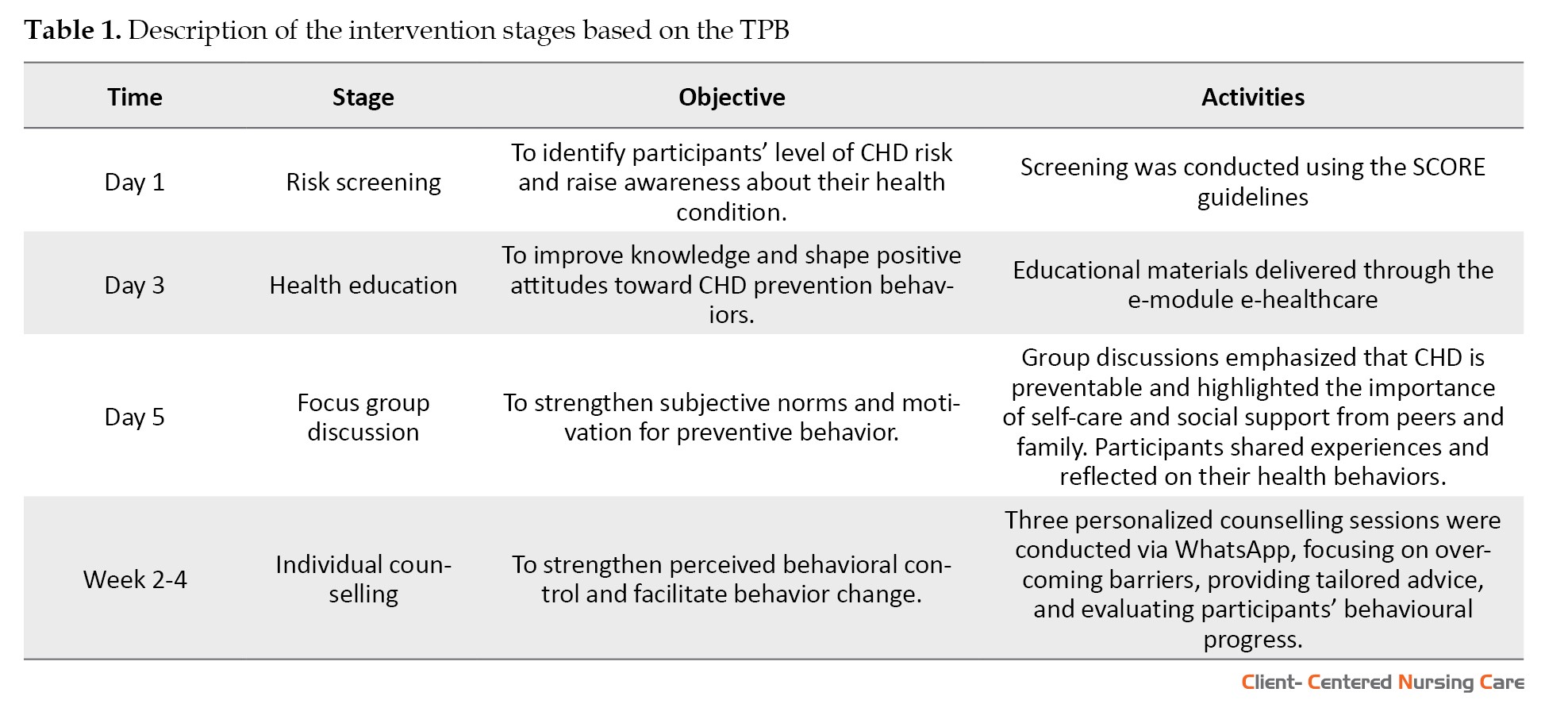
The intervention was developed by the principal investigator (PI) based on the TPB and a comprehensive literature review. The intervention consisted of four sequential stages: risk screening, health education, focus group discussion, and individual counselling (Table 1).
Procedure
The intervention was implemented over a total duration of four weeks, consisting of three face-to-face sessions in the first week, followed by three chat-based counselling sessions during the subsequent three weeks.
Heart disease risk screening was conducted using the systematic coronary risk evaluation (SCORE) guidelines (Graham et al., 2021). Participants were categorized into four risk levels: very high risk (SCORE risk ≥10%), high risk (SCORE 5–9%), medium risk (SCORE 1–4%), and low risk (SCORE <1%). At this stage, participants were also provided with information regarding their specific risk factors and their potential health consequences.
The experimental group received TPB -based education from the PI in addition to routine care, while the control group received only routine care.
During the health education stage for the intervention group, an E-Module called e-healthcare was used to deliver information about CHD, including its definition, risk factors, signs and symptoms, and preventive strategies, particularly for individuals with hypertension and diabetes mellitus.
Focus group discussions were designed to enhance participants’ awareness that CHD is preventable and to strengthen their attitudes and intentions toward adopting heart disease preventive behaviors. The final stage involved individual counselling, conducted through three personalized sessions via WhatsApp, which addressed participants’ barriers to behavior change, monitored progress, and evaluated their preventive practices.
Prior to the intervention, participants completed a pre-test questionnaire assessing their knowledge and preventive behaviors related to heart disease. Then, at the end of this period, they were asked to complete the post-test questionnaire via a Google Form available on the website.
In the control group, nurses provided education on heart disease prevention, covering the same components as the intervention group. Additionally, participants were given informational leaflets to take home. The control group was asked to complete a questionnaire in the first week before receiving the education as a pre-test assessment. They were then asked to complete the questionnaire again in the fourth week as a post-test assessment. Two research assistants, who were qualified nursing professionals trained in data collection, assisted PI throughout the study.
Data analysis
Data were analyzed using descriptive statistics, including frequency distributions, percentages, and Mean±SD. The chi-square test, Fisher’s exact test, and independent t-test were used to compare baseline demographic characteristics between the intervention and control groups. The normality of continuous data was tested using the Shapiro–Wilk test, as the number of participants in each group was fewer than 50. Variables with a P>0.05 were considered normally distributed. Normally distributed data were analyzed using the paired t-test (within-group comparisons) and the independent t-test (between-group comparisons). For data that were not normally distributed (P<0.05), the Wilcoxon signed-rank test and Mann–Whitney U test were applied to compare pre- and post-intervention scores of knowledge and CVD prevention behavior within and between groups, respectively.
Results
The total number of participants was 46, and there was no attrition in either group. The findings revealed no significant difference between the two group regarding demographic characteristic and health condition prior to the study (Table 2).
 .
Effectiveness of the TPB-based education
Before the intervention, there were no significant differences in TPB constructs and average knowledge scores between the groups (Table 3).

Nonetheless, the mean post-test scores of the TPB constructs in the intervention group were significantly higher than those of the control group (Mann–Whitney=13.500, p=0.001). Additionally, all core components of the TPB construct, including “attitude” (Mann–Whitney=0.000, P<0.001), “perceived behavioral control” (Mann–Whitney=106.00, P<0.001), “subjective norm” (Mann–Whitney=141.500, P<0.006), and “behavioral intention” (t=6.527, P<0.001), showed higher post-test scores for respondents in the intervention group than in the control group. Within-group comparisons showed that all of the TPB core components improved after the intervention in the experimental group, while only the subjective norm component showed an increase in the control group (Wilcoxon=-2.43, P=0.015). Furthermore, the experimental group’s mean score on CVD prevention knowledge increased significantly at the end of the intervention compared to before (t=-9.436, P<0.001), while the control group also showed a significant increase, although not as much as the intervention group (t=2.598, P=0.016) (Table 3).
Discussion
The findings of this study demonstrated that education based on the TPB was effective in improving knowledge and preventive behaviors related to heart disease among high-risk individuals, especially those with diabetes mellitus and hypertension. These results are consistent with previous TPB-based interventions in cardiovascular contexts. Khani Jeihooni et al. (2021) found that an educational program grounded in the TPB significantly improved nutritional behaviors associated with CVD, particularly through enhancing attitudes, subjective norms, and perceived behavioral control. Similarly, Wang et al. (2023) integrated TPB with the temporal self-regulation theory to predict physical activity behavior among patients with CHD, showing that attitude and perceived behavioral control were key determinants of intention and subsequent behavioral change.
Increased knowledge in the current study likely strengthened participants’ awareness of risk factors and facilitated more informed decision-making regarding their health. This aligns with TPB’s assumption that behavioral change is driven by cognitive factors shaping individual intentions to act (Ajzen, 2010). Improvements in preventive behaviors observed in this study suggest that TPB-based education effectively targeted these determinants, leading to a higher likelihood of adopting and maintaining heart-healthy behaviors.
Moreover, the present findings reinforce the importance of focusing on behavioral intention as a critical mediator between cognition and action. Consistent with previous studies, attitude, subjective norms, and perceived behavioral control remain core components influencing behavioral outcomes in patients with or at risk of CVD (Khani Jeihooni et al., 2021; Wang et al., 2023). Similar evidence has also been reported in TPB-based programs addressing heart disease prevention and lifestyle modification, highlighting their role in enhancing adherence to diet, medication, and physical activity recommendations (Izadpanah et al., 2023). Collectively, these findings strengthen the argument that TPB-based education can serve as an effective behavioral framework for promoting cardiovascular health.
The application of TPB has also proven effective in modifying health behaviors, particularly through the three main constructs of the theory: attitudes, subjective norms, and perceived behavioral control. Prior research has shown that TPB-based interventions can improve patient adherence to treatment regimens and lifestyle modifications—factors that are essential for managing chronic conditions (Paul et al., 2022a; Teng et al., 2023). Accordingly, it can be concluded that behavioral intention is the most influential factor driving behavior change (Steele Gray et al., 2018; Paul et al., 2022b; Barbosa et al., 2021; Zeidi et al., 2021).
One of the primary mechanisms underlying the success of TPB interventions is the enhancement of perceived behavioral control, which increases patients’ confidence in performing preventive actions. Interventions that incorporate skill training, personalized feedback, and goal-setting have been shown to improve patient adherence to recommended health practices. Evidence suggests that the reduction of perceived barriers and the increase in an individual’s sense of control significantly enhance the likelihood of sustaining health behaviors over time (Barbosa et al., 2021; Vaziri Esferjani et al., 2024). This is further supported by another research (Pourmand et al., 2020), which emphasized that patients’ perceptions of control over self-care behavior are critical determinants of their engagement in such behaviors.
In addition to perceived behavioral control, positive attitudes toward health behaviors are fundamental in fostering the adoption and maintenance of healthy habits. TPB-based interventions aim to shift patient attitudes by delivering evidence-based information on the benefits of preventive actions and the risks associated with unhealthy behaviors. Research indicates that positive attitude changes, such as recognizing the long-term benefits of physical activity or understanding the dangers of smoking, are closely associated with sustained behavior change (Miller-Rosales et al., 2017). Furthermore, strategies that employ emotional appeals, patient testimonials, and real-life success stories have been shown to be particularly effective in reshaping individuals’ health perceptions (Siegenthaler, et al., 2021; Dudley et al., 2023).
Subjective norms, which represent the social influences on health-related decision-making, also contribute to the effectiveness of TPB-based interventions. Prior studies highlight the importance of social support from family, friends, and healthcare professionals in enhancing adherence to positive health behaviors (Okube et al., 2023). Additionally, community- and culturally-based interventions have been found to exert a stronger influence on creating supportive environments that foster behavior change. The findings of this study reinforce the notion that TPB-based educational interventions are a valuable strategy for improving knowledge and heart disease preventive behaviors.
While this study demonstrated the effectiveness of TPB-based education in enhancing knowledge and preventive behaviors, several limitations should be acknowledged. The relatively short follow-up period and the absence of long-term evaluation restricted the ability to assess sustained behavioral changes. Additionally, the small sample size and the lack of randomization limit the generalizability of the findings. Future research should consider increasing the sample size, employing more rigorous sampling methods, and implementing extended follow-up assessments to evaluate the long-term impact of the intervention.
Conclusion
A TPB-based educational intervention delivered by nurses is an effective strategy for improving knowledge and promoting heart disease preventive behaviors among high-risk individuals. This approach holds significant potential for strengthening CVD prevention efforts, particularly in resource-limited settings. Nurses can play a pivotal role in delivering educational interventions and facilitating behavioral change, ultimately contributing to a reduction in the burden of CVD.
Ethical Considerations
Compliance with ethical guidelines
This research was approved by the Health Research Ethics Committee of Dr. Moewardi General Hospital, Surakarta, Central Java, Indonesia (No.: 371/II/HREC/2024). Prior to the study, all participants received a written explanation of the research procedures, benefits, objectives, risks, and their right to withdraw from the study at any time without affecting their healthcare services. Informed written consent was obtained from all participants. Participant information will be kept confidential and stored in a secure location accessible only to the researchers, and the data will be destroyed at the end of the research period.
Funding
This research was supported by a grant from Universitas Muhammadiyah Surakarta, Central Java, Indonesia.
Authors' contributions
Conceptualization, investigation, and supervision: Dian Hudiyawati; Data collection: Ekan Faozi and Dian Hudiyawati; Formal analysis: Agus Sudaryanto and Dian Hudiyawati; Consultation: Arif widodo, Mazlinda Musa and Fahrun Nur Rosyid; Writing the original draft: Dian Hudiyawati, Ekan Faozi, Agus Sudaryanto, and Ida Imamah; Final approval: Dian Hudiyawati, Mazlinda Musa, Agus Sudaryanto, Arif Widodo, Ekan Faozi, Fahrun Nur Rosyid, and Ida Imamah.
Conflict of interest
The authors declared no conflict of interests.
Acknowledgments
The authors would like to thank the participants, hospital management, and nursing staff for their valuable support and participation in this study.
References
Ajzen, I., 1991. The Theory of Planned Behavior. Organizational Behavior and Human Decision Processes, 50(2), pp. 179-211. [DOI:10.1016/0749-5978(91)90020-T]
Amalia, R. & Kismiantini, K., 2022. Analysis of the effect of smoking and exercise habits on coronary heart disease in Indonesia using logistic regression. AIP Conference Proceedings, 2575, pp. 070004. [DOI:10.1063/5.0111575]
Barbosa, H. C. et al. 2021. Empowerment-oriented strategies to identify behavior change in patients with chronic diseases: An integrative review of the literature’, Patient Education and Counseling, 104(4), pp. 689–702. [DOI:10.1016/j.pec.2021.01.011] [PMID]
Dudley, M. Z., et al., 2023. The use of narrative in science and health communication: A scoping review. Patient Education and Counseling, 112, pp. 107752. [DOI:10.1016/j.pec.2023.107752] [PMID]
Fishbein, M., & Ajzen, I. (2010). Predicting and Changing Behavior: The Reasoned Action Approach (1st ed.). Psychology Press. [DOI:10.4324/9780203838020]
Graham, I. M., et al., 2021. Systematic coronary risk evaluation (SCORE): JACC focus seminar 4/8. Journal of the American College of Cardiology, 77(24), pp. 3046-57. [DOI:10.1016/j.jacc.2021.04.052] [PMID]
Haynes, A. B., Haukoos, J. S. & Dimick, J. B., 2021. TREND reporting guidelines for nonrandomized/quasi-experimental study designs. JAMA Surgery, 156(9), pp. 879-80. [DOI:10.1001/jamasurg.2021.0552] [PMID]
Hong, K. N., et al., 2017. how low to go with glucose, cholesterol, and blood pressure in primary prevention of CVD. Journal of the American College of Cardiology, 70(17), pp. 2171-85. [DOI:10.1016/j.jacc.2017.09.001] [PMID]
Hussain, M. A., et al., 2016. The burden of cardiovascular disease attributable to major modifiable risk factors in Indonesia. Journal of Epidemiology, 26(10), pp. 515-21. [DOI:10.2188/jea.JE20150178] [PMID]
Izadpanah, P., et al., 2023. The effect of base theory educational intervention on health-promoting lifestyle in women susceptible to cardiovascular diseases: application of the theory of planned behavior. Cardiology Research & Practice, 2023, pp. 8528123. [DOI:10.1155/2023/8528123] [PMID]
Jalali Javaran, E., et al., 2020. Effectiveness of a theory of planned behavior-based intervention for promoting medication adherence among rural elderly hypertensive patients in Iran. Elderly Health Journal, 6(1), pp. 9-15. [DOI:10.18502/ehj.v6i1.3410]
Khani Jeihooni, A., et al., 2021. The application of the theory of planned behavior to nutritional behaviors related to cardiovascular disease among the women. BMC Cardiovascular Disorders, 21(1), pp. 589. [DOI:10.1186/s12872-021-02399-3] [PMID]
Kim, J. & Hur, M. H., 2021. “The effects of dietary education interventions on individuals with type 2 diabetes: A systematic review and meta-analysis. International Journal of Environmental Research and Public Health, 18(16), pp. 8439. [DOI:10.3390/ijerph18168439] [PMID]
Kristinawati, B., Mardana, N. W. & Wijayanti, N. W. D., 2024.Sustaining quality of life with education-based treatment for hypertension patients during covid-19 adaptation. Journal of Holistic Nursing, 42(2_suppl), pp. S118-25. [DOI:10.1177/08980101231217358] [PMID]
Lakerveld, J., et al., 2008. Primary prevention of diabetes mellitus type 2 and cardiovascular diseases using a cognitive behavior program aimed at lifestyle changes in people at risk: Design of a randomized controlled trial. BMC Endocrine Disorders, 8, pp. 6. [DOI:10.1186/1472-6823-8-6] [PMID]
Lindstrom, M., et al., 2022. Global burden of cardiovascular diseases and risks collaboration, 1990-2021. Journal of the American College of Cardiology, 80(25), pp. 2372–425. [DOI:10.1016/j.jacc.2022.11.001] [PMID]
Mazloomy-Mahmoodabad, S. S., et al., 2017. The effect of educational intervention on weight loss in adolescents with overweight and obesity: Application of the theory of planned behavior. ARYA Atherosclerosis, 13(4), pp. 176-83. [PMID]
Miller-Rosales, C., et al., 2017. “CREATE Wellness: A multi-component behavioral intervention for patients not responding to traditional cardiovascular disease management. Contemporary Clinical Trials Communications, 8, pp. 140-6. [DOI:10.1016/j.conctc.2017.10.001] [PMID]
Mirahmadizadeh, A., et al., 2020. Adherence to medication, diet and physical activity and the associated factors amongst patients with type 2 diabetes. Diabetes Therapy, 11(2), pp. 479-94. [DOI:10.1007/s13300-019-00750-8] [PMID]
Nugroho, A. S., Astutik, E. & Tama, T. D., 2022. Risk Factors for Coronary Heart Disease in Productive Age Group in Indonesia. Malaysian Journal of Medicine and Health Sciences, 18(2), pp. 99-105. [Link]
Okube, O. T., Kimani, S. T. & Mirie, W., 2023. Effect of a nurse-led intervention on knowledge of the modifiable risk behaviors of cardiovascular disease: A randomized controlled trial. SAGE Open Nursing, 9, pp. 23779608231201044. [DOI:10.1177/23779608231201044] [PMID]
Paul, B., et al., 2022. Theory of planned behaviour-based interventions in chronic diseases among low health-literacy population: Protocol for a systematic review. Systematic Reviews, 11(1), pp. 127. [DOI:10.1186/s13643-022-02006-2] [PMID]
Pomeroy, J. & Palacios, C., 2012. Translating findings from lifestyle intervention trials of cardiovascular disease and diabetes to the primary care setting. Current Nutrition Reports, 1(4), pp. 215-21. [DOI:10.1007/s13668-012-0024-0] [PMID]
Pourmand, G., et al., 2020. An application of the theory of planned behavior to self-care in patients with hypertension. BMC Public Health, 20(1), pp. 1290. [DOI:10.1186/s12889-020-09385-y] [PMID]
Ramadhaniah, F., Sudaryo, M. K. & Syarif, S., 2022. Metabolic syndrome as a risk for coronary heart disease in Indonesia: A longitudinal study 2007-2014. Malaysian Journal of Medicine and Health Sciences, 18(5), pp. 86-92. [DOI:10.47836/mjmhs.18.5.13]
Risdahidayanti, F., Prabadiyan, R. & Abu Bakar, S., 2020. Analysis of risk factors related to coroner heart disease in one of the Indonesian national hospitals. International Journal of Psychosocial Rehabilitation, 24(2), pp. 4089-97. [DOI:10.61841/xcxatb92]
Sartika, I., Mustikasari, M. & Azzam, R., 2023. Relationship of self efficacy and family support with self care in elderly age diabetes mellitus type II. Jurnal Berita Ilmu Keperawatan, 16(1), pp. 89-98. [DOI:10.23917/bik.v16i1.1161]
Siegenthaler, P., Ort, A. & Fahr, A., 2021. The influence of valence shifts in fear appeals on message processing and behavioral intentions: A moderated mediation model. Plos One, 16(9), pp. e0255113. [DOI:10.1371/journal.pone.0255113] [PMID]
Steele Gray, C., et al., 2018.Using information communication technology in models of integrated community-based primary health care: learning from the iCOACH case studies. Implementation Science, 13(1), pp. 87. [DOI:10.1186/s13012-018-0780-3] [PMID]
Steinmetz, H., et al., 2016. How effective are behavior change interventions based on the theory of planned behavior?: A three-level meta analysis. Zeitschrift fur Psychologie / Journal of Psychology, 224(3), pp. 216-33. [DOI:10.1027/2151-2604/a000255]
Teng, L., et al., 2023. Explaining the intention and behaviours of interinstitutional collaboration in chronic disease management among health care personnel: A cross-sectional study from Fujian Province, China. BMC Health Services Research, 23(1), pp. 477. [DOI:10.1186/s12913-023-09453-0] [PMID]
Utami, M., Setiawati, F., Ahmad, MS. and Adiatman, M. (2002) “Cross-cultural adaptation and psychometric properties of the Indonesian version of theory of planned behavior questionnaire to measure dental attendance of children with hearing loss: A pilot study,” Spec Care Dentist, 42(5), pp. 516-523. [DOI:10.1111/scd.12702] [PMID]
Vaziri Esferjani, S. V. et al. (2024) ‘Factors related to the empowerment of patients with diabetes: a cross-sectional study’, Journal of Public Health, 32(2), pp. 229–236. [DOI:10.1007/s10389-022-01798-w]
Wagner, J., et al., 2005. Development of a questionnaire to measure heart disease risk knowledge in people with diabetes: The Heart Disease Fact Questionnaire. Patient Education and Counseling, 58(1), pp. 82-7. [DOI:10.1016/j.pec.2004.07.004] [PMID]
Wang, W., et al., 2023. Using an integrated model of the theory of planned behavior and the temporal self-regulation theory to explain physical activity in patients with coronary heart disease. Frontiers in Psychology, 14, pp. 1049358. [DOI:10.3389/fpsyg.2023.1049358] [PMID]
World Health Organization., 2025. Cardiovascular diseases (CVDs). Geneva: WHO. [Link]
Yuliawan, D. & Hanoum, S., 2025. Analysis of Individual Health Behaviors in Relation to Cardiovascular Disease Prevention among Employees of an Oil and Gas Company. Benefit: Jurnal Manajemen dan Bisnis, 10(1), pp. 73-84. [DOI:10.23917/benefit.v10i1.8378]
Yuniartika, W. & Hidayati, D. A. N., 2021. Improving knowledge of diabetes mellitus patients using booklet. Journal of Medicinal and Chemical Sciences, 4(3), pp. 238-45. [DOI:10.26655/JMCHEMSCI.2021.3.4]
Zeidi, I. M., Morshedi, H. & Otaghvar, H. A., 2021. A theory of planned behavior-enhanced intervention to promote health literacy and self-care behaviors of type 2 diabetic patients. Journal of Preventive Medicine and Hygiene, 61(4), pp. E601-13. [PMID]
Coronary heart disease (CHD) remains a major global health challenge, contributing significantly to morbidity and mortality worldwide. The burden of cardiovascular diseases (CVDs) has increased substantially over the past decades, with estimated deaths rising from approximately 12.1 million in 1990 to 18.6 million in 2019, affecting 9.6 million men and 8.9 million women (Lindstrom et al., 2022). Projections by the World Health Organization (WHO) estimate that 19.8 million people died from CVDs in 2022, representing 32% of all global deaths. This substantial burden highlights the critical importance of implementing effective prevention and management strategies (WHO, 2025).
In Indonesia, CHD continues to be a significant public health concern. Although its overall prevalence has not exhibited a drastic increase, the rising trends of key risk factors—such as metabolic syndrome, hypertension, and low level of high-density lipoprotein (HDL) suggest a heightened future burden of the disease (Hussain et al., 2016; Amalia & Kismiantini, 2022). Recent epidemiological data indicate that the incidence of CHD in Indonesia is approximately 2.72%, with an incidence rate of 34 per 100,000 person-years. Major risk factors, including smoking, hypertension, and hypercholesterolemia, have been identified as primary predictors of CHD in the Indonesian population (Ramadhaniah et al., 2022). The high prevalence of these modifiable risk factors signals a potential increase in CHD incidence and other diseases, necessitating evidence-based interventions to mitigate its progression (Nugroho et al., 2022).
In Central Java Province, Indonesia, CHD prevalence is strongly influenced by well-established risk factors. A study conducted at a national referral hospital identified age, dyslipidemia, hypertension, and diabetes mellitus as the primary determinants of CHD (Risdahidayanti et al., 2020). Individuals over the age of 40 with a history of these conditions are at significantly higher risk of developing CHD. Notably, diabetes mellitus and hypertension exacerbate cardiovascular risk by adversely affecting glucose metabolism, lipid profiles, and blood pressure regulation. Given these findings, targeted preventive interventions for high-risk populations are imperative to delay the onset and progression of CHD. Effective management of modifiable risk factors—such as hyperglycaemia, dyslipidaemia, and hypertension—through lifestyle modifications and optimized medical therapy has been shown to substantially reduce cardiovascular risk (Hong et al., 2017).
Preventive measures, particularly those initiated early and sustained over time, are essential for promoting long-term cardiovascular health. Research indicates that comprehensive lifestyle interventions, encompassing regular physical activity and dietary modifications, can delay or even prevent the onset of type 2 diabetes mellitus and improve cardiovascular outcomes (Pomeroy & Palacios, 2012; Sartika et al., 2023). Preventive efforts targeting individuals at risk of are essential to reduce disease burden and improve population health outcomes (Yuliawan & Hanoum, 2025). Furthermore, behavior-focused strategies, such as motivational interviewing and behavioral counseling, have demonstrated efficacy in facilitating sustainable lifestyle changes, improving quality of life, and mitigating cardiovascular risk factors (Lakerveld et al., 2008; Yuniartika & Hidayati, 2021; Kristinawati et al., 2024).
One promising theoretical framework for guiding behavioral interventions in CHD prevention is the theory of planned behavior (TPB). TPB posits that human behavior is primarily guided by behavioral intention, which in turn is influenced by three core cognitive determinants: attitude toward the behavior, subjective norms, and perceived behavioral control (Ajzen, 1991; Steinmetz et al., 2016). Attitude reflects an individual’s evaluation of the outcomes of performing a behavior—such as perceiving healthy eating or regular exercise as beneficial for heart health. Subjective norms involve perceived social pressure or expectations from significant others, including family, peers, or healthcare providers, to engage in preventive actions. Perceived behavioral control denotes one’s confidence in his/her ability to perform the behavior, often shaped by prior experiences, self-efficacy, and available resources (Steinmetz et al., 2016).
In the context of CHD prevention, TPB offers a comprehensive framework to understand why individuals at risk—such as those with hypertension or diabetes—may or may not engage in preventive behaviors, like maintaining a balanced diet, adhering to medication, or engaging in physical activity. By identifying and addressing specific cognitive determinants, TPB allows interventions to be precisely tailored: for instance, by strengthening positive attitudes toward lifestyle modification, enhancing perceived social support for heart-healthy behaviors, and improving individuals’ confidence and skills to overcome perceived barriers. Moreover, TPB’s predictive validity has been consistently demonstrated in cardiovascular health studies, where interventions targeting its constructs have led to significant improvements in behavioral intention, lifestyle adherence, and self-regulatory practices (Khani Jeihooni et al., 2021; Wang et al., 2023). Therefore, TPB not only provides a conceptual explanation of behavioral change but also serves as a practical foundation for designing structured, theory-driven educational programs that promote sustainable heart disease prevention behaviors.
Previous studies have demonstrated the effectiveness of TPB-based interventions in promoting physical activity, improving dietary habits, and enhancing medication adherence—factors critical for reducing cardiovascular risk among populations with diabetes and hypertension (Jalali Javaran et al., 2020; Mirahmadizadeh et al., 2020; Kim & Hur, 2021). A meta-analysis highlighted the significant impact of TPB-based strategies on behavioral modification across various health domains (Steinmetz et al., 2016). Notably, TPB-driven interventions have successfully influenced dietary behaviors, such as increasing fibber intake and reducing body mass index (BMI) in adolescent populations (Mazloomy-Mahmoodabad et al., 2017).
Given the established benefits of TPB in shaping health behaviors, this study aimed to implement an educational intervention based on this theory to enhance CHD prevention behaviors in at-risk populations. By leveraging a structured behavioral framework, this approach seeks to facilitate sustainable lifestyle modifications, ultimately contributing to the reduction of CHD incidence and its associated health burden. This research aimed to analyze the effectiveness of a TPB-based educational intervention on heart disease preventive behaviors in at-risk individuals.
Materials and Methods
Design, setting, and sample
This study was a non-randomized, controlled clinical trial with a pre-test and post-test design. The TREND (transparent reporting of evaluations with non-randomized designs) 2010 checklist guidelines guided this report (Haynes et al., 2021).
This research was conducted at community health centers located in the Central Java region of Indonesia. The research sample consisted of patients with diabetes mellitus and hypertension who are part of a group called PROLANIS (chronic disease management program in Indonesia). Participants were first recruited based on the inclusion criteria: PROLANIS participants with risk factors for CHD (including diabetes mellitus and hypertension), who had never received education on heart disease prevention, and who were under 65 years of age. Participants with other heart diseases, cognitive impairments, dementia, or those who did not comply with the research protocol were excluded.
The sample size was calculated using G*power software (version 3.1.9.6), considering an effect size assumption of 0.80, 80% power, and a significance level of 0.05 (Khani Jeihooni et al., 2021). The total sample required was 42 based on the calculations, which increased to 46 participants after accounting for 10% attrition, and 23 samples were considered for each group. The participants were assigned non-randomly to the groups. In the first stage, the eligibility of participants in the intervention group was determined, and 23 participants were selected. The same procedure was carried out for the control group, resulting in 23 participants who met the research criteria.
Instruments and data collection
Three questionnaires were used for data collection. Demographic information, including age, gender, main risk factors, marital status, and smoking history were collected using a checklist.
CVD prevention behavior was measured using a questionnaire developed based on the TPB by Fishbein and Ajzen (2010) in predicting and changing behavior: the reasoned action approach. The instrument was designed to assess four key TPB constructs: attitude, subjective norms, perceived behavioral control, and behavioral intention. A previous cross-cultural adaptation and psychometric evaluation of the Indonesian version of the TPB questionnaire was conducted by Utami et al. (2002) among mothers of children with hearing loss. The study confirmed the validity of all TPB constructs (P<0.05), with satisfactory internal consistency (Cronbach’s α=0.773) and excellent test re-test reliability (ICC=0.903), indicating that the TPB framework is applicable within the Indonesian cultural context.
Building upon these findings, the present study further adapted and validated the instrument to fit the context of CVD prevention. The modified version consisted of 21 items distributed across four domains: attitude (6 items), subjective norms (5 items), perceived behavioral control (5 items), and behavioral intention (5 items). A 5-point Likert scale (1=strongly disagree to 5=strongly agree, with higher scores indicative of better CVD prevention behavior) was used to enhance clarity and cultural appropriateness. Content validity was evaluated by three experts in behavioral science and health promotion, yielding a content validity index (CVI) of 0.87. The internal consistency test produced a Cronbach’s α coefficient of 0.74, demonstrating that the modified TPB-based questionnaire was valid and reliable for assessing behavioral constructs related to CVD prevention in this population.
Respondents’ knowledge was measured using the heart disease fact questionnaire (HDFQ) (Wagner et al., 2005). This questionnaire measured knowledge of CAD risk factors, the relationship between diabetes and CAD, and preventive measures to reduce CAD risk. It consisted of 25 items that were rated using the Gottman scale, in which responses were categorized as “true”, “false”, or “don’t know”. Six items were reverse-scored. Each correct response received a score of 1, while incorrect responses and “I do not know” answers received a score of 0. The total score was calculated by multiplying the number of correct responses by four, resulting in a range of 0 to 100. In this study, the HDFQ was translated from English into the Indonesian language through a standardized forward and backward translation process conducted by bilingual experts. The translated version was reviewed by a panel of nursing and cardiology experts to ensure content validity. The CVI of the translated instrument was 0.92, indicating excellent validity. Reliability testing using Cronbach’s α yielded a coefficient of 0.81, confirming the internal consistency of the adapted version used in this study.
Education based on the TPB
The intervention was developed by the principal investigator (PI) based on the TPB and a comprehensive literature review. The intervention consisted of four sequential stages: risk screening, health education, focus group discussion, and individual counselling (Table 1).
Procedure
The intervention was implemented over a total duration of four weeks, consisting of three face-to-face sessions in the first week, followed by three chat-based counselling sessions during the subsequent three weeks.
Heart disease risk screening was conducted using the systematic coronary risk evaluation (SCORE) guidelines (Graham et al., 2021). Participants were categorized into four risk levels: very high risk (SCORE risk ≥10%), high risk (SCORE 5–9%), medium risk (SCORE 1–4%), and low risk (SCORE <1%). At this stage, participants were also provided with information regarding their specific risk factors and their potential health consequences.
The experimental group received TPB -based education from the PI in addition to routine care, while the control group received only routine care.
During the health education stage for the intervention group, an E-Module called e-healthcare was used to deliver information about CHD, including its definition, risk factors, signs and symptoms, and preventive strategies, particularly for individuals with hypertension and diabetes mellitus.
Focus group discussions were designed to enhance participants’ awareness that CHD is preventable and to strengthen their attitudes and intentions toward adopting heart disease preventive behaviors. The final stage involved individual counselling, conducted through three personalized sessions via WhatsApp, which addressed participants’ barriers to behavior change, monitored progress, and evaluated their preventive practices.
Prior to the intervention, participants completed a pre-test questionnaire assessing their knowledge and preventive behaviors related to heart disease. Then, at the end of this period, they were asked to complete the post-test questionnaire via a Google Form available on the website.
In the control group, nurses provided education on heart disease prevention, covering the same components as the intervention group. Additionally, participants were given informational leaflets to take home. The control group was asked to complete a questionnaire in the first week before receiving the education as a pre-test assessment. They were then asked to complete the questionnaire again in the fourth week as a post-test assessment. Two research assistants, who were qualified nursing professionals trained in data collection, assisted PI throughout the study.
Data analysis
Data were analyzed using descriptive statistics, including frequency distributions, percentages, and Mean±SD. The chi-square test, Fisher’s exact test, and independent t-test were used to compare baseline demographic characteristics between the intervention and control groups. The normality of continuous data was tested using the Shapiro–Wilk test, as the number of participants in each group was fewer than 50. Variables with a P>0.05 were considered normally distributed. Normally distributed data were analyzed using the paired t-test (within-group comparisons) and the independent t-test (between-group comparisons). For data that were not normally distributed (P<0.05), the Wilcoxon signed-rank test and Mann–Whitney U test were applied to compare pre- and post-intervention scores of knowledge and CVD prevention behavior within and between groups, respectively.
Results
The total number of participants was 46, and there was no attrition in either group. The findings revealed no significant difference between the two group regarding demographic characteristic and health condition prior to the study (Table 2).
.Effectiveness of the TPB-based education
Before the intervention, there were no significant differences in TPB constructs and average knowledge scores between the groups (Table 3).
Nonetheless, the mean post-test scores of the TPB constructs in the intervention group were significantly higher than those of the control group (Mann–Whitney=13.500, p=0.001). Additionally, all core components of the TPB construct, including “attitude” (Mann–Whitney=0.000, P<0.001), “perceived behavioral control” (Mann–Whitney=106.00, P<0.001), “subjective norm” (Mann–Whitney=141.500, P<0.006), and “behavioral intention” (t=6.527, P<0.001), showed higher post-test scores for respondents in the intervention group than in the control group. Within-group comparisons showed that all of the TPB core components improved after the intervention in the experimental group, while only the subjective norm component showed an increase in the control group (Wilcoxon=-2.43, P=0.015). Furthermore, the experimental group’s mean score on CVD prevention knowledge increased significantly at the end of the intervention compared to before (t=-9.436, P<0.001), while the control group also showed a significant increase, although not as much as the intervention group (t=2.598, P=0.016) (Table 3).
Discussion
The findings of this study demonstrated that education based on the TPB was effective in improving knowledge and preventive behaviors related to heart disease among high-risk individuals, especially those with diabetes mellitus and hypertension. These results are consistent with previous TPB-based interventions in cardiovascular contexts. Khani Jeihooni et al. (2021) found that an educational program grounded in the TPB significantly improved nutritional behaviors associated with CVD, particularly through enhancing attitudes, subjective norms, and perceived behavioral control. Similarly, Wang et al. (2023) integrated TPB with the temporal self-regulation theory to predict physical activity behavior among patients with CHD, showing that attitude and perceived behavioral control were key determinants of intention and subsequent behavioral change.
Increased knowledge in the current study likely strengthened participants’ awareness of risk factors and facilitated more informed decision-making regarding their health. This aligns with TPB’s assumption that behavioral change is driven by cognitive factors shaping individual intentions to act (Ajzen, 2010). Improvements in preventive behaviors observed in this study suggest that TPB-based education effectively targeted these determinants, leading to a higher likelihood of adopting and maintaining heart-healthy behaviors.
Moreover, the present findings reinforce the importance of focusing on behavioral intention as a critical mediator between cognition and action. Consistent with previous studies, attitude, subjective norms, and perceived behavioral control remain core components influencing behavioral outcomes in patients with or at risk of CVD (Khani Jeihooni et al., 2021; Wang et al., 2023). Similar evidence has also been reported in TPB-based programs addressing heart disease prevention and lifestyle modification, highlighting their role in enhancing adherence to diet, medication, and physical activity recommendations (Izadpanah et al., 2023). Collectively, these findings strengthen the argument that TPB-based education can serve as an effective behavioral framework for promoting cardiovascular health.
The application of TPB has also proven effective in modifying health behaviors, particularly through the three main constructs of the theory: attitudes, subjective norms, and perceived behavioral control. Prior research has shown that TPB-based interventions can improve patient adherence to treatment regimens and lifestyle modifications—factors that are essential for managing chronic conditions (Paul et al., 2022a; Teng et al., 2023). Accordingly, it can be concluded that behavioral intention is the most influential factor driving behavior change (Steele Gray et al., 2018; Paul et al., 2022b; Barbosa et al., 2021; Zeidi et al., 2021).
One of the primary mechanisms underlying the success of TPB interventions is the enhancement of perceived behavioral control, which increases patients’ confidence in performing preventive actions. Interventions that incorporate skill training, personalized feedback, and goal-setting have been shown to improve patient adherence to recommended health practices. Evidence suggests that the reduction of perceived barriers and the increase in an individual’s sense of control significantly enhance the likelihood of sustaining health behaviors over time (Barbosa et al., 2021; Vaziri Esferjani et al., 2024). This is further supported by another research (Pourmand et al., 2020), which emphasized that patients’ perceptions of control over self-care behavior are critical determinants of their engagement in such behaviors.
In addition to perceived behavioral control, positive attitudes toward health behaviors are fundamental in fostering the adoption and maintenance of healthy habits. TPB-based interventions aim to shift patient attitudes by delivering evidence-based information on the benefits of preventive actions and the risks associated with unhealthy behaviors. Research indicates that positive attitude changes, such as recognizing the long-term benefits of physical activity or understanding the dangers of smoking, are closely associated with sustained behavior change (Miller-Rosales et al., 2017). Furthermore, strategies that employ emotional appeals, patient testimonials, and real-life success stories have been shown to be particularly effective in reshaping individuals’ health perceptions (Siegenthaler, et al., 2021; Dudley et al., 2023).
Subjective norms, which represent the social influences on health-related decision-making, also contribute to the effectiveness of TPB-based interventions. Prior studies highlight the importance of social support from family, friends, and healthcare professionals in enhancing adherence to positive health behaviors (Okube et al., 2023). Additionally, community- and culturally-based interventions have been found to exert a stronger influence on creating supportive environments that foster behavior change. The findings of this study reinforce the notion that TPB-based educational interventions are a valuable strategy for improving knowledge and heart disease preventive behaviors.
While this study demonstrated the effectiveness of TPB-based education in enhancing knowledge and preventive behaviors, several limitations should be acknowledged. The relatively short follow-up period and the absence of long-term evaluation restricted the ability to assess sustained behavioral changes. Additionally, the small sample size and the lack of randomization limit the generalizability of the findings. Future research should consider increasing the sample size, employing more rigorous sampling methods, and implementing extended follow-up assessments to evaluate the long-term impact of the intervention.
Conclusion
A TPB-based educational intervention delivered by nurses is an effective strategy for improving knowledge and promoting heart disease preventive behaviors among high-risk individuals. This approach holds significant potential for strengthening CVD prevention efforts, particularly in resource-limited settings. Nurses can play a pivotal role in delivering educational interventions and facilitating behavioral change, ultimately contributing to a reduction in the burden of CVD.
Ethical Considerations
Compliance with ethical guidelines
This research was approved by the Health Research Ethics Committee of Dr. Moewardi General Hospital, Surakarta, Central Java, Indonesia (No.: 371/II/HREC/2024). Prior to the study, all participants received a written explanation of the research procedures, benefits, objectives, risks, and their right to withdraw from the study at any time without affecting their healthcare services. Informed written consent was obtained from all participants. Participant information will be kept confidential and stored in a secure location accessible only to the researchers, and the data will be destroyed at the end of the research period.
Funding
This research was supported by a grant from Universitas Muhammadiyah Surakarta, Central Java, Indonesia.
Authors' contributions
Conceptualization, investigation, and supervision: Dian Hudiyawati; Data collection: Ekan Faozi and Dian Hudiyawati; Formal analysis: Agus Sudaryanto and Dian Hudiyawati; Consultation: Arif widodo, Mazlinda Musa and Fahrun Nur Rosyid; Writing the original draft: Dian Hudiyawati, Ekan Faozi, Agus Sudaryanto, and Ida Imamah; Final approval: Dian Hudiyawati, Mazlinda Musa, Agus Sudaryanto, Arif Widodo, Ekan Faozi, Fahrun Nur Rosyid, and Ida Imamah.
Conflict of interest
The authors declared no conflict of interests.
Acknowledgments
The authors would like to thank the participants, hospital management, and nursing staff for their valuable support and participation in this study.
References
Ajzen, I., 1991. The Theory of Planned Behavior. Organizational Behavior and Human Decision Processes, 50(2), pp. 179-211. [DOI:10.1016/0749-5978(91)90020-T]
Amalia, R. & Kismiantini, K., 2022. Analysis of the effect of smoking and exercise habits on coronary heart disease in Indonesia using logistic regression. AIP Conference Proceedings, 2575, pp. 070004. [DOI:10.1063/5.0111575]
Barbosa, H. C. et al. 2021. Empowerment-oriented strategies to identify behavior change in patients with chronic diseases: An integrative review of the literature’, Patient Education and Counseling, 104(4), pp. 689–702. [DOI:10.1016/j.pec.2021.01.011] [PMID]
Dudley, M. Z., et al., 2023. The use of narrative in science and health communication: A scoping review. Patient Education and Counseling, 112, pp. 107752. [DOI:10.1016/j.pec.2023.107752] [PMID]
Fishbein, M., & Ajzen, I. (2010). Predicting and Changing Behavior: The Reasoned Action Approach (1st ed.). Psychology Press. [DOI:10.4324/9780203838020]
Graham, I. M., et al., 2021. Systematic coronary risk evaluation (SCORE): JACC focus seminar 4/8. Journal of the American College of Cardiology, 77(24), pp. 3046-57. [DOI:10.1016/j.jacc.2021.04.052] [PMID]
Haynes, A. B., Haukoos, J. S. & Dimick, J. B., 2021. TREND reporting guidelines for nonrandomized/quasi-experimental study designs. JAMA Surgery, 156(9), pp. 879-80. [DOI:10.1001/jamasurg.2021.0552] [PMID]
Hong, K. N., et al., 2017. how low to go with glucose, cholesterol, and blood pressure in primary prevention of CVD. Journal of the American College of Cardiology, 70(17), pp. 2171-85. [DOI:10.1016/j.jacc.2017.09.001] [PMID]
Hussain, M. A., et al., 2016. The burden of cardiovascular disease attributable to major modifiable risk factors in Indonesia. Journal of Epidemiology, 26(10), pp. 515-21. [DOI:10.2188/jea.JE20150178] [PMID]
Izadpanah, P., et al., 2023. The effect of base theory educational intervention on health-promoting lifestyle in women susceptible to cardiovascular diseases: application of the theory of planned behavior. Cardiology Research & Practice, 2023, pp. 8528123. [DOI:10.1155/2023/8528123] [PMID]
Jalali Javaran, E., et al., 2020. Effectiveness of a theory of planned behavior-based intervention for promoting medication adherence among rural elderly hypertensive patients in Iran. Elderly Health Journal, 6(1), pp. 9-15. [DOI:10.18502/ehj.v6i1.3410]
Khani Jeihooni, A., et al., 2021. The application of the theory of planned behavior to nutritional behaviors related to cardiovascular disease among the women. BMC Cardiovascular Disorders, 21(1), pp. 589. [DOI:10.1186/s12872-021-02399-3] [PMID]
Kim, J. & Hur, M. H., 2021. “The effects of dietary education interventions on individuals with type 2 diabetes: A systematic review and meta-analysis. International Journal of Environmental Research and Public Health, 18(16), pp. 8439. [DOI:10.3390/ijerph18168439] [PMID]
Kristinawati, B., Mardana, N. W. & Wijayanti, N. W. D., 2024.Sustaining quality of life with education-based treatment for hypertension patients during covid-19 adaptation. Journal of Holistic Nursing, 42(2_suppl), pp. S118-25. [DOI:10.1177/08980101231217358] [PMID]
Lakerveld, J., et al., 2008. Primary prevention of diabetes mellitus type 2 and cardiovascular diseases using a cognitive behavior program aimed at lifestyle changes in people at risk: Design of a randomized controlled trial. BMC Endocrine Disorders, 8, pp. 6. [DOI:10.1186/1472-6823-8-6] [PMID]
Lindstrom, M., et al., 2022. Global burden of cardiovascular diseases and risks collaboration, 1990-2021. Journal of the American College of Cardiology, 80(25), pp. 2372–425. [DOI:10.1016/j.jacc.2022.11.001] [PMID]
Mazloomy-Mahmoodabad, S. S., et al., 2017. The effect of educational intervention on weight loss in adolescents with overweight and obesity: Application of the theory of planned behavior. ARYA Atherosclerosis, 13(4), pp. 176-83. [PMID]
Miller-Rosales, C., et al., 2017. “CREATE Wellness: A multi-component behavioral intervention for patients not responding to traditional cardiovascular disease management. Contemporary Clinical Trials Communications, 8, pp. 140-6. [DOI:10.1016/j.conctc.2017.10.001] [PMID]
Mirahmadizadeh, A., et al., 2020. Adherence to medication, diet and physical activity and the associated factors amongst patients with type 2 diabetes. Diabetes Therapy, 11(2), pp. 479-94. [DOI:10.1007/s13300-019-00750-8] [PMID]
Nugroho, A. S., Astutik, E. & Tama, T. D., 2022. Risk Factors for Coronary Heart Disease in Productive Age Group in Indonesia. Malaysian Journal of Medicine and Health Sciences, 18(2), pp. 99-105. [Link]
Okube, O. T., Kimani, S. T. & Mirie, W., 2023. Effect of a nurse-led intervention on knowledge of the modifiable risk behaviors of cardiovascular disease: A randomized controlled trial. SAGE Open Nursing, 9, pp. 23779608231201044. [DOI:10.1177/23779608231201044] [PMID]
Paul, B., et al., 2022. Theory of planned behaviour-based interventions in chronic diseases among low health-literacy population: Protocol for a systematic review. Systematic Reviews, 11(1), pp. 127. [DOI:10.1186/s13643-022-02006-2] [PMID]
Pomeroy, J. & Palacios, C., 2012. Translating findings from lifestyle intervention trials of cardiovascular disease and diabetes to the primary care setting. Current Nutrition Reports, 1(4), pp. 215-21. [DOI:10.1007/s13668-012-0024-0] [PMID]
Pourmand, G., et al., 2020. An application of the theory of planned behavior to self-care in patients with hypertension. BMC Public Health, 20(1), pp. 1290. [DOI:10.1186/s12889-020-09385-y] [PMID]
Ramadhaniah, F., Sudaryo, M. K. & Syarif, S., 2022. Metabolic syndrome as a risk for coronary heart disease in Indonesia: A longitudinal study 2007-2014. Malaysian Journal of Medicine and Health Sciences, 18(5), pp. 86-92. [DOI:10.47836/mjmhs.18.5.13]
Risdahidayanti, F., Prabadiyan, R. & Abu Bakar, S., 2020. Analysis of risk factors related to coroner heart disease in one of the Indonesian national hospitals. International Journal of Psychosocial Rehabilitation, 24(2), pp. 4089-97. [DOI:10.61841/xcxatb92]
Sartika, I., Mustikasari, M. & Azzam, R., 2023. Relationship of self efficacy and family support with self care in elderly age diabetes mellitus type II. Jurnal Berita Ilmu Keperawatan, 16(1), pp. 89-98. [DOI:10.23917/bik.v16i1.1161]
Siegenthaler, P., Ort, A. & Fahr, A., 2021. The influence of valence shifts in fear appeals on message processing and behavioral intentions: A moderated mediation model. Plos One, 16(9), pp. e0255113. [DOI:10.1371/journal.pone.0255113] [PMID]
Steele Gray, C., et al., 2018.Using information communication technology in models of integrated community-based primary health care: learning from the iCOACH case studies. Implementation Science, 13(1), pp. 87. [DOI:10.1186/s13012-018-0780-3] [PMID]
Steinmetz, H., et al., 2016. How effective are behavior change interventions based on the theory of planned behavior?: A three-level meta analysis. Zeitschrift fur Psychologie / Journal of Psychology, 224(3), pp. 216-33. [DOI:10.1027/2151-2604/a000255]
Teng, L., et al., 2023. Explaining the intention and behaviours of interinstitutional collaboration in chronic disease management among health care personnel: A cross-sectional study from Fujian Province, China. BMC Health Services Research, 23(1), pp. 477. [DOI:10.1186/s12913-023-09453-0] [PMID]
Utami, M., Setiawati, F., Ahmad, MS. and Adiatman, M. (2002) “Cross-cultural adaptation and psychometric properties of the Indonesian version of theory of planned behavior questionnaire to measure dental attendance of children with hearing loss: A pilot study,” Spec Care Dentist, 42(5), pp. 516-523. [DOI:10.1111/scd.12702] [PMID]
Vaziri Esferjani, S. V. et al. (2024) ‘Factors related to the empowerment of patients with diabetes: a cross-sectional study’, Journal of Public Health, 32(2), pp. 229–236. [DOI:10.1007/s10389-022-01798-w]
Wagner, J., et al., 2005. Development of a questionnaire to measure heart disease risk knowledge in people with diabetes: The Heart Disease Fact Questionnaire. Patient Education and Counseling, 58(1), pp. 82-7. [DOI:10.1016/j.pec.2004.07.004] [PMID]
Wang, W., et al., 2023. Using an integrated model of the theory of planned behavior and the temporal self-regulation theory to explain physical activity in patients with coronary heart disease. Frontiers in Psychology, 14, pp. 1049358. [DOI:10.3389/fpsyg.2023.1049358] [PMID]
World Health Organization., 2025. Cardiovascular diseases (CVDs). Geneva: WHO. [Link]
Yuliawan, D. & Hanoum, S., 2025. Analysis of Individual Health Behaviors in Relation to Cardiovascular Disease Prevention among Employees of an Oil and Gas Company. Benefit: Jurnal Manajemen dan Bisnis, 10(1), pp. 73-84. [DOI:10.23917/benefit.v10i1.8378]
Yuniartika, W. & Hidayati, D. A. N., 2021. Improving knowledge of diabetes mellitus patients using booklet. Journal of Medicinal and Chemical Sciences, 4(3), pp. 238-45. [DOI:10.26655/JMCHEMSCI.2021.3.4]
Zeidi, I. M., Morshedi, H. & Otaghvar, H. A., 2021. A theory of planned behavior-enhanced intervention to promote health literacy and self-care behaviors of type 2 diabetic patients. Journal of Preventive Medicine and Hygiene, 61(4), pp. E601-13. [PMID]
Type of Study: Research |
Subject:
General
Received: 2025/04/14 | Accepted: 2025/10/15 | Published: 2026/05/1
Received: 2025/04/14 | Accepted: 2025/10/15 | Published: 2026/05/1
Send email to the article author
| Rights and permissions | |
 |
This work is licensed under a Creative Commons Attribution-NonCommercial 4.0 International License. |

Copyright © The Author(s);
This is an open access article distributed under the terms of the Creative Commons Attribution License (CC-By-NC), which permits use, distribution, and reproduction in any medium, provided the original work is properly cited and is not used for commercial purposes.
Contact Information
