Thu, Oct 15, 2026
[Archive]
Volume 12, Issue 2 (Spring 2026)
JCCNC 2026, 12(2): 189-200 |
Back to browse issues page




Download citation:
BibTeX | RIS | EndNote | Medlars | ProCite | Reference Manager | RefWorks
Send citation to:


BibTeX | RIS | EndNote | Medlars | ProCite | Reference Manager | RefWorks
Send citation to:
Etebari-Asl F, Gardashkhani S, Ajri-Khameslou M, Heidarzadeh M. Ethical Behavior and Its Relationship With Ethical Climate and Moral Intelligence Among Nursing Students. JCCNC 2026; 12 (2) :189-200
URL: http://jccnc.iums.ac.ir/article-1-943-en.html
URL: http://jccnc.iums.ac.ir/article-1-943-en.html


1- Department of Medical-Surgical Nursing, School of Nursing and Midwifery, Ardabil University of Medical Sciences, Ardabil, Iran.
2- Student Research Committee, Tabriz University of Medical Sciences, Tabriz, Iran.
3- Department of Intensive Care Nursing, School of Nursing and Midwifery, Ardabil University of Medical Sciences, Ardabil, Iran.
4- Department of Medical-Surgical Nursing, School of Nursing and Midwifery, Ardabil University of Medical Sciences, Ardabil, Iran. ,m.mahda@gmail.com
2- Student Research Committee, Tabriz University of Medical Sciences, Tabriz, Iran.
3- Department of Intensive Care Nursing, School of Nursing and Midwifery, Ardabil University of Medical Sciences, Ardabil, Iran.
4- Department of Medical-Surgical Nursing, School of Nursing and Midwifery, Ardabil University of Medical Sciences, Ardabil, Iran. ,
Full-Text [PDF 656 kb]
(415 Downloads)
| Abstract (HTML) (838 Views)
Full-Text: (93 Views)
Introduction
Ethical behavior is defined as adhering to standards related to correct or incorrect actions and implementing ethical codes, such as independence, equality, forgiveness, the beneficence principle, integrity, confidentiality, and loyalty (Varkey, 2021). In simpler terms, ethical behavior involves maximizing benefits from available resources and acting in accordance with principles, like justice and equality (Tseng & Wang, 2021). Ethical behavior in any organization, including educational environments, is crucial for optimal performance (Hidayat, 2019).
Ethical behavior is an essential part of nurses’ duties and a fundamental characteristic of professional nursing (Haddad & Geiger, 2018; Dare Azeez, 2019). The main goal of nurses is to protect patients from injuries and complications and to create and maintain a healthy environment. Therefore, it is crucial to pay attention to ethics and ethical behavior in the profession (Hasanlo et al., 2019). This is especially important in today’s world, with advances in healthcare and related technologies and growing concern about unethical behavior and its underlying factors (Zarif, 2022).
Nurses are constantly faced with situations that require the proper handling of ethical issues in care environments (Ekramifar et al., 2018). Therefore, it is necessary to train nurses in ethics and ethical behavior. It can be helpful to start training during the student period because they will be working as healthcare providers in the future (Andersson et al., 2022). In other words, in clinical education environments, nursing students must possess mental and psychological characteristics, positive moral qualities, and moral intelligence in addition to clinical competencies (Eskandari et al., 2019).
Some variables influence ethical behavior. Among these is ethical climate, defined as a set of common beliefs and values regarding appropriate behavior and ways to address ethical issues (Eskandari et al., 2019). Ethical climate serves as a framework that establishes and reinforces acceptable norms, values, and beliefs (Elçi & Alpkan, 2009). Cullen et al. stated that ethical climate is crucial for organizations and has an impact on the ethical behavior of employees (Cullen et al., 2003). Ethical climate sets the stage for ethical behavior and decision-making (Olson, 1998). Several studies have shown a strong, positive correlation between ethical climate and ethical behavior (Hidayat, 2019; Spruit et al., 2019). For instance, Spruit et al. conducted a meta-analysis on young athletes. They found a significant and positive relationship between the ethical climate in sports and the ethical behavior of young athletes (Spruit et al., 2019). Moral intelligence is also discussed as a concept related to ethical behavior. Moral intelligence is the management of problem-solving and conflict-resolution processes, with conscious participation in interpersonal and intrapersonal communication, a term recently introduced in the nursing profession (Eskandari et al., 2019; Shirazi & Sabetsarvestani, 2021). Also, moral intelligence refers to the ability to distinguish between right and wrong, to hold strong moral principles, and to act upon them (Mellor & Gregoric, 2016). Research in this area has revealed a correlation between moral intelligence and ethical behavior. For instance, a study by Alizadeh (2018) found a positive and significant relationship between moral intelligence and ethical behavior among staff at the Institute for intellectual development of children and young adults.
It is expected that ethical behavior and its related factors will be considered during the student period before entering the nursing field. However, most studies have focused on ethical behavior and influencing factors among nurses (Deshpande & Joseph, 2009; Hassanian & Shayan, 2019). Therefore, although nursing students constantly face ethical dilemmas while caring for patients, their learning of ethical behavior has received less attention in theoretical and clinical education settings (Dehkordi et al., 2024). Also, the moral issues faced by nursing students differ from those of nurses, and the actions they take are different as well (Shayestehfard et al., 2020).
On the other hand, today’s students are tomorrow’s nurses who will make decisions about individuals’ health and lives (Eskandari et al., 2019). Being at the university can be an opportunity for them to learn and grow both morally and professionally. Also, the development of professional values in students begins as soon as they enter university and continues to evolve throughout their training period (Schwartz, 2019). Although previous studies have independently examined ethical behavior, ethical climate, or moral intelligence, the nature and strength of the relationships among these variables remain unclear. Some studies have reported a strong association between ethical climate and ethical behavior (Hidayat, 2019; Spruit et al., 2019), while others have suggested that the relationship may be mediated or moderated by individual moral capacities, such as moral intelligence (Shirazi & Sabetsarvestani, 2021). Similarly, despite evidence that moral intelligence influences ethical decision-making (Engelbrecht & Hendrikz, 2020), the interplay between moral intelligence and the perceived ethical climate in shaping ethical behavior among nursing students has not been investigated. Since nursing education environments expose students simultaneously to ethical norms (ethical climate) and opportunities to exercise moral reasoning (moral intelligence), it is theoretically and practically important to understand how these variables interact. Clarifying these relationships can provide empirical evidence to guide the development of ethics education programs that foster both individual and contextual factors influencing ethical behavior. Therefore, in this study, we aimed to examine ethical behavior and its relationship with moral climate and moral intelligence among nursing students.
Materials and Methods
Design, setting, and sample
This cross-sectional correlational study was conducted on nursing students from Ardabil University of Medical Sciences (ARUMS) and Ardabil Islamic Azad University in Ardabil, Iran. Sampling was done using the census method from January to March 2018.
The inclusion criteria required subjects to be in the 3rd to 8th semesters of the nursing course and willing to take part in the study. Exclusion criteria included unwillingness to cooperate and being guest students from other universities. A total of 382 nursing students met the requirements, with 32 being excluded due to temporary enrollment as guest students and 30 declining to participate. Ultimately, data from 320 students were included in the final analysis.
Instruments
In this study, along with the demographic questionnaire, which provided information on age, sex, marital status, academic semester, place of residence, and satisfaction with the field of study, four other questionnaires were used as follows:
Ethical behavior questionnaire: The ethical behavior questionnaire was developed by Swanson and Hill in 1993. This questionnaire consists of 15 items rated on a 5-point Likert scale (ranging from never to always). The minimum score is 15 and the maximum score is 75. A score higher than 45 indicates positive ethical behavior. Swanson and Hill in 1993 reported the reliability of the entire questionnaire using Cronbach’s α method as 0.96 (Swanson & Hill, 1993). In Iran, this questionnaire was translated and validated by Talebzadeh and Kadivar in 2008 among students in Iran, and its reliability was calculated as 0.78 using Cronbach’s α. The results of exploratory factor analysis (EFA) and confirmatory factor analysis (CFA) also confirmed the construct validity of the instrument (Talebzadeh & Kadivar, 2008). In this study, the Cronbach’s α coefficient for the entire instrument was 0.84.
Olson’s hospital ethical climate survey (HECS): The Olson’s HECS (1998) was utilized to assess the ethical climate within hospitals. The questionnaire consists of 26 items categorized into five dimensions: colleagues, doctors, hospital environment, patients, and managers. Respondents rate each item using a 5-point Likert scale ranging from “never” to “always”. The total score of the questionnaire ranges from 26-130. A score of 3.5 or lower on each item indicates an unfavorable hospital ethical climate, while a score above 3.5 indicates a favorable one. The questionnaire has demonstrated high internal reliability, with Cronbach’s α coefficients ranging from 0.68 to 0.92 for five domains and 0.91 for the entire questionnaire (Olson, 1998). The validity and reliability of this questionnaire were confirmed in a study by Khalesi et al. in 2015 among nurses in Iran, and its overall Cronbach’s α was 0.95. Also, CFA showed acceptable model fit: a standardized root mean square residual (SRMR) of 0.064, a non-normalized fit index (NNFI) of 0.96, a comparative fit index (CFI) of 0.96, and a root mean square error of approximation (RMSEA) of 0.075 (Khalesi et al., 2015).
Organizational ethical climate questionnaire: The ethical climate questionnaire, developed by Victor and Cullen in 1988, assesses ethical climates at both individual and organizational levels. This questionnaire consists of 26 items across five categories: caring, rules, instrumentalism, law and professional code, and independence. Responses are rated on a 6-point Likert scale ranging from “completely disagree” to “completely agree.” Scores on this questionnaire can range from 0 to 130. A score of 3.5 or lower on each item indicates an unfavorable organizational ethical climate, while a score above 3.5 indicates a favorable one (Victor & Cullen, 1988). In Iran, this questionnaire was translated and validated by Jalali et al. in 2017 among emergency medical technicians in Iran, its reliability was calculated as 0.73 using Cronbach’s α (Jalali et al., 2017), and its content validity index (CVI) was 0.81. In the current study, Cronbach’s α coefficient for the entire questionnaire was 0.94.
Moral intelligence questionnaire: The moral intelligence questionnaire, developed by Lennick and Kiel in 2005, consists of 20 questions in the areas of honesty, forgiveness, and compassion. Responses are measured using a 5-point Likert scale ranging from “never” to “all situations.” The highest possible score is 100, while the lowest is 20. A score of 20 to 33 indicates low moral intelligence, 33 to 66 indicates average moral intelligence, and 66 to 100 indicates high moral intelligence. Its validity and reliability have been confirmed (Lennick & Keil, 2005). The validity and reliability of this questionnaire were confirmed in a study by Majidi et al. in 2018 among nurses in Iran, and its overall Cronbach’s α was 0.88 (Majidi et al., 2018). The CVI was calculated as 85% and the content validity ratio (CVR) was found to be more than 90%. In this study, Cronbach’s α coefficient for the entire questionnaire was 0.95.
Data analysis
The researchers used SPSS software, version 26.0 (IBM Corp., Armonk, NY, USA) for data analysis. They employed descriptive statistics (frequency, percentage, and Mean±SD) to summarize demographic characteristics, hospital ethical climate, organizational ethical climate, and moral intelligence variables. All variables in the study were analyzed using both quantitative and qualitative methods. In the quantitative approach, the Mean±SD of the total and item mean scores were reported. Pearson’s correlation coefficients were used to examine the relationships among hospital ethical climate, organizational ethical climate, and moral intelligence. Before conducting the statistical tests, data distribution was assessed using the Kolmogorov-Smirnov one-sample test. Multiple linear regression using the enter method was conducted to examine predictors of ethical behavior while controlling participants’ demographic characteristics. Before conducting multiple linear regression, we assessed multicollinearity, consistency, and independence among the remaining variables using variance inflation factors (VIFs), tolerance values, and the Durbin-Watson test (P<0.05). Generally, a tolerance value less than 0.1 and a VIF value greater than 5 indicate multicollinearity. None of the variables in this study showed significant multicollinearity based on these measures (Draper, 1998). The Durbin-Watson value fell between 1.5 and 2.5, indicating the absence of autocorrelation (Turner, 2020). The significance level for statistical analysis was set at P<0.05.
Results
The mean age of the students was 22.43±2.7 years, and 51.9% of them were women. Other demographic characteristics of the students are shown in Table 1.
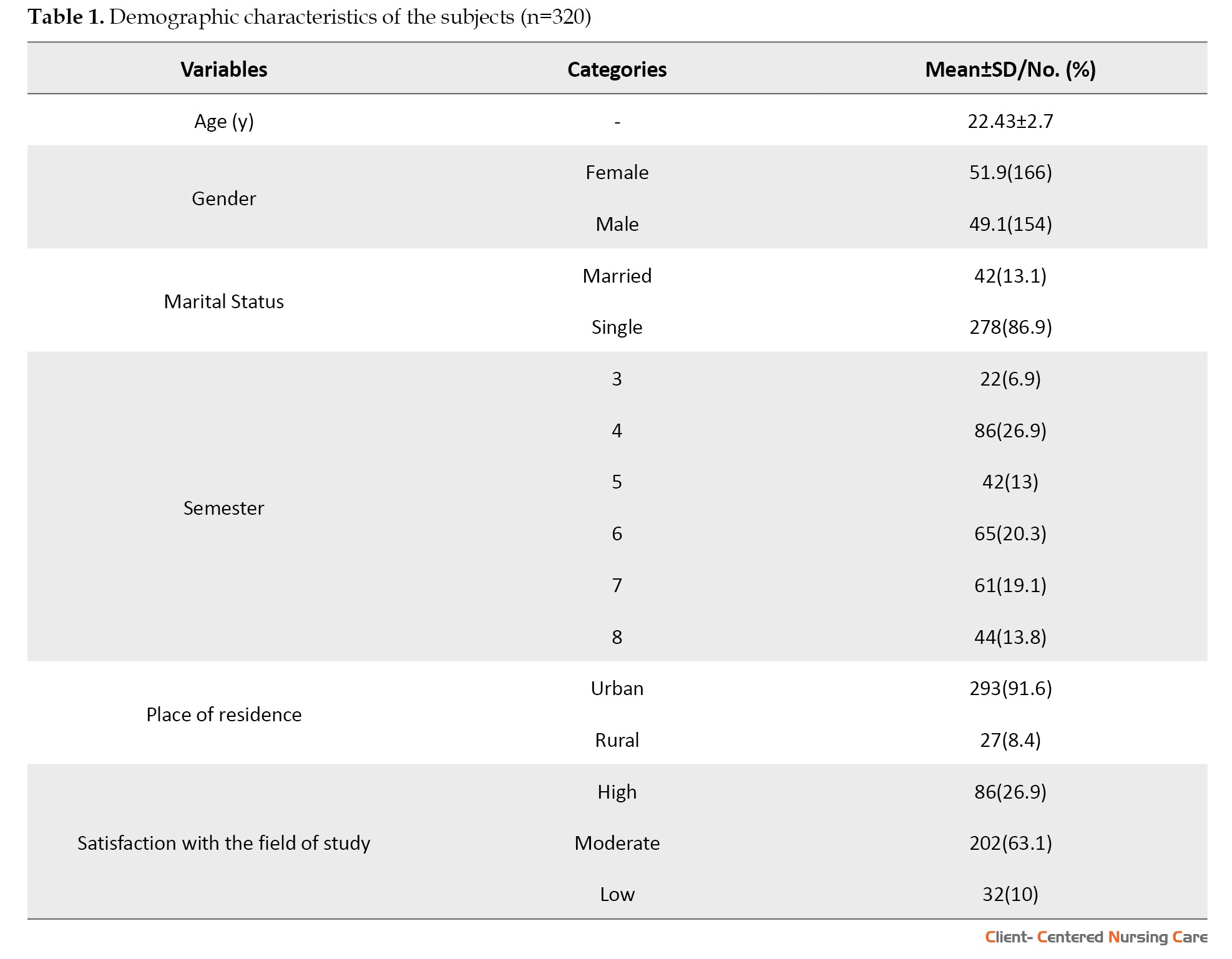
The mean values ethical behavior, hospital ethical climate, organizational ethical climate, and moral intelligence were 62.29±6.73, 91.1±17.15, 62.11±22.13, and 73.43±14.04, respectively. The mean values of the above variables, along with the subscales, are shown in Table 2.

The relationships between demographic variables and ethical behavior are presented in Table 3.

Among the examined variables, satisfaction with the field of study and place of residence showed a significant relationship with ethical behavior (P=0.002 and P=0.004, respectively).
Most subjects (97.8%) exhibited good ethical behavior. A total of 51.2% rated the hospital’s ethical climate as desirable, whereas 90.3% rated the nursing school’s ethical climate as undesirable. Regarding the ethical climate of the hospital, the highest average (3.66) was related to the “colleagues” area and the lowest (3.33) was related to the “physicians” area. Most subjects (76.9%) demonstrated high moral intelligence. The highest average was in the domain of “honesty” (3.71), and the lowest was in the domain of “forgiveness” (3.59).
To determine the relationships among hospital ethical climate, organizational ethical climate, and moral intelligence with ethical behavior, correlations among these variables were first evaluated using the Pearson correlation coefficient. The results showed that all three variables had a positive and significant (P<0.001) relationship with ethical behavior (the correlation coefficients for hospital ethical climate, organizational ethical climate, and moral intelligence with ethical behavior were r=0.324, r=0.233, and r=0.392, respectively). Thus, all of them were entered into the regression model.
The results of the analysis of variance for all factors were statistically significant, indicating that the regression model was a good fit. Examination of the coefficient of determination (R2) revealed that the predictor variables accounted for 21% of the variation in ethical behavior (P<0.001). Hospital ethical climate (β=0.24, P<0.001) and moral intelligence (β=0.14, P<0.001) were able to predict ethical behavior. Additionally, the highest effect was associated with moral intelligence, with a coefficient of 0.3 (Table 4).

Discussion
The present study aimed to investigate predictors of ethical behavior and its relationships with ethical climate and moral intelligence among nursing students. The study revealed ethical behavior at a positive level, high levels of moral intelligence, an unsupportive organizational ethical climate, and a supportive hospital ethical climate. Significant positive correlations were found between ethical behavior, ethical climate, and moral intelligence. Moral intelligence and the hospital’s ethical climate were able to predict 21% of ethical behavior.
The ethical behavior score of nursing students was desirable. This suggests that students have aligned their atitudes, beliefs, feelings, goals, and values with their field of study and are dedicated to it (Baghbani et al., 2016). The literature review did not uncover a similar study involving nursing students. Still, studies on nurses have shown that their ethical behavior scores were lower than those in the present study. The mean score for ethical behavior among nursing students was 62.29, which was higher than scores reported in studies on nurses (Baghbani et al., 2016; Deshpande & Joseph, 2009; Zakaria et al., 2016). It appears that working in a hospital and encountering numerous challenging situations may negatively impact nurses’ ethical behavior. Nurses encounter various variables in their roles that could influence their ethical behavior scores. For instance, Jafariharandi et al. (2020) demonstrated that low job satisfaction is consistently associated with more unfavorable ethical behavior among nurses. However, nursing students have not yet entered the job market, so work-related factors such as job satisfaction do not yet apply to them. Studies have shown that undergraduate nursing students with positive professional values exhibit strong active thinking and learning skills, demonstrate proactive ethical behavior when faced with dilemmas, and are more willing to invest time and effort to overcome obstacles to implement ethical actions (Aydın et al., 2022; İlaslan et al., 2021). The complex clinical environment has less influence on the ethical behavior of nursing students, as it is rooted in their education. Completion of a nursing ethics course helps students maintain ethical principles, leading to higher ethical behavior scores. A literature review has highlighted the importance of ethics education in nurturing ethical behavior among nursing students, equipping them to identify and address ethical issues effectively (Andersson et al., 2022).
The results of this study showed that ethical behavior was significantly related to satisfaction with the field of study and place of residence. Nursing students who reported higher satisfaction with their field had higher ethical behavior scores. This finding is consistent with previous studies showing that professional satisfaction and intrinsic motivation are associated with greater adherence to ethical values and professional conduct (Nezhadhoseini et al., 2024; Ozdoba et al., 2025). Students who feel more committed to their field are likely to internalize professional norms and act more responsibly in clinical situations (Poorchangizi et al., 2019). Conversely, those with lower satisfaction may experience reduced moral sensitivity or professional engagement, which could negatively affect ethical decision-making.
Additionally, the significant relationship between place of residence and ethical behavior may reflect the influence of cultural, social, and environmental factors. Students living in urban areas reported higher ethical behavior scores than those from rural areas. This might be due to cultural differences between rural and urban contexts, which shape moral reasoning and behavioral norms (Caravita et al., 2012).
Given that nursing students receive training in both academic and clinical settings, the study examined the ethical climate in both the organizational (nursing school) and hospital environments. The findings revealed that while half of the subjects found the hospital’s ethical climate satisfactory, the majority found the organization’s (i.e. nursing school) ethical climate unsatisfactory. According to students’ opinions, faculty and staff —including faculty members, managers, and other staff —were perceived as prioritizing individual interests over the organization’s goals. As a result, they did not receive favorable scores in any of the dimensions of the faculty’s organizational climate, such as law and code, caring, instrumentalism, independence, and professionalism. This issue highlights the weakness of the organizational environment in nursing schools within the region.
On the other hand, the hospital’s organizational climate was favorable from the students’ perspective, which was mainly due to the reported good communication between nurses and nursing managers. Since students have not yet entered the workplace and job satisfaction is not clearly defined for them, these favorable relationships may affect satisfaction with the hospital’s ethical climate, as job satisfaction is believed to be closely related to the ethical environment of the institution in which the employee works (Asgari et al., 2019). However, in the realm of hospital organizational climate, low scores were obtained in the relationship between nurses and doctors. Poor communication between nurses and doctors in Iranian society has always been a significant challenge. The development of nursing roles, the professionalization of nursing, the ability to make decisions, increasing nurses’ knowledge, and disobedience to doctors are among the factors that have caused the relationship between nurses and doctors to shift from a hierarchical state to a competitive situation (Farhadie et al., 2017; Rouhi-Balasi et al., 2020).
The moral intelligence of nursing students was evaluated at a high level, indicating that they can distinguish between right and wrong, hold strong moral beliefs, and adhere to them (Nobahar et al., 2022). This aligns with other studies examining moral intelligence among nursing students in Iran (Areshtanab et al., 2022; Nobahar et al., 2022). However, in a study regarding medical students, moral intelligence was found to be weak. The authors justify the low moral intelligence in medical students by linking it to deficiencies in their education. They suggest that since moral intelligence is a learned skill, poor performance in this area may indicate shortcomings in the student training program (Rafati et al., 2014). However, another study found a significant correlation between nursing students’ moral intelligence, clinical work experience, and professional behavior, highlighting the influence of clinical exposure on ethical development (Pourteimour & Raiesdana, 2021). In this study, the highest mean score was related to “honesty”, while the lowest was found for “forgiveness”. This result is consistent with studies in Iran (Dehghani et al., 2020; Gorzin et al., 2019) and inconsistent with those in other regions (Guiab et al., 2015), which could be due to differences in educational and demographic characteristics of the samples. Honesty had the highest mean score among the moral intelligence dimensions. In this regard, Yazdani and Asefi (2018) reported that honesty in communication is often associated with moral integrity among nursing students. When carrying out assigned responsibilities, they try to demonstrate this belief through their actions and behaviors (Amini & Rahimi, 2015).
According to the regression model, hospital ethical climate and moral intelligence were able to predict 21% of the variance in ethical behavior. This is significant because over half of nursing students’ training occurs in clinical settings. As a result, students can apply their theoretical knowledge in real-life situations and encounter various challenges and dilemmas (Jamshidi et al., 2016). Ethical behavior necessitates higher moral intelligence and moral intelligence, as a type of intelligence, can serve as a framework for ethical behavior (Majidi et al., 2023). According to a study by Cheraghi et al., nurses and nursing students with higher moral intelligence exhibit stronger ethical behavior and greater caring. For instance, they excel in tasks, such as diagnosing patients’ pain and suffering, embracing diversity, recognizing various human values, rejecting unethical actions, showing empathy, and standing up against injustice (Cheraghi et al., 2009). The study by Khajavi et al. further supports this by indicating a positive correlation between moral intelligence and professional behavior among nurses. As moral intelligence increases, professional conduct also increases. Enhancing nurses’ understanding of moral intelligence can result in improved patient care, enhanced service quality, and increased patient satisfaction in medical facilities (Khajavi et al., 2020). Given the significant role of ethical behavior in nursing care, prioritizing moral intelligence as a guiding principle for nursing students is crucial. The study by Eskandari et al. found that improving nursing students’ moral intelligence during their studies can significantly enhance their work efficiency. In addition to clinical qualifications, nursing students in clinical education settings should possess the necessary psychological traits, moral principles, and intelligence (Eskandari et al., 2019).
In this study, only the relationships between ethical behavior, ethical climate, and moral intelligence were examined, and hospital ethical climate and moral intelligence together explained 21% of the variance in students’ ethical behavior. This relatively modest explanatory power suggests that ethical behavior is influenced by other unexamined variables, highlighting the need for future studies to identify additional individual and contextual factors that contribute to students’ ethical conduct. The extensive number of questions in the study may have caused participant fatigue, potentially reducing the accuracy of their responses. To mitigate this, we made efforts to engage students at the appropriate time and provide sufficient time for completion. Since the data-gathering tools were self-reported, respondents’ bias and social desirability may be increased. Another limitation is the geographic context. Some perceptions are sensitive to social and cultural influences, and therefore, the findings might not be generalizable to other countries. Furthermore, the cross-sectional nature of the study does not permit conclusions about causal relationships. Consequently, it is recommended that future research investigate the development of ethical behavior in nursing students from the commencement of their training through their professional careers.
Conclusion
This study showed that nursing students’ ethical behavior is at a desirable level. Moral intelligence and the hospital’s ethical climate determine students’ ethical behavior. Given the impact of the hospital’s ethical climate on ethical behavior, it is evident that the ethical behavior model among hospital staff has a crucial effect on nursing students. This issue should be taken into consideration in the hidden curriculum by educational planners. Managers and planners in the nursing sector are recommended to promote professional regulations and to design and implement policies that foster a climate of humane behavior and the proper application of codes. Considering the high correlation between moral intelligence and students’ ethical behavior, it is suggests that educational officials, professors, and clinical trainers prioritize enhancing the moral intelligence of nursing students. Nursing educators are also expected to improve the ethics education system and develop students’ professional values to enable them to resolve ethical dilemmas in clinical practice.
Ethical Considerations
Compliance with ethical guidelines
This study was approved by the Research Ethics Committee of Ardabil University of Medical Sciences, Ardabil, Iran (Code: IR.ARUMS.REC.1398.370) and complies with the Helsinki Declaration. All the subjects were informed about the study’s objectives and the voluntary nature of participation. All the subject provided verbal informed consent before data collection and were assured that the information collected would remain confidential and that the results would be published collectively. Also, they were told that the research results would be provided to them if they were interested.
Funding
This study was extracted from the master’s thesis of Farzaneh Etebari-Asl, approved by the Department of Medical-Surgical Nursing, Faculty of Nursing and Midwifery, Ardabil University of Medical Sciences, Ardabil, Iran.
Authors' contributions
Conceptualization and methodology: Farzaneh Etebari-Asl and Mehdi Heidarzadeh; Investigation and data curation: Sevda Gardashkhani, Mehdi Ajri-Khameslou, and Mehdi Heidarzadeh; Formal analysis and data interpretation: Farzaneh Etebari-Asl, Sevda Gardashkhani, and Mehdi Heidarzadeh; Writing the original draft: Farzaneh Etebari-Asl, Sevda Gardashkhani, and Mehdi Heidarzadeh; Review and editing: Sevda Gardashkhani, Mehdi Ajri-Khameslou, and Mehdi Heidarzadeh; Final approval: All authors.
Conflict of interest
The authors declared no conflict of interest.
Acknowledgments
The authors thank all the nursing students who participated in the study and the staff of the University’s research department.
References
Alizadeh, Z., 2018. [Relationship between moral intelligence, emotional intelligence, and ethical behavior (Persian)]. Ethics in Science and Technology, 13(2), pp. 167-75. [Link]
Amini, M. & Rahimi, H., 2015. [Assessing the status of moral intelligence of students of the faculty of engineering of Kashan university (Persian)]. Iranian Engineering Education Quarterly, 17(66), pp. 1-16. [DOI:10.22047/ijee.2015.9660]
Andersson, H., et al., 2022. Ethics education to support ethical competence learning in healthcare: An integrative systematic review. BMC Medical Ethics, 23(1), pp. 29. [DOI:10.1186/s12910-022-00766-z] [PMID]
Areshtanab, H. N., et al., 2022. Moral intelligence and its relationship to resilience among nursing students in Iran. Journal of Psychiatric Nursing, 13(1), pp. 9-14. [Link]
Asgari, S., et al., 2019. Relationship between moral distress and ethical climate with job satisfaction in nurses. Nursing Ethics, 26(2), pp. 346-56. [DOI:10.1177/0969733017712083] [PMID]
Aydın, G. Ö., et al., 2022. Nursing students’ individual values, inclination to ethical and professional values. Perspectives in Psychiatric Care, 58(2), pp. 850-60. [DOI:10.1111/ppc.12863] [PMID]
Baghbani, S., 2016. The relationship between organizational commitment, job satisfaction and social orientation, and the nurses’ moral behavior. Medical Ethics Journal, 10(37), pp. 27-36. [Link]
Caravita, S. C., et al., 2012. Socio-economic factors related to moral reasoning in childhood and adolescence: The missing link between brain and behavior. Frontiers in Human Neuroscience, 6, pp. 262. [DOI:10.3389/fnhum.2012.00262] [PMID]
Cheraghi, F., et al., 2009. Developing a valid and reliable self‐efficacy in clinical performance scale. International Nursing Review, 56(2), pp. 214-21. [DOI:10.1111/j.1466-7657.2008.00685.x] [PMID]
Cullen, J. B., Parboteeah, K. P. & Victor, B., 2003. The effects of ethical climates on organizational commitment: A two-study analysis. Journal of Business Ethics, 46, pp. 127-41. [DOI:10.1023/A:1025089819456]
Dare Azeez, F., 2019. Role ambiguity and organizational justice as the predictors of unethical behavior among nurses. Journal of Client-Centered Nursing Care, 5(2), pp. 81-6. [DOI:10.32598/JCCNC.5.2.81]
Dehghani, M., et al., 2020. [Relationship between moral sensitivity and moral intelligence in nurses working in intensive care units (Persian)]. Journal of Mazandaran University of Medical Sciences, 30(184), pp. 148-53. [Link]
Dehkordi, L. M., Kianian, T. & Nasrabadi, A. N., 2024. Nursing students’ experience of moral distress in clinical settings: A phenomenological study. Nursing Open, 11(3), pp. e2141.[DOI:10.1002/nop2.2141] [PMID]
Deshpande, S. P. & Joseph, J., 2009. Impact of emotional intelligence, ethical climate, and behavior of peers on ethical behavior of nurses. Journal of Business, Ethics, 85, pp. 403-10. [DOI:10.1007/s10551-008-9779-z]
Draper, N. & Smith., 1998. Applied regression analysis. Ohio: McGraw-Hill. Inc. [Link]
Ekramifar, F., et al., 2018. The effect of spiritual training on the moral sensitivity of nursing students. Journal of Client-Centered Nursing Care, 4(4), pp. 213-22. [DOI:10.32598/jccnc.4.4.213]
Elçi, M. & Alpkan, L., 2009. The impact of perceived organizational ethical climate on work satisfaction. Journal of Business Ethics, 84, pp. 297-311. [DOI:10.1007/s10551-008-9709-0]
Engelbrecht, A. & Hendrikz, K., 2020. Influence of moral intelligence, principled leadership and trust on organisational citizenship behaviour. South African Journal of Economic and Management Sciences, 23(1), pp. 1-9. [DOI:10.4102/sajems.v23i1.3429]
Eskandari, N., et al., 2019. Explaining the relationship between moral intelligence and professional self-concept with the competency of nursing students in providing spiritual care to promote nursing education. Journal of Education and Health Promotion, 8(1), pp. 230. [DOI:10.4103%2Fjehp.jehp_105_19]
Farhadie, A., Elahi, N. & Jalali, R., 2017. [Nurses’ and physicians’ experiences of the pattern of their professional relationship with each other: A phenomenological study (Persian)]. Journal of Qualitative Research in Health Sciences, 6(2), pp. 201-13. [Link]
Gorzin, H., et al., 2019. [Nurses’ moral intelligence in a selected military hospital. a descriptive analytical study (Persian)]. Journal of Critical Care Nursing, 12(2), pp. 28-34. [Link]
Guiab M., et al., 2015. Moral intelligence of faculty and prospective teacher graduates of pnu north luzon : Basis for the development of a framework for a values training program for pre-service teachers. The Normal Lights, 9(1), pp. 93-118. [DOI:10.56278/tnl.v9i1.9]
Haddad LM, & Geiger RA. 2026. Nursing ethical considerations. Treasure Island: StatPearls. [Link]
Hasanlo, M., et al., 2019. Analytical study of care quality and moral distress in clinical situations and patient care. Frontiers of Nursing, 6(4), pp. 327-34. [DOI:10.2478/FON-2019-0037]
Hassanian, Z. M. & Shayan, A., 2019. The mediating effect of ethical climate on religious orientation and ethical behavior. Nursing ethics, 26(4), pp. 1114-27. [DOI:10.1177/0969733017738133] [PMID]
Hidayat H., 2019. The Effect of moral reasoning, ethical sensitivity, and ethical climate on the accounting student’s ethical behavior. Proceedings of the 1st International Conference on Applied Economics and Social Science (ICAESS 2019), pp. 51-6. [DOI:10.2991/icaess-19.2019.10]
İlaslan, E., et al., 2021. Examination of the professional values of the nurses and the associated factors. Perspectives in Psychiatric Care, 57(1), pp. 56-65. [DOI:10.1111/ppc.12524] [PMID]
Jafari, H., et al., 2019. Nursing and midwifery students’ attitudes towards principles of medical ethics in Kermanshah, Iran. BMC Medical Ethics, 20(1), pp. 26. [DOI:10.1186/s12910-019-0364-z] [PMID]
Jafariharandi, R., Sharifi Ghortani, M. & Eslami Harandi, F., 2020. [the mediating role of organizational commitment between organizational justice and job satisfaction with teacher’s unethical behaviors (Persian)]. Educational and Scholastic Studies, 8(2), pp. 271-90. [Link]
Jalali, T., et al., 2017. [Relationship between ethical climate and organizational commitment of medical emergency technicians in kerman university of medical sciences (Persian)]. Iranian Journal of Medical Ethics and History of Medicine, 10, pp. 91-102. [Link]
Jamshidi, N., et al., 2016. The challenges of nursing students in the clinical learning environment: a qualitative study. TheScientificWorldJournal, 2016, pp. 1846178.[DOI:10.1155/2016/1846178] [PMID]
Khajavi, Z., et al., 2020. [Relationship between ethical intelligence and professional behavior in nurses (Persian)]. Journal of Mazandaran University of Medical Sciences, 30(185), pp. 86-95. [Link]
Khalesi, N., et al., 2014. Psychometric properties of the Persian version of the “hospital ethical climate survey”. Journal of Medical Ethics and History of Medicine, 7, pp. 15. [PMID]
Lennick, D. & Keil, F. K., 2005. Moral Intelligence. Upper Saddle River: Pearson Education, Inc. [Link]
Majidi, S. A., et al., 2018. Assessment of hospital nurses’ moral intelligence: a cross-sectional study in Guilan province, north of Iran. Shiraz E-Medical Journal, 19(10), pp. e62299. [DOI:10.5812/semj.62299]
Majidi, S. A., et al., 2023. The relationship between moral intelligence and patient safety culture in nurses. Journal of Caring Sciences, 12(4), pp. 241–7. [DOI:10.34172/jcs.2023.30501] [PMID]
Mellor, P. & Gregoric, C., 2016. Ways of being: Preparing nursing students for transition to professional practice. Journal of Continuing Education in Nursing, 47(7), pp. 330-40. [DOI:10.3928/00220124-20160616-10] [PMID]
Nezhadhoseini, P., Mousavi, S. K. & Javadzadeh, A., 2024. The relationship between academic motivation and moral sensitivity in nursing students. BMC Medical Education, 24(1), pp. 1487. [DOI:10.1186/s12909-024-06440-9] [PMID]
Nobahar, M., et al., 2022. Predicting moral intelligence in nursing students and its relationships with self-compassion, and cultural competence: A cross-sectional study. BMC Nursing, 21(1), pp. 327. [DOI:10.1186/s12912-022-01111-w] [PMID]
Olson, L. L., 1998. Hospital nurses’ perceptions of the ethical climate of their work setting. Image--The Journal of Nursing Scholarship, 30(4), pp. 345–9. [DOI:10.1111/j.1547-5069.1998.tb01331.x] [PMID]
Ozdoba, P., Jurek, K. & Dobrowolska, B., 2025. Correlation descriptive study on nurses’ professional values and job satisfaction and the ethical climate of the hospital. Medical Science Monitor: International Medical Journal of Experimental and Clinical Research, 31, pp. e945639. [DOI:10.12659/MSM.945639] [PMID]
Poorchangizi, B., et al., 2019. The importance of professional values from nursing students’ perspective. BMC Nursing, 18, pp. 26. [DOI:10.1186/s12912-019-0351-1] [PMID]
Pourteimour, S., Nobahar, M. & Raiesdana, N., 2021. Moral intelligence, clinical placement experience and professional behaviors among Iranian undergraduate nursing students in a baccalaureate nursing program: A descriptive correlational study. Nurse Education in Practice, 55, pp. 103146. [DOI:10.1016/j.nepr.2021.103146] [PMID]
Rafati S RN, AhmadiVash T, Davati A. 2014. [Moral intelligence of medical students of Tehran university of medical sciences (Persian)]. Quarterly Journal of Medical Ethics. 8(27), pp. 71-91. [Link]
Rouhi-Balasi, L., et al., 2020. Professional autonomy of nurses: A qualitative meta-synthesis study. Iranian Journal of Nursing and Midwifery Research, 25(4), pp. 273-81. [DOI:10.4103/ijnmr.ijnmr_213_19] [PMID]
Schwartz, S., 2019. Educating the nurse of the future: report of the independent review of nursing education. Canberra, Australia: Department of Health. [Link]
Shayestehfard, M., et al., 2020. Ethical sensitivity in nursing students: Developing a context-based education. Electronic Journal of General Medicine, 17(2), pp. em195. [DOI:10.29333/ejgm/7812]
Shirazi, Z. H. & Sabetsarvestani, R., 2021. Moral intelligence in nursing: An evolutionary concept analysis. Nursing Practice Today. [DOI:10.18502/npt.v8i4.6705]
Spruit, A., et al., 2019. The relationship between moral climate of sports and the moral behavior of young athletes: A multilevel meta-analysis. Journal of Youth and Adolescence, 48(2), pp. 228-42. [DOI:10.1007/s10964-018-0968-5] [PMID]
Swanson, H. L. & Hill, G., 1993. Metacognitive aspects of moral reasoning and behavior. Adolescence, 28(111), pp. 711-35. [Link]
Talebzadeh, S. H. & Kadivar, P., 2008. [The relationship between metacognition with moral reasoning and behavior (Persian)]. Journal of Education, 24(1), pp. 7-32. [Link]
Tseng, P. E. & Wang, Y. H., 2021. Deontological or utilitarian? An eternal ethical dilemma in outbreak. International Journal of Environmental Research and Public Health, 18(16), pp. 8565. [DOI:10.3390%2Fijerph18168565] [PMID]
Turner, P., 2020. Critical values for the Durbin-Watson test in large samples. Applied Economics Letters, 27(18), pp. 1495-9. [DOI:10.1080/13504851.2019.1691711]
Varkey, B. 2021., Principles of clinical ethics and their application to practice. Medical Principles and Practice, 30(1), pp. 17-28. [DOI:10.1159/000509119] [PMID]
Victor, B. & Cullen, J. B., 1988. The organizational bases of ethical work climates. Administrative Science Quarterly, 33(1), pp. 101-25. [DOI:10.2307/2392857]
Yazdani, R. & Asefi, M., 2018. [Evaluation of moral intelligence of the first and sixth year dental students in the Tehran university of medical sciences (Persian)]. Iranian Journal of Medical Ethics and History of Medicine, 11, pp. 165-75. [Link]
Zakaria, A. M., Sleem, W. F. & Seada, A. M., 2016. Effectiveness of ethical issues teaching program on knowledge, ethical behavior and ethical stress among nurses. Journal of Nursing Education and Practice, 6(7), pp. 125-34. [DOI:10.5430/jnep.v6n7p125]
Zarif, A., 2022. The ethical challenges facing the widespread adoption of digital healthcare technology. Health and Technology, 12(1), pp. 175-9. [DOI:10.1007/s12553-021-00596-w] [PMID]
Ethical behavior is defined as adhering to standards related to correct or incorrect actions and implementing ethical codes, such as independence, equality, forgiveness, the beneficence principle, integrity, confidentiality, and loyalty (Varkey, 2021). In simpler terms, ethical behavior involves maximizing benefits from available resources and acting in accordance with principles, like justice and equality (Tseng & Wang, 2021). Ethical behavior in any organization, including educational environments, is crucial for optimal performance (Hidayat, 2019).
Ethical behavior is an essential part of nurses’ duties and a fundamental characteristic of professional nursing (Haddad & Geiger, 2018; Dare Azeez, 2019). The main goal of nurses is to protect patients from injuries and complications and to create and maintain a healthy environment. Therefore, it is crucial to pay attention to ethics and ethical behavior in the profession (Hasanlo et al., 2019). This is especially important in today’s world, with advances in healthcare and related technologies and growing concern about unethical behavior and its underlying factors (Zarif, 2022).
Nurses are constantly faced with situations that require the proper handling of ethical issues in care environments (Ekramifar et al., 2018). Therefore, it is necessary to train nurses in ethics and ethical behavior. It can be helpful to start training during the student period because they will be working as healthcare providers in the future (Andersson et al., 2022). In other words, in clinical education environments, nursing students must possess mental and psychological characteristics, positive moral qualities, and moral intelligence in addition to clinical competencies (Eskandari et al., 2019).
Some variables influence ethical behavior. Among these is ethical climate, defined as a set of common beliefs and values regarding appropriate behavior and ways to address ethical issues (Eskandari et al., 2019). Ethical climate serves as a framework that establishes and reinforces acceptable norms, values, and beliefs (Elçi & Alpkan, 2009). Cullen et al. stated that ethical climate is crucial for organizations and has an impact on the ethical behavior of employees (Cullen et al., 2003). Ethical climate sets the stage for ethical behavior and decision-making (Olson, 1998). Several studies have shown a strong, positive correlation between ethical climate and ethical behavior (Hidayat, 2019; Spruit et al., 2019). For instance, Spruit et al. conducted a meta-analysis on young athletes. They found a significant and positive relationship between the ethical climate in sports and the ethical behavior of young athletes (Spruit et al., 2019). Moral intelligence is also discussed as a concept related to ethical behavior. Moral intelligence is the management of problem-solving and conflict-resolution processes, with conscious participation in interpersonal and intrapersonal communication, a term recently introduced in the nursing profession (Eskandari et al., 2019; Shirazi & Sabetsarvestani, 2021). Also, moral intelligence refers to the ability to distinguish between right and wrong, to hold strong moral principles, and to act upon them (Mellor & Gregoric, 2016). Research in this area has revealed a correlation between moral intelligence and ethical behavior. For instance, a study by Alizadeh (2018) found a positive and significant relationship between moral intelligence and ethical behavior among staff at the Institute for intellectual development of children and young adults.
It is expected that ethical behavior and its related factors will be considered during the student period before entering the nursing field. However, most studies have focused on ethical behavior and influencing factors among nurses (Deshpande & Joseph, 2009; Hassanian & Shayan, 2019). Therefore, although nursing students constantly face ethical dilemmas while caring for patients, their learning of ethical behavior has received less attention in theoretical and clinical education settings (Dehkordi et al., 2024). Also, the moral issues faced by nursing students differ from those of nurses, and the actions they take are different as well (Shayestehfard et al., 2020).
On the other hand, today’s students are tomorrow’s nurses who will make decisions about individuals’ health and lives (Eskandari et al., 2019). Being at the university can be an opportunity for them to learn and grow both morally and professionally. Also, the development of professional values in students begins as soon as they enter university and continues to evolve throughout their training period (Schwartz, 2019). Although previous studies have independently examined ethical behavior, ethical climate, or moral intelligence, the nature and strength of the relationships among these variables remain unclear. Some studies have reported a strong association between ethical climate and ethical behavior (Hidayat, 2019; Spruit et al., 2019), while others have suggested that the relationship may be mediated or moderated by individual moral capacities, such as moral intelligence (Shirazi & Sabetsarvestani, 2021). Similarly, despite evidence that moral intelligence influences ethical decision-making (Engelbrecht & Hendrikz, 2020), the interplay between moral intelligence and the perceived ethical climate in shaping ethical behavior among nursing students has not been investigated. Since nursing education environments expose students simultaneously to ethical norms (ethical climate) and opportunities to exercise moral reasoning (moral intelligence), it is theoretically and practically important to understand how these variables interact. Clarifying these relationships can provide empirical evidence to guide the development of ethics education programs that foster both individual and contextual factors influencing ethical behavior. Therefore, in this study, we aimed to examine ethical behavior and its relationship with moral climate and moral intelligence among nursing students.
Materials and Methods
Design, setting, and sample
This cross-sectional correlational study was conducted on nursing students from Ardabil University of Medical Sciences (ARUMS) and Ardabil Islamic Azad University in Ardabil, Iran. Sampling was done using the census method from January to March 2018.
The inclusion criteria required subjects to be in the 3rd to 8th semesters of the nursing course and willing to take part in the study. Exclusion criteria included unwillingness to cooperate and being guest students from other universities. A total of 382 nursing students met the requirements, with 32 being excluded due to temporary enrollment as guest students and 30 declining to participate. Ultimately, data from 320 students were included in the final analysis.
Instruments
In this study, along with the demographic questionnaire, which provided information on age, sex, marital status, academic semester, place of residence, and satisfaction with the field of study, four other questionnaires were used as follows:
Ethical behavior questionnaire: The ethical behavior questionnaire was developed by Swanson and Hill in 1993. This questionnaire consists of 15 items rated on a 5-point Likert scale (ranging from never to always). The minimum score is 15 and the maximum score is 75. A score higher than 45 indicates positive ethical behavior. Swanson and Hill in 1993 reported the reliability of the entire questionnaire using Cronbach’s α method as 0.96 (Swanson & Hill, 1993). In Iran, this questionnaire was translated and validated by Talebzadeh and Kadivar in 2008 among students in Iran, and its reliability was calculated as 0.78 using Cronbach’s α. The results of exploratory factor analysis (EFA) and confirmatory factor analysis (CFA) also confirmed the construct validity of the instrument (Talebzadeh & Kadivar, 2008). In this study, the Cronbach’s α coefficient for the entire instrument was 0.84.
Olson’s hospital ethical climate survey (HECS): The Olson’s HECS (1998) was utilized to assess the ethical climate within hospitals. The questionnaire consists of 26 items categorized into five dimensions: colleagues, doctors, hospital environment, patients, and managers. Respondents rate each item using a 5-point Likert scale ranging from “never” to “always”. The total score of the questionnaire ranges from 26-130. A score of 3.5 or lower on each item indicates an unfavorable hospital ethical climate, while a score above 3.5 indicates a favorable one. The questionnaire has demonstrated high internal reliability, with Cronbach’s α coefficients ranging from 0.68 to 0.92 for five domains and 0.91 for the entire questionnaire (Olson, 1998). The validity and reliability of this questionnaire were confirmed in a study by Khalesi et al. in 2015 among nurses in Iran, and its overall Cronbach’s α was 0.95. Also, CFA showed acceptable model fit: a standardized root mean square residual (SRMR) of 0.064, a non-normalized fit index (NNFI) of 0.96, a comparative fit index (CFI) of 0.96, and a root mean square error of approximation (RMSEA) of 0.075 (Khalesi et al., 2015).
Organizational ethical climate questionnaire: The ethical climate questionnaire, developed by Victor and Cullen in 1988, assesses ethical climates at both individual and organizational levels. This questionnaire consists of 26 items across five categories: caring, rules, instrumentalism, law and professional code, and independence. Responses are rated on a 6-point Likert scale ranging from “completely disagree” to “completely agree.” Scores on this questionnaire can range from 0 to 130. A score of 3.5 or lower on each item indicates an unfavorable organizational ethical climate, while a score above 3.5 indicates a favorable one (Victor & Cullen, 1988). In Iran, this questionnaire was translated and validated by Jalali et al. in 2017 among emergency medical technicians in Iran, its reliability was calculated as 0.73 using Cronbach’s α (Jalali et al., 2017), and its content validity index (CVI) was 0.81. In the current study, Cronbach’s α coefficient for the entire questionnaire was 0.94.
Moral intelligence questionnaire: The moral intelligence questionnaire, developed by Lennick and Kiel in 2005, consists of 20 questions in the areas of honesty, forgiveness, and compassion. Responses are measured using a 5-point Likert scale ranging from “never” to “all situations.” The highest possible score is 100, while the lowest is 20. A score of 20 to 33 indicates low moral intelligence, 33 to 66 indicates average moral intelligence, and 66 to 100 indicates high moral intelligence. Its validity and reliability have been confirmed (Lennick & Keil, 2005). The validity and reliability of this questionnaire were confirmed in a study by Majidi et al. in 2018 among nurses in Iran, and its overall Cronbach’s α was 0.88 (Majidi et al., 2018). The CVI was calculated as 85% and the content validity ratio (CVR) was found to be more than 90%. In this study, Cronbach’s α coefficient for the entire questionnaire was 0.95.
Data analysis
The researchers used SPSS software, version 26.0 (IBM Corp., Armonk, NY, USA) for data analysis. They employed descriptive statistics (frequency, percentage, and Mean±SD) to summarize demographic characteristics, hospital ethical climate, organizational ethical climate, and moral intelligence variables. All variables in the study were analyzed using both quantitative and qualitative methods. In the quantitative approach, the Mean±SD of the total and item mean scores were reported. Pearson’s correlation coefficients were used to examine the relationships among hospital ethical climate, organizational ethical climate, and moral intelligence. Before conducting the statistical tests, data distribution was assessed using the Kolmogorov-Smirnov one-sample test. Multiple linear regression using the enter method was conducted to examine predictors of ethical behavior while controlling participants’ demographic characteristics. Before conducting multiple linear regression, we assessed multicollinearity, consistency, and independence among the remaining variables using variance inflation factors (VIFs), tolerance values, and the Durbin-Watson test (P<0.05). Generally, a tolerance value less than 0.1 and a VIF value greater than 5 indicate multicollinearity. None of the variables in this study showed significant multicollinearity based on these measures (Draper, 1998). The Durbin-Watson value fell between 1.5 and 2.5, indicating the absence of autocorrelation (Turner, 2020). The significance level for statistical analysis was set at P<0.05.
Results
The mean age of the students was 22.43±2.7 years, and 51.9% of them were women. Other demographic characteristics of the students are shown in Table 1.
The mean values ethical behavior, hospital ethical climate, organizational ethical climate, and moral intelligence were 62.29±6.73, 91.1±17.15, 62.11±22.13, and 73.43±14.04, respectively. The mean values of the above variables, along with the subscales, are shown in Table 2.
The relationships between demographic variables and ethical behavior are presented in Table 3.
Among the examined variables, satisfaction with the field of study and place of residence showed a significant relationship with ethical behavior (P=0.002 and P=0.004, respectively).
Most subjects (97.8%) exhibited good ethical behavior. A total of 51.2% rated the hospital’s ethical climate as desirable, whereas 90.3% rated the nursing school’s ethical climate as undesirable. Regarding the ethical climate of the hospital, the highest average (3.66) was related to the “colleagues” area and the lowest (3.33) was related to the “physicians” area. Most subjects (76.9%) demonstrated high moral intelligence. The highest average was in the domain of “honesty” (3.71), and the lowest was in the domain of “forgiveness” (3.59).
To determine the relationships among hospital ethical climate, organizational ethical climate, and moral intelligence with ethical behavior, correlations among these variables were first evaluated using the Pearson correlation coefficient. The results showed that all three variables had a positive and significant (P<0.001) relationship with ethical behavior (the correlation coefficients for hospital ethical climate, organizational ethical climate, and moral intelligence with ethical behavior were r=0.324, r=0.233, and r=0.392, respectively). Thus, all of them were entered into the regression model.
The results of the analysis of variance for all factors were statistically significant, indicating that the regression model was a good fit. Examination of the coefficient of determination (R2) revealed that the predictor variables accounted for 21% of the variation in ethical behavior (P<0.001). Hospital ethical climate (β=0.24, P<0.001) and moral intelligence (β=0.14, P<0.001) were able to predict ethical behavior. Additionally, the highest effect was associated with moral intelligence, with a coefficient of 0.3 (Table 4).
Discussion
The present study aimed to investigate predictors of ethical behavior and its relationships with ethical climate and moral intelligence among nursing students. The study revealed ethical behavior at a positive level, high levels of moral intelligence, an unsupportive organizational ethical climate, and a supportive hospital ethical climate. Significant positive correlations were found between ethical behavior, ethical climate, and moral intelligence. Moral intelligence and the hospital’s ethical climate were able to predict 21% of ethical behavior.
The ethical behavior score of nursing students was desirable. This suggests that students have aligned their atitudes, beliefs, feelings, goals, and values with their field of study and are dedicated to it (Baghbani et al., 2016). The literature review did not uncover a similar study involving nursing students. Still, studies on nurses have shown that their ethical behavior scores were lower than those in the present study. The mean score for ethical behavior among nursing students was 62.29, which was higher than scores reported in studies on nurses (Baghbani et al., 2016; Deshpande & Joseph, 2009; Zakaria et al., 2016). It appears that working in a hospital and encountering numerous challenging situations may negatively impact nurses’ ethical behavior. Nurses encounter various variables in their roles that could influence their ethical behavior scores. For instance, Jafariharandi et al. (2020) demonstrated that low job satisfaction is consistently associated with more unfavorable ethical behavior among nurses. However, nursing students have not yet entered the job market, so work-related factors such as job satisfaction do not yet apply to them. Studies have shown that undergraduate nursing students with positive professional values exhibit strong active thinking and learning skills, demonstrate proactive ethical behavior when faced with dilemmas, and are more willing to invest time and effort to overcome obstacles to implement ethical actions (Aydın et al., 2022; İlaslan et al., 2021). The complex clinical environment has less influence on the ethical behavior of nursing students, as it is rooted in their education. Completion of a nursing ethics course helps students maintain ethical principles, leading to higher ethical behavior scores. A literature review has highlighted the importance of ethics education in nurturing ethical behavior among nursing students, equipping them to identify and address ethical issues effectively (Andersson et al., 2022).
The results of this study showed that ethical behavior was significantly related to satisfaction with the field of study and place of residence. Nursing students who reported higher satisfaction with their field had higher ethical behavior scores. This finding is consistent with previous studies showing that professional satisfaction and intrinsic motivation are associated with greater adherence to ethical values and professional conduct (Nezhadhoseini et al., 2024; Ozdoba et al., 2025). Students who feel more committed to their field are likely to internalize professional norms and act more responsibly in clinical situations (Poorchangizi et al., 2019). Conversely, those with lower satisfaction may experience reduced moral sensitivity or professional engagement, which could negatively affect ethical decision-making.
Additionally, the significant relationship between place of residence and ethical behavior may reflect the influence of cultural, social, and environmental factors. Students living in urban areas reported higher ethical behavior scores than those from rural areas. This might be due to cultural differences between rural and urban contexts, which shape moral reasoning and behavioral norms (Caravita et al., 2012).
Given that nursing students receive training in both academic and clinical settings, the study examined the ethical climate in both the organizational (nursing school) and hospital environments. The findings revealed that while half of the subjects found the hospital’s ethical climate satisfactory, the majority found the organization’s (i.e. nursing school) ethical climate unsatisfactory. According to students’ opinions, faculty and staff —including faculty members, managers, and other staff —were perceived as prioritizing individual interests over the organization’s goals. As a result, they did not receive favorable scores in any of the dimensions of the faculty’s organizational climate, such as law and code, caring, instrumentalism, independence, and professionalism. This issue highlights the weakness of the organizational environment in nursing schools within the region.
On the other hand, the hospital’s organizational climate was favorable from the students’ perspective, which was mainly due to the reported good communication between nurses and nursing managers. Since students have not yet entered the workplace and job satisfaction is not clearly defined for them, these favorable relationships may affect satisfaction with the hospital’s ethical climate, as job satisfaction is believed to be closely related to the ethical environment of the institution in which the employee works (Asgari et al., 2019). However, in the realm of hospital organizational climate, low scores were obtained in the relationship between nurses and doctors. Poor communication between nurses and doctors in Iranian society has always been a significant challenge. The development of nursing roles, the professionalization of nursing, the ability to make decisions, increasing nurses’ knowledge, and disobedience to doctors are among the factors that have caused the relationship between nurses and doctors to shift from a hierarchical state to a competitive situation (Farhadie et al., 2017; Rouhi-Balasi et al., 2020).
The moral intelligence of nursing students was evaluated at a high level, indicating that they can distinguish between right and wrong, hold strong moral beliefs, and adhere to them (Nobahar et al., 2022). This aligns with other studies examining moral intelligence among nursing students in Iran (Areshtanab et al., 2022; Nobahar et al., 2022). However, in a study regarding medical students, moral intelligence was found to be weak. The authors justify the low moral intelligence in medical students by linking it to deficiencies in their education. They suggest that since moral intelligence is a learned skill, poor performance in this area may indicate shortcomings in the student training program (Rafati et al., 2014). However, another study found a significant correlation between nursing students’ moral intelligence, clinical work experience, and professional behavior, highlighting the influence of clinical exposure on ethical development (Pourteimour & Raiesdana, 2021). In this study, the highest mean score was related to “honesty”, while the lowest was found for “forgiveness”. This result is consistent with studies in Iran (Dehghani et al., 2020; Gorzin et al., 2019) and inconsistent with those in other regions (Guiab et al., 2015), which could be due to differences in educational and demographic characteristics of the samples. Honesty had the highest mean score among the moral intelligence dimensions. In this regard, Yazdani and Asefi (2018) reported that honesty in communication is often associated with moral integrity among nursing students. When carrying out assigned responsibilities, they try to demonstrate this belief through their actions and behaviors (Amini & Rahimi, 2015).
According to the regression model, hospital ethical climate and moral intelligence were able to predict 21% of the variance in ethical behavior. This is significant because over half of nursing students’ training occurs in clinical settings. As a result, students can apply their theoretical knowledge in real-life situations and encounter various challenges and dilemmas (Jamshidi et al., 2016). Ethical behavior necessitates higher moral intelligence and moral intelligence, as a type of intelligence, can serve as a framework for ethical behavior (Majidi et al., 2023). According to a study by Cheraghi et al., nurses and nursing students with higher moral intelligence exhibit stronger ethical behavior and greater caring. For instance, they excel in tasks, such as diagnosing patients’ pain and suffering, embracing diversity, recognizing various human values, rejecting unethical actions, showing empathy, and standing up against injustice (Cheraghi et al., 2009). The study by Khajavi et al. further supports this by indicating a positive correlation between moral intelligence and professional behavior among nurses. As moral intelligence increases, professional conduct also increases. Enhancing nurses’ understanding of moral intelligence can result in improved patient care, enhanced service quality, and increased patient satisfaction in medical facilities (Khajavi et al., 2020). Given the significant role of ethical behavior in nursing care, prioritizing moral intelligence as a guiding principle for nursing students is crucial. The study by Eskandari et al. found that improving nursing students’ moral intelligence during their studies can significantly enhance their work efficiency. In addition to clinical qualifications, nursing students in clinical education settings should possess the necessary psychological traits, moral principles, and intelligence (Eskandari et al., 2019).
In this study, only the relationships between ethical behavior, ethical climate, and moral intelligence were examined, and hospital ethical climate and moral intelligence together explained 21% of the variance in students’ ethical behavior. This relatively modest explanatory power suggests that ethical behavior is influenced by other unexamined variables, highlighting the need for future studies to identify additional individual and contextual factors that contribute to students’ ethical conduct. The extensive number of questions in the study may have caused participant fatigue, potentially reducing the accuracy of their responses. To mitigate this, we made efforts to engage students at the appropriate time and provide sufficient time for completion. Since the data-gathering tools were self-reported, respondents’ bias and social desirability may be increased. Another limitation is the geographic context. Some perceptions are sensitive to social and cultural influences, and therefore, the findings might not be generalizable to other countries. Furthermore, the cross-sectional nature of the study does not permit conclusions about causal relationships. Consequently, it is recommended that future research investigate the development of ethical behavior in nursing students from the commencement of their training through their professional careers.
Conclusion
This study showed that nursing students’ ethical behavior is at a desirable level. Moral intelligence and the hospital’s ethical climate determine students’ ethical behavior. Given the impact of the hospital’s ethical climate on ethical behavior, it is evident that the ethical behavior model among hospital staff has a crucial effect on nursing students. This issue should be taken into consideration in the hidden curriculum by educational planners. Managers and planners in the nursing sector are recommended to promote professional regulations and to design and implement policies that foster a climate of humane behavior and the proper application of codes. Considering the high correlation between moral intelligence and students’ ethical behavior, it is suggests that educational officials, professors, and clinical trainers prioritize enhancing the moral intelligence of nursing students. Nursing educators are also expected to improve the ethics education system and develop students’ professional values to enable them to resolve ethical dilemmas in clinical practice.
Ethical Considerations
Compliance with ethical guidelines
This study was approved by the Research Ethics Committee of Ardabil University of Medical Sciences, Ardabil, Iran (Code: IR.ARUMS.REC.1398.370) and complies with the Helsinki Declaration. All the subjects were informed about the study’s objectives and the voluntary nature of participation. All the subject provided verbal informed consent before data collection and were assured that the information collected would remain confidential and that the results would be published collectively. Also, they were told that the research results would be provided to them if they were interested.
Funding
This study was extracted from the master’s thesis of Farzaneh Etebari-Asl, approved by the Department of Medical-Surgical Nursing, Faculty of Nursing and Midwifery, Ardabil University of Medical Sciences, Ardabil, Iran.
Authors' contributions
Conceptualization and methodology: Farzaneh Etebari-Asl and Mehdi Heidarzadeh; Investigation and data curation: Sevda Gardashkhani, Mehdi Ajri-Khameslou, and Mehdi Heidarzadeh; Formal analysis and data interpretation: Farzaneh Etebari-Asl, Sevda Gardashkhani, and Mehdi Heidarzadeh; Writing the original draft: Farzaneh Etebari-Asl, Sevda Gardashkhani, and Mehdi Heidarzadeh; Review and editing: Sevda Gardashkhani, Mehdi Ajri-Khameslou, and Mehdi Heidarzadeh; Final approval: All authors.
Conflict of interest
The authors declared no conflict of interest.
Acknowledgments
The authors thank all the nursing students who participated in the study and the staff of the University’s research department.
References
Alizadeh, Z., 2018. [Relationship between moral intelligence, emotional intelligence, and ethical behavior (Persian)]. Ethics in Science and Technology, 13(2), pp. 167-75. [Link]
Amini, M. & Rahimi, H., 2015. [Assessing the status of moral intelligence of students of the faculty of engineering of Kashan university (Persian)]. Iranian Engineering Education Quarterly, 17(66), pp. 1-16. [DOI:10.22047/ijee.2015.9660]
Andersson, H., et al., 2022. Ethics education to support ethical competence learning in healthcare: An integrative systematic review. BMC Medical Ethics, 23(1), pp. 29. [DOI:10.1186/s12910-022-00766-z] [PMID]
Areshtanab, H. N., et al., 2022. Moral intelligence and its relationship to resilience among nursing students in Iran. Journal of Psychiatric Nursing, 13(1), pp. 9-14. [Link]
Asgari, S., et al., 2019. Relationship between moral distress and ethical climate with job satisfaction in nurses. Nursing Ethics, 26(2), pp. 346-56. [DOI:10.1177/0969733017712083] [PMID]
Aydın, G. Ö., et al., 2022. Nursing students’ individual values, inclination to ethical and professional values. Perspectives in Psychiatric Care, 58(2), pp. 850-60. [DOI:10.1111/ppc.12863] [PMID]
Baghbani, S., 2016. The relationship between organizational commitment, job satisfaction and social orientation, and the nurses’ moral behavior. Medical Ethics Journal, 10(37), pp. 27-36. [Link]
Caravita, S. C., et al., 2012. Socio-economic factors related to moral reasoning in childhood and adolescence: The missing link between brain and behavior. Frontiers in Human Neuroscience, 6, pp. 262. [DOI:10.3389/fnhum.2012.00262] [PMID]
Cheraghi, F., et al., 2009. Developing a valid and reliable self‐efficacy in clinical performance scale. International Nursing Review, 56(2), pp. 214-21. [DOI:10.1111/j.1466-7657.2008.00685.x] [PMID]
Cullen, J. B., Parboteeah, K. P. & Victor, B., 2003. The effects of ethical climates on organizational commitment: A two-study analysis. Journal of Business Ethics, 46, pp. 127-41. [DOI:10.1023/A:1025089819456]
Dare Azeez, F., 2019. Role ambiguity and organizational justice as the predictors of unethical behavior among nurses. Journal of Client-Centered Nursing Care, 5(2), pp. 81-6. [DOI:10.32598/JCCNC.5.2.81]
Dehghani, M., et al., 2020. [Relationship between moral sensitivity and moral intelligence in nurses working in intensive care units (Persian)]. Journal of Mazandaran University of Medical Sciences, 30(184), pp. 148-53. [Link]
Dehkordi, L. M., Kianian, T. & Nasrabadi, A. N., 2024. Nursing students’ experience of moral distress in clinical settings: A phenomenological study. Nursing Open, 11(3), pp. e2141.[DOI:10.1002/nop2.2141] [PMID]
Deshpande, S. P. & Joseph, J., 2009. Impact of emotional intelligence, ethical climate, and behavior of peers on ethical behavior of nurses. Journal of Business, Ethics, 85, pp. 403-10. [DOI:10.1007/s10551-008-9779-z]
Draper, N. & Smith., 1998. Applied regression analysis. Ohio: McGraw-Hill. Inc. [Link]
Ekramifar, F., et al., 2018. The effect of spiritual training on the moral sensitivity of nursing students. Journal of Client-Centered Nursing Care, 4(4), pp. 213-22. [DOI:10.32598/jccnc.4.4.213]
Elçi, M. & Alpkan, L., 2009. The impact of perceived organizational ethical climate on work satisfaction. Journal of Business Ethics, 84, pp. 297-311. [DOI:10.1007/s10551-008-9709-0]
Engelbrecht, A. & Hendrikz, K., 2020. Influence of moral intelligence, principled leadership and trust on organisational citizenship behaviour. South African Journal of Economic and Management Sciences, 23(1), pp. 1-9. [DOI:10.4102/sajems.v23i1.3429]
Eskandari, N., et al., 2019. Explaining the relationship between moral intelligence and professional self-concept with the competency of nursing students in providing spiritual care to promote nursing education. Journal of Education and Health Promotion, 8(1), pp. 230. [DOI:10.4103%2Fjehp.jehp_105_19]
Farhadie, A., Elahi, N. & Jalali, R., 2017. [Nurses’ and physicians’ experiences of the pattern of their professional relationship with each other: A phenomenological study (Persian)]. Journal of Qualitative Research in Health Sciences, 6(2), pp. 201-13. [Link]
Gorzin, H., et al., 2019. [Nurses’ moral intelligence in a selected military hospital. a descriptive analytical study (Persian)]. Journal of Critical Care Nursing, 12(2), pp. 28-34. [Link]
Guiab M., et al., 2015. Moral intelligence of faculty and prospective teacher graduates of pnu north luzon : Basis for the development of a framework for a values training program for pre-service teachers. The Normal Lights, 9(1), pp. 93-118. [DOI:10.56278/tnl.v9i1.9]
Haddad LM, & Geiger RA. 2026. Nursing ethical considerations. Treasure Island: StatPearls. [Link]
Hasanlo, M., et al., 2019. Analytical study of care quality and moral distress in clinical situations and patient care. Frontiers of Nursing, 6(4), pp. 327-34. [DOI:10.2478/FON-2019-0037]
Hassanian, Z. M. & Shayan, A., 2019. The mediating effect of ethical climate on religious orientation and ethical behavior. Nursing ethics, 26(4), pp. 1114-27. [DOI:10.1177/0969733017738133] [PMID]
Hidayat H., 2019. The Effect of moral reasoning, ethical sensitivity, and ethical climate on the accounting student’s ethical behavior. Proceedings of the 1st International Conference on Applied Economics and Social Science (ICAESS 2019), pp. 51-6. [DOI:10.2991/icaess-19.2019.10]
İlaslan, E., et al., 2021. Examination of the professional values of the nurses and the associated factors. Perspectives in Psychiatric Care, 57(1), pp. 56-65. [DOI:10.1111/ppc.12524] [PMID]
Jafari, H., et al., 2019. Nursing and midwifery students’ attitudes towards principles of medical ethics in Kermanshah, Iran. BMC Medical Ethics, 20(1), pp. 26. [DOI:10.1186/s12910-019-0364-z] [PMID]
Jafariharandi, R., Sharifi Ghortani, M. & Eslami Harandi, F., 2020. [the mediating role of organizational commitment between organizational justice and job satisfaction with teacher’s unethical behaviors (Persian)]. Educational and Scholastic Studies, 8(2), pp. 271-90. [Link]
Jalali, T., et al., 2017. [Relationship between ethical climate and organizational commitment of medical emergency technicians in kerman university of medical sciences (Persian)]. Iranian Journal of Medical Ethics and History of Medicine, 10, pp. 91-102. [Link]
Jamshidi, N., et al., 2016. The challenges of nursing students in the clinical learning environment: a qualitative study. TheScientificWorldJournal, 2016, pp. 1846178.[DOI:10.1155/2016/1846178] [PMID]
Khajavi, Z., et al., 2020. [Relationship between ethical intelligence and professional behavior in nurses (Persian)]. Journal of Mazandaran University of Medical Sciences, 30(185), pp. 86-95. [Link]
Khalesi, N., et al., 2014. Psychometric properties of the Persian version of the “hospital ethical climate survey”. Journal of Medical Ethics and History of Medicine, 7, pp. 15. [PMID]
Lennick, D. & Keil, F. K., 2005. Moral Intelligence. Upper Saddle River: Pearson Education, Inc. [Link]
Majidi, S. A., et al., 2018. Assessment of hospital nurses’ moral intelligence: a cross-sectional study in Guilan province, north of Iran. Shiraz E-Medical Journal, 19(10), pp. e62299. [DOI:10.5812/semj.62299]
Majidi, S. A., et al., 2023. The relationship between moral intelligence and patient safety culture in nurses. Journal of Caring Sciences, 12(4), pp. 241–7. [DOI:10.34172/jcs.2023.30501] [PMID]
Mellor, P. & Gregoric, C., 2016. Ways of being: Preparing nursing students for transition to professional practice. Journal of Continuing Education in Nursing, 47(7), pp. 330-40. [DOI:10.3928/00220124-20160616-10] [PMID]
Nezhadhoseini, P., Mousavi, S. K. & Javadzadeh, A., 2024. The relationship between academic motivation and moral sensitivity in nursing students. BMC Medical Education, 24(1), pp. 1487. [DOI:10.1186/s12909-024-06440-9] [PMID]
Nobahar, M., et al., 2022. Predicting moral intelligence in nursing students and its relationships with self-compassion, and cultural competence: A cross-sectional study. BMC Nursing, 21(1), pp. 327. [DOI:10.1186/s12912-022-01111-w] [PMID]
Olson, L. L., 1998. Hospital nurses’ perceptions of the ethical climate of their work setting. Image--The Journal of Nursing Scholarship, 30(4), pp. 345–9. [DOI:10.1111/j.1547-5069.1998.tb01331.x] [PMID]
Ozdoba, P., Jurek, K. & Dobrowolska, B., 2025. Correlation descriptive study on nurses’ professional values and job satisfaction and the ethical climate of the hospital. Medical Science Monitor: International Medical Journal of Experimental and Clinical Research, 31, pp. e945639. [DOI:10.12659/MSM.945639] [PMID]
Poorchangizi, B., et al., 2019. The importance of professional values from nursing students’ perspective. BMC Nursing, 18, pp. 26. [DOI:10.1186/s12912-019-0351-1] [PMID]
Pourteimour, S., Nobahar, M. & Raiesdana, N., 2021. Moral intelligence, clinical placement experience and professional behaviors among Iranian undergraduate nursing students in a baccalaureate nursing program: A descriptive correlational study. Nurse Education in Practice, 55, pp. 103146. [DOI:10.1016/j.nepr.2021.103146] [PMID]
Rafati S RN, AhmadiVash T, Davati A. 2014. [Moral intelligence of medical students of Tehran university of medical sciences (Persian)]. Quarterly Journal of Medical Ethics. 8(27), pp. 71-91. [Link]
Rouhi-Balasi, L., et al., 2020. Professional autonomy of nurses: A qualitative meta-synthesis study. Iranian Journal of Nursing and Midwifery Research, 25(4), pp. 273-81. [DOI:10.4103/ijnmr.ijnmr_213_19] [PMID]
Schwartz, S., 2019. Educating the nurse of the future: report of the independent review of nursing education. Canberra, Australia: Department of Health. [Link]
Shayestehfard, M., et al., 2020. Ethical sensitivity in nursing students: Developing a context-based education. Electronic Journal of General Medicine, 17(2), pp. em195. [DOI:10.29333/ejgm/7812]
Shirazi, Z. H. & Sabetsarvestani, R., 2021. Moral intelligence in nursing: An evolutionary concept analysis. Nursing Practice Today. [DOI:10.18502/npt.v8i4.6705]
Spruit, A., et al., 2019. The relationship between moral climate of sports and the moral behavior of young athletes: A multilevel meta-analysis. Journal of Youth and Adolescence, 48(2), pp. 228-42. [DOI:10.1007/s10964-018-0968-5] [PMID]
Swanson, H. L. & Hill, G., 1993. Metacognitive aspects of moral reasoning and behavior. Adolescence, 28(111), pp. 711-35. [Link]
Talebzadeh, S. H. & Kadivar, P., 2008. [The relationship between metacognition with moral reasoning and behavior (Persian)]. Journal of Education, 24(1), pp. 7-32. [Link]
Tseng, P. E. & Wang, Y. H., 2021. Deontological or utilitarian? An eternal ethical dilemma in outbreak. International Journal of Environmental Research and Public Health, 18(16), pp. 8565. [DOI:10.3390%2Fijerph18168565] [PMID]
Turner, P., 2020. Critical values for the Durbin-Watson test in large samples. Applied Economics Letters, 27(18), pp. 1495-9. [DOI:10.1080/13504851.2019.1691711]
Varkey, B. 2021., Principles of clinical ethics and their application to practice. Medical Principles and Practice, 30(1), pp. 17-28. [DOI:10.1159/000509119] [PMID]
Victor, B. & Cullen, J. B., 1988. The organizational bases of ethical work climates. Administrative Science Quarterly, 33(1), pp. 101-25. [DOI:10.2307/2392857]
Yazdani, R. & Asefi, M., 2018. [Evaluation of moral intelligence of the first and sixth year dental students in the Tehran university of medical sciences (Persian)]. Iranian Journal of Medical Ethics and History of Medicine, 11, pp. 165-75. [Link]
Zakaria, A. M., Sleem, W. F. & Seada, A. M., 2016. Effectiveness of ethical issues teaching program on knowledge, ethical behavior and ethical stress among nurses. Journal of Nursing Education and Practice, 6(7), pp. 125-34. [DOI:10.5430/jnep.v6n7p125]
Zarif, A., 2022. The ethical challenges facing the widespread adoption of digital healthcare technology. Health and Technology, 12(1), pp. 175-9. [DOI:10.1007/s12553-021-00596-w] [PMID]
Type of Study: Research |
Subject:
General
Received: 2025/07/29 | Accepted: 2025/11/9 | Published: 2026/05/1
Received: 2025/07/29 | Accepted: 2025/11/9 | Published: 2026/05/1
Send email to the article author
| Rights and permissions | |
 |
This work is licensed under a Creative Commons Attribution-NonCommercial 4.0 International License. |

Copyright © The Author(s);
This is an open access article distributed under the terms of the Creative Commons Attribution License (CC-By-NC), which permits use, distribution, and reproduction in any medium, provided the original work is properly cited and is not used for commercial purposes.
Contact Information
